Zcash Mining News: ZEC Rewards Top Bitcoin Per Rig and Per MWh

Zcash Mining Rewards Pull Ahead of Bitcoin
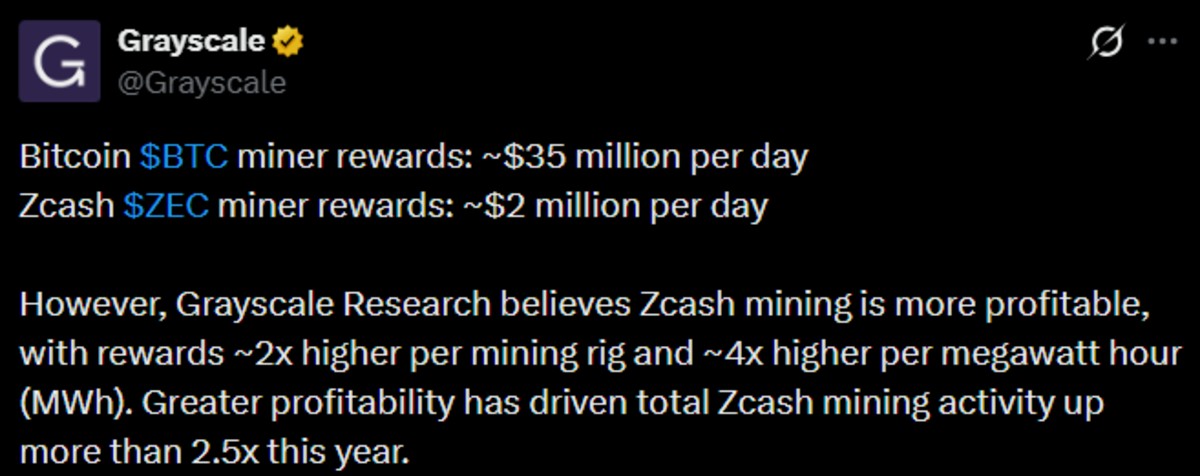
Zcash Mining News spread quickly across the crypto industry on September 11, 2026. Grayscale Research published data comparing miner rewards on Zcash and Bitcoin. The report said a single ZEC-rig now earns close to twice the daily reward of a comparable BTC machine. It also said ZEC revenue per megawatt-hour runs near four times higher than BTC. Grayscale linked the shift to a sharp rise in ZEC-hashpower through 2026.
BTC operators still earn far more in total. Grayscale estimates BTC miners collect close to $35 million a day in combined rewards. ZEC miners collect nearer $2 million a day in total.
That gap reflects BTC's much larger scale, not weaker ZEC-hardware. On a per-rig and per-MWh basis, the coin currently rewards operators better. The shift follows a ZEC price rally that pushed the token above $1,000 for the first time in years.
A new ZEC-linked exchange-traded product also began trading on NYSE Arca in late August 2026.
Source: Official X Post
Reward Comparison: BTC and ZEC Output Side by Side
Metric | Bitcoin | Zcash |
Daily rewards, whole network | About $35 million | About $2 million |
Reward per rig | Baseline | About 2x higher |
Revenue per megawatt-hour | Baseline | About 4x higher |
Core algorithm | SHA-256 | Equihash |
Activity growth in 2026 | Steady | Up more than 2.5x |
This Zcash Mining News comparison shows why efficiency, not total size, is pulling fresh operator interest toward ZEC-hardware.
Why ZEC Hashpower Jumped 2.5x This Year
Grayscale said standardized ZEC-hashpower has grown more than 2.5 times since January 2026. Rising token prices lifted the dollar value of block rewards faster than difficulty adjusted upward. That gap created a short-term profit window for existing operators.
ZEC price climbed above $1,000 for the first time in nearly a decade.
A new ZEC-linked exchange-traded product started trading on NYSE Arca in August 2026.
Standardized hashpower rose without a matching jump in network difficulty.
Grayscale said more hashpower could support stronger network security over time.
This Zcash Mining News detail explains why difficulty lagged behind price gains, at least for now.
Hardware and Cost Differences Behind the Gap
BTC and ZEC rely on separate hardware. BTC runs on SHA-256 chips. ZEC depends on rigs built for the Equihash algorithm. Operators cannot easily move the same machines between the two systems.
Grayscale also said its figures track gross revenue, not net profit. Electricity, cooling, equipment, and pool fees all reduce what operators actually keep.
Rising ZEC-hashpower could raise difficulty and pull per-rig rewards back down over time. Readers comparing BTC mining hardware costs against ZEC-rigs should weigh these variable expenses before assuming the gap holds.
Anyone following this Zcash Mining News update should treat the current gap as a snapshot, not a fixed advantage.
Expert Take: What This Means for Operators
Grayscale framed the current setup as a possible self-reinforcing cycle. Higher rewards could draw more machines and strengthen network security over time.
ZEC and BTC still serve different purposes within crypto markets. The token focuses on transaction privacy, while BTC-remains the largest proof-of-work network by hashrate and market value.
The reward gap favors ZEC-hardware today. Actual returns on both coins depend on token prices, electricity costs, and difficulty resets that can shift within weeks.
This Zcash Mining News update fits a broader pattern. Rising token prices, not chain design alone, often decide which coin rewards operators best right now.
Glossary
Hashrate: total computing power securing a proof-of-work network.
Equihash: the algorithm ZEC-uses for block validation.
SHA-256: the algorithm BTC-uses for block validation.
Megawatt-hour (MWh): a unit of electricity used over time, used here to compare energy efficiency.
Network difficulty: a setting that adjusts how hard it is to validate a new block.
Conclusion
This roundup shows BTC remains dominant in scale, while the coin currently offers stronger returns per rig and per megawatt-hour. Grayscale's data points to rising ZEC hashpower as the main driver, alongside a price rally that lifted rewards faster than difficulty could adjust.
Rewards on both coins can shift quickly with token prices, electricity costs, and hardware expenses, so today's gap is not fixed.
Full details are available from Grayscale Research's blog post - https://www.grayscale.com/the-stack/zcash-mining-is-taking-off
YMYL Disclaimer: This article is for general information only. It does not offer financial, investment, or trading advice. Readers should verify current data through official sources before making any decisions, since crypto markets and mining rewards can change quickly.
Also read:









