Why OpenAI, Anthropic, Google Sued by AI Users Over Antitrust Claims?

AI Antitrust Lawsuit Claims: ChatGPT, Claude, Gemini Users Take Action
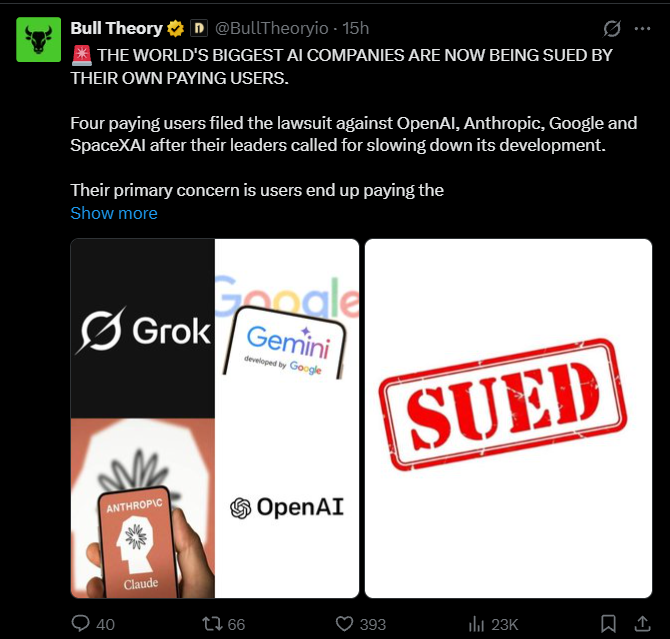
An antitrust lawsuit against AI companies has put the AI safety debate in an unusual place. The people suing are not regulators or rivals. They are customers who pay for ChatGPT, Claude, Grok or Gemini. They say a joint push for slower progress could leave subscribers paying the same price for less.
At a Glance
-
What happened: Four paying AI users filed a lawsuit on September 18, 2026, in the US District Court for the Northern District of California.
-
Who is named: OpenAI, Anthropic, Google, and SpaceXAI.
-
Core claim: Rival firms cannot jointly agree to slow AI development without breaking antitrust law.
-
Relief sought: A stop to the alleged group action and triple damages if the claims succeed.
-
Status: These are allegations only. No court has ruled.
OpenAI, Anthropic and Google Face Antitrust Lawsuit From Users
The four plaintiffs filed on behalf of a proposed nationwide class of paid subscribers. The complaint targets four market leaders, excluding Chinese firms.
The plaintiffs say they have no objection to one company slowing down or adding its own safeguards. Their objection is to competitors coordinating that choice together.
Source: The Bull Theory
Why Did AI Users Sue OpenAI, Anthropic, Google and xAI?
The complaint argues that a coordinated slowdown could reduce competition. With less pressure to improve, subscribers might get fewer upgrades while prices stay the same.
The plaintiffs' lead attorney, Nick Rowley, warned that private deals between profit-driven giants should not control AI precautions, as AP reported. These claims are allegations, not proven violations.
What Triggered the Lawsuit? Anthropic CEO's Call for Slower AI Development
On September 12, Anthropic CEO Dario Amodei published an essay arguing that leading labs should cooperate to slow capability gains and spend more time on safety. He suggested the US government could allow a narrow antitrust waiver for certain protection discussions.
The same day, OpenAI CEO Sam Altman, SpaceX AI CEO Elon Musk and Google search DeepMind chair Demis Hassabis publicly agreed with his proposals. The plaintiffs also cite a July statement from senior staff at several labs, which acknowledged the pressure companies face when slowing down alone.
OpenAI, Google DeepMind and Anthropic Had Already Discussed AI Safety
On September 15, OpenAI's policy chief confirmed that the company had been coordinating with Anthropic AI and Google DeepMind on AI safety for several weeks. The plaintiffs treat this as important background to their case.
Talking about safety is not automatically an antitrust breach. The case turns on whether those talks became an agreement to restrain competition, which the lawsuit alleges, and the companies have not been found to have done.
What Is the Antitrust Argument in the AI Lawsuit?
Antitrust law exists to protect fair competition and prevent monopolies. Competitors who coordinate instead of competing on their own draw the most scrutiny.
The plaintiffs offer a simple example. Four carmakers each adding a safety feature is fine. Four carmakers agreeing that none will build faster cars for years is a different matter. The lawsuit says AI firms fall into the second group.
Whether US antitrust law actually covers this conduct will be decided through the courts.
AI Safety Debate Raises Questions About Competition and Consumer Costs
Other players are skeptical too. France's Mistral said some incumbents may use this moment to entrench their position, and Proton's chief operating officer Raphael Auphan called it self-serving, according to Reuters.
| Issue | What Companies and Supporters Say | What Plaintiffs and Critics Argue |
| AI safety | Cooperation could help manage risks from powerful AI | Safety cooperation should not restrain competition |
| Development speed | Slower progress allows more safety work | A coordinated slowdown could reduce innovation |
| Competition | Joint talks can tackle risks no single firm can handle | Agreements between rivals weaken competitive pressure |
| Consumer impact | Safety measures may lower AI risks | Users could get fewer improvements at the same price |
| Regulation | Government involvement could set clearer rules | Coordination could favor established companies |
Timeline: From AI Safety Proposal to September 18 Lawsuit
-
July 2026: Senior employees from several AI labs sign a statement on the competitive pressure against slowing down alone.
-
September 12: Amodei publishes his essay. Altman, Elon Musk and Hassabis respond in agreement.
-
September 15: OpenAI policy chief confirms weeks of safety coordination with Anthropic and Google DeepMind.
-
September 18: The antitrust lawsuit is filed in the Northern District of California.
-
September 19: President Donald Trump announces plans for an "AI czar" and an "AI force," saying the US will not hinder or stifle the industry.
-
September 20: The case draws wider media attention.
What Happens Next in the AI Antitrust Case?
The court must now consider the allegations and any legal responses. The plaintiffs want to represent a nationwide class of paid subscribers, and they seek an order stopping the alleged coordination plus triple damages if the claims hold up. Filing a case does not establish wrongdoing.
Conclusion
This antitrust lawsuit against AI companies raises a hard question: how can competitors work together on real safety risks without weakening competition that benefits users? The court, regulators, and the wider industry will likely spend months on it. Readers should watch for the companies' formal responses.
YMYL Disclaimer: This article is for general information only and is not legal, financial, or investment advice. The lawsuit's claims are unproven allegations. Consult a qualified professional before making decisions. If you follow crypto or digital asset markets, remember they are volatile and this article does not recommend buying or selling any asset. Do your own research.









