Binance EU License Update: Why Greece Rejected Major MiCA Approval?


Binance EU License: Stablecoins, Digital Euro, MiCA, Lagarde in Focus
A new report from The Wall Street Journal has reignited questions about political influence inside Europe's crypto licensing process. According to the report, the collapse of Binance's bid for an Binance EU Mica License through Greece was not simply a regulatory rejection but the result of a direct, personal request from ECB President Christine Lagarde.
The exchange has disputed how its situation has been characterized, and neither the ECB nor Greek authorities have publicly confirmed the account. Still, the reporting has drawn fresh attention to how Europe's Markets in Crypto-Assets framework interacts with political and monetary policy concerns.
At a Glance
-
The Wall Street Journal reports ECB President Christine Lagarde personally urged Greek PM Kyriakos Mitsotakis to block Binance's EU-wide license.
-
Binance had applied through Greece's HCMC for a MiCA authorization covering all 27 EU member states.
-
Binance withdrew its application on June 24, 2026, before regulators issued a formal decision.
-
Reported concerns centered on Binance's 2023 US guilty plea and fears over dollar-stablecoin dominance affecting the digital euro.
-
The ECB has no formal licensing authority under MiCA; approvals rest with national regulators.
Binance EU License Bid: Lagarde Reportedly Asked Greece to Stop Approval
Citing people familiar with the matter, the Journal said Lagarde asked Mitsotakis not to approve Binance's application for an EU Binance License routed through Greece's Hellenic Capital Market Commission.
A single MiCA authorization from any member state typically allows a crypto firm to passport services across the entire bloc, which made the Greek filing significant for Binance's broader European ambitions.
Notably, the ECB holds no formal power to approve or deny crypto-asset service provider licenses under MiCA, making the reported intervention a political rather than regulatory action.
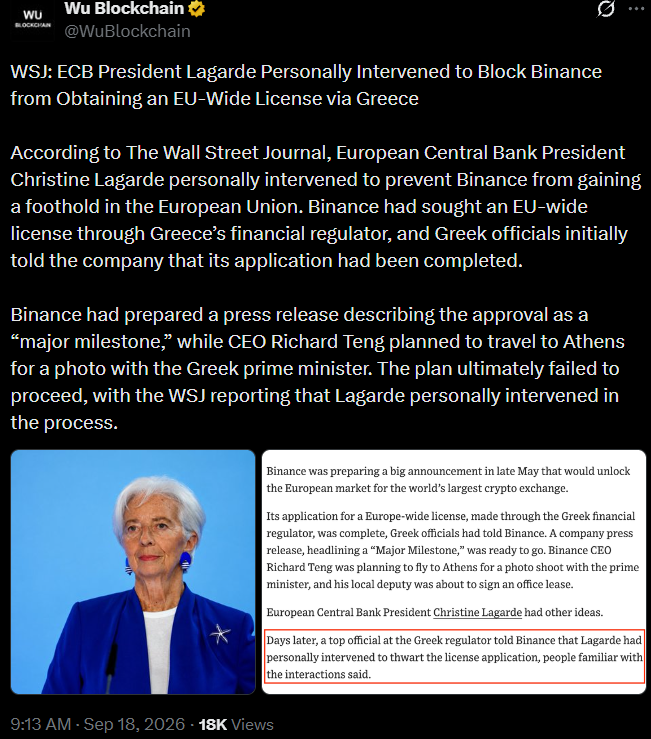
Source: Wu Blockchain
Binance Was Preparing for a Major Greek License Announcement
Documents and sources cited by the Journal indicate Binance believed approval was imminent. Greek officials reportedly told the exchange in April that its application file was complete.
By late May, Binance had drafted a press release referring to the milestone, and CEO Richard Teng had planned a trip to Athens for a public appearance with the Greek prime minister.
The company had also set up Binance Greece locally and was preparing office arrangements, projecting roughly €200 million in tax contributions and around 100 new jobs from the expansion.
Why Did Lagarde Oppose Binance's EU License?
Binance's Previous US Regulatory Case
Binance pleaded guilty in 2023 to violations tied to anti-money-laundering rules and sanctions compliance in the United States, agreeing to a settlement exceeding $4 billion. Founder Changpeng Zhao stepped aside as part of that resolution, a history reportedly weighing on Lagarde's assessment.
Concerns Over Dollar-Pegged Stablecoins
The second reported concern involved stablecoins. Lagarde has publicly warned that dollar-denominated stablecoins, led by Tether and Circle, dominate the market and risk what she called digital dollarization in Europe. Granting the world's largest exchange an EU License, sources suggested, could accelerate that trend and undercut the ECB's digital euro project.
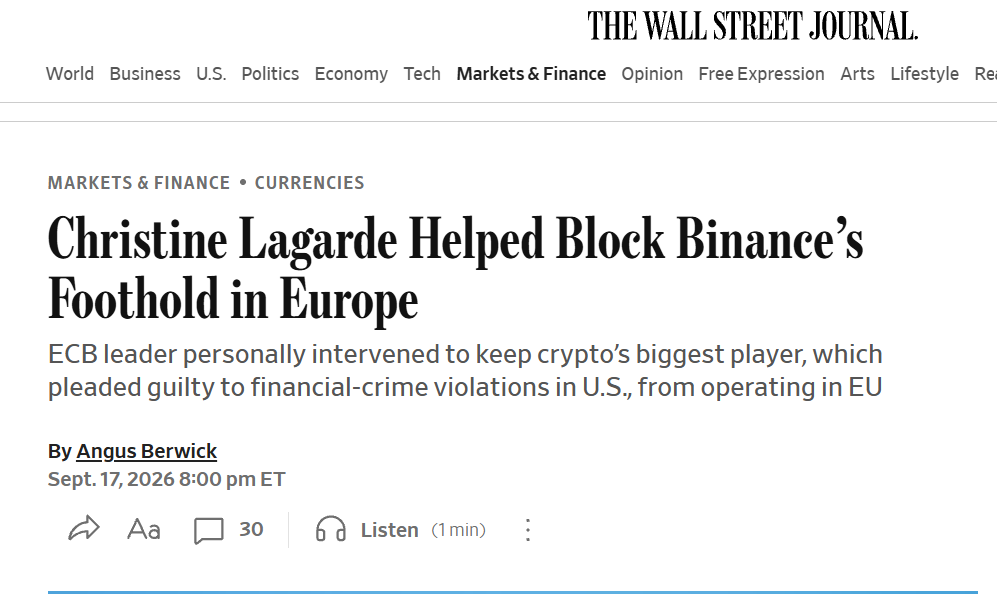
Source: The Wall Street
Binance Greece License Timeline: From Expected Approval to Withdrawal
| Date | Key Development |
| April 2026 | Greek officials reportedly told Binance its application was complete. |
| Late May 2026 | Binance exchange prepared its "Major Milestone" announcement and Teng's Athens visit. |
| Early June 2026 | Greece reportedly informed ESMA's digital finance committee of its intent to approve. |
| June 2026 | WSJ reported Lagarde had opposed the approval. |
| June 24, 2026 | The exchange withdrew its Greek application before a formal decision. |
| July 1, 2026 | MiCA transition deadline limited Binance's ability to serve EU users without a license. |
| Sept. 17 to 18, 2026 | WSJ report renewed public scrutiny of the alleged intervention. |
How MiCA Licensing Works and Where the ECB Fits In
Under MiCA, national regulators, not the ECB, decide whether to grant crypto licenses. The HCMC maintained it reviewed Binance's application independently under Greek and EU law.
Even so, the reported political pressure highlights an ongoing debate in Brussels over whether ESMA should take direct supervisory control of the largest crypto firms rather than leaving oversight fragmented across 27 national bodies.
Binance Withdraws Application Before Formal Rejection
The exchange pulled its filing on June 24, citing the status and timeline of the Greek process rather than any external pressure. Binance's European head, Gillian Lynch, pushed back on the Journal's account, saying it mischaracterized how certain accounts were reviewed and acted upon. The exchange has continued serving some EU users through offshore and reverse-solicitation arrangements, which fall outside a formal MiCA passport.
Digital Euro and Stablecoins Add Another Layer to the Binance Dispute
Beyond the exchange itself, the episode underscores Europe's wider anxiety about foreign-currency stablecoins undermining monetary sovereignty as the ECB advances toward a digital euro pilot expected in the second half of 2027.
What Happens to Binance's EU Expansion After the Greece Setback?
The exchange remains without a valid EU Binance License and has reportedly explored authorization through France instead. Whether the alleged Lagarde intervention becomes a precedent for future crypto licensing decisions remains unresolved as EU lawmakers continue debating ESMA's expanded supervisory role, with consultations open through September 30.
Conclusion
The reported blocking of EU license bid illustrates the friction between national licensing authorities, ECB monetary policy goals, and Europe's evolving stance on stablecoins. While the core claims rest on WSJ sourcing and remain unconfirmed by official bodies, the story adds a notable chapter to how political considerations may shape crypto regulation across the bloc.
YMYL Disclaimer: This article is for informational purposes only and does not constitute financial, legal, investment, or regulatory advice. Details are based on reporting from The Wall Street Journal and other cited sources and have not been independently verified by the ECB, the Greek government, or the HCMC. Cryptocurrency markets are highly volatile and involve significant risk. Nothing in this article should be interpreted as investment advice. Always conduct your own research before making financial decisions.









