EU MiCA Update: How Binance Still Trade With 45% Global Spot Share?

Binance EU MiCA Update: What Happens After Greece Application Exit?
Binance's relationship with European regulators has entered a new, murkier phase. Even though the exchange missed the July 1 deadline to secure a Markets in Crypto-Assets (MiCA) license and pulled its application in Greece weeks earlier, it has not fully exited the EU market. This Binance EU MiCA update breaks down how the exchange is doing it, what regulators are saying, and what might happen next.
At a Glance:
-
Binance exchange is still onboarding and serving some European Union customers more than two months after missing the bloc's EU MiCA licensing deadline.
-
The exchange is leaning on a regulatory exemption known as reverse solicitation and routing some EU trading through an Abu Dhabi entity.
-
Regulators, including ESMA, are asking questions about whether Binance's wind-down is happening as required.
Binance Continues Serving Some EU Customers After MiCA Deadline
MiCA requires any crypto asset service provider operating in the EU to hold authorization from a regulator in at least one member state. Once granted, that license can be passported across the bloc. exchange does not currently have one.
Yet according to people familiar with the matter cited, the exchange has kept parts of its business running, including new account creation in several countries.
Earlier reporting had already found that users in markets such as Austria, France, Germany, Spain, and Belgium were able to register and pass identity checks weeks after the deadline. The exchange itself remains absent from the ESMA public register of authorized providers.
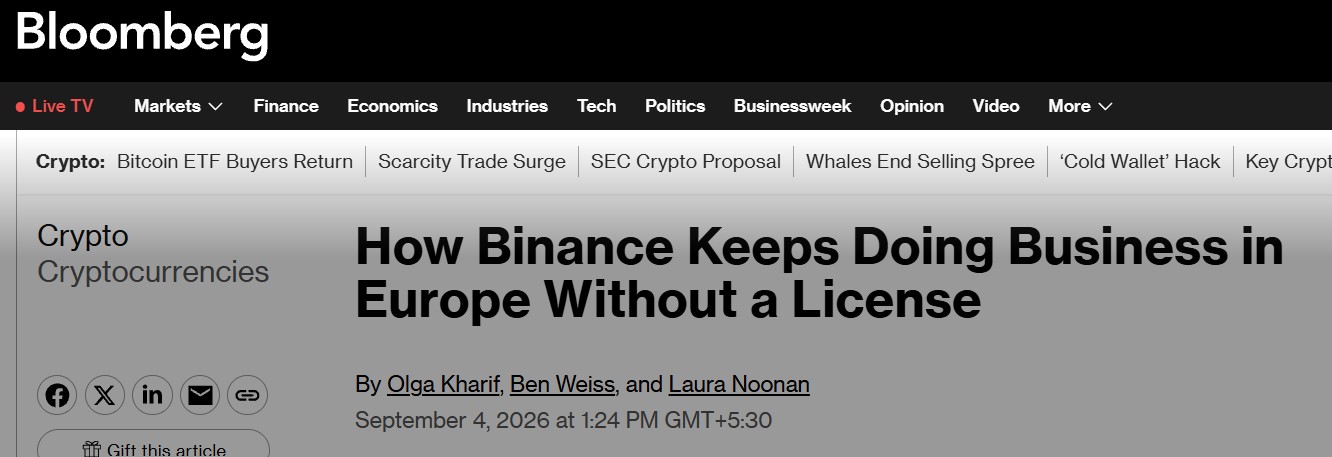
Source: Bloomberg Report
How Binance Is Using MiCA's "Reverse Solicitation" Rule
The mechanism behind this is a MiCA provision called reverse solicitation. In plain terms, it allows an unlicensed firm to serve a customer if that customer approaches the firm entirely on their own initiative, without being marketed to or actively solicited.
It appears to be interpreting this narrowly but usefully: rather than promoting its services to European residents, it is accepting new sign-ups from people who independently seek out the platform.
The distinction matters because active marketing to unlicensed jurisdictions is exactly what crypto laws aims to shut down, while a customer walking in the door on their own sits in a legal gray zone that Binance is choosing to use.
Binance Routes Some EU Trading Through Abu Dhabi Entity
Alongside reverse solicitation, some EU customer trading activity is reportedly being routed through Binance's Abu Dhabi entity, which operates under the United Arab Emirates' own regulatory framework rather than MiCA.
This routing effectively lets certain EU-based trades continue outside the EU's direct oversight, giving Binance an additional way to keep revenue and activity flowing from European users while it lacks a license inside the bloc itself.
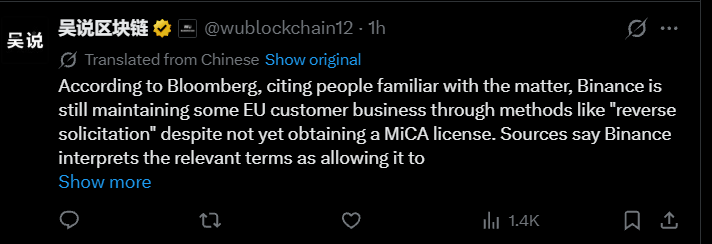
Source: Wu Blockchain X
Binance's MiCA License Timeline: From Greece Application to New EU Route
Binance's strategy has shifted several times this year.
| Date | Binance EU MiCA Development |
| June 16, 2026 | Binance withdrew its MiCA application in Greece |
| July 1, 2026 | MiCA licensing deadline took effect for operations |
| August 2026 | Reports indicated some users could still register and verify accounts |
| September 4, 2026 | It continues serving some customers |
| Next | It plans to seek authorization in another member state |
The Greek application unraveled quickly. Scrutiny intensified ahead of a scheduled June 17 board review by the Hellenic Capital Market Commission, and exchnage withdrew the filing a day earlier, before any formal decision was made.
European Central Bank President Christine Lagarde raised concerns behind the scenes about the application, though the ECB has declined to comment. Binance says it plans to pursue authorization through a different member state but has not named which one.
Why European Regulators Are Watching Binance's EU Operations
ESMA has reportedly reached out to seek confirmation that its European trading wind-down is being handled properly, though the authority has declined to comment on any individual company, noting enforcement sits with national regulators.
Compliance specialists point out that missing a license does not automatically force an exchange to close every European account; it depends on how narrowly rules like reverse solicitation are applied in practice, which is precisely the gray area now under review.
What Binance Says About Its MiCA Compliance Plans
The exchange maintains that it follows the rules of every jurisdiction where it operates and is committed to running its business on a long-term, compliant basis.
The company describes obtaining a license as an important step toward offering a consistent, regulated service across European markets, and says it is actively working toward that authorization.
Binance Trading Activity Holds Up Despite EU Restrictions
Commercially, the disruption looks limited. The data shows the exchange still controls more than 45% of global spot crypto trading volume in late August, while its euro-denominated trading share held around 3% to 4%, roughly unchanged from before the deadline.
The app has also remained among the most downloaded crypto trading tools in European app stores, even as licensed rivals like Coinbase now use laws passporting to operate freely across the bloc.
What Happens Next for Binance in the EU?
The core question is unresolved: how long can the exchange maintain partial access under reverse solicitation while regulators decide whether that interpretation goes too far. A new application in another member state could resolve the standoff, but until it's filed and approved, Binance's customers and its European strategy remain in limbo.
Disclaimer: This article is for informational purposes only and does not constitute financial, investment, legal, or trading advice. Cryptocurrency markets are volatile and carry risk. Readers should conduct their own research and consult a qualified professional before making any financial decisions.






