BRICS Summit 2026 News: BRICS Pay Push Changes the Game


BRICS Summit 2026 News: Is BRICS Pay Finally Ready to Go Global?
If you've been following the headlines this week, you've probably seen a flood of BRICS Summit 2026 news coming out of New Delhi.
In crypto news today, leaders from the bloc's 11 member nations gathered for the 18th BRICS Summit on September 12-13, 2026, and what came out of it was a lot more than just another photo-op.
There's a detailed joint declaration, a real push on payment infrastructure, and some striking economic numbers being passed around.
Let's break down what actually happened, in plain language, with every claim tied back to where it came from.
The New Delhi Declaration: What Leaders Actually Agreed To
The centerpiece of this year's summit is the New Delhi Declaration, adopted unanimously by all BRICS leaders.
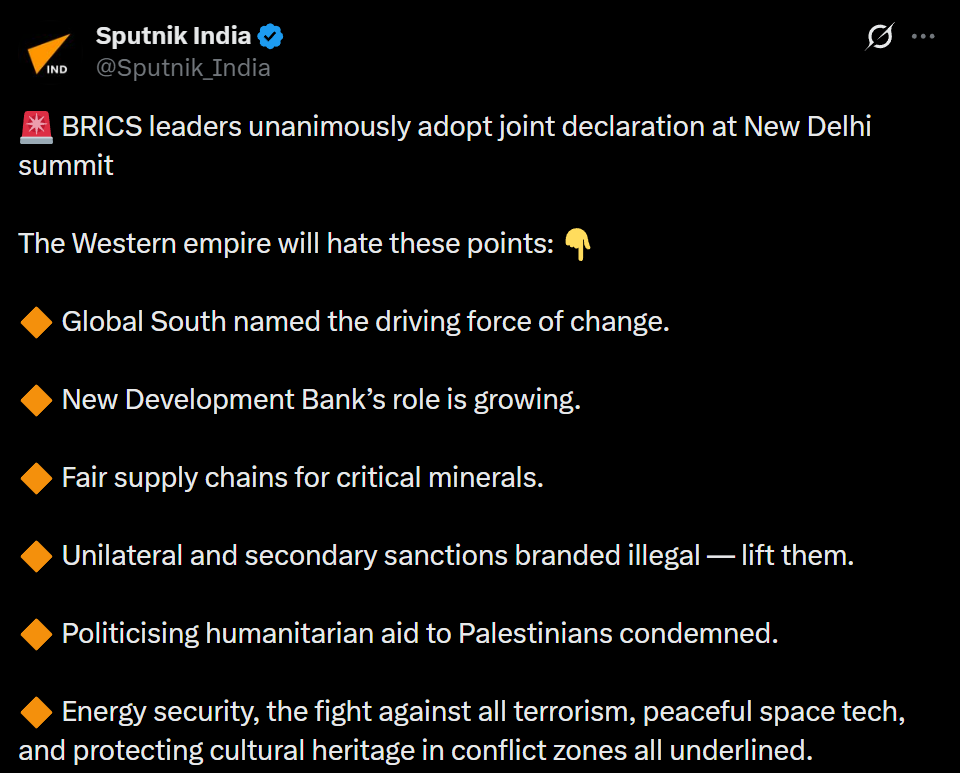
According to a summary shared by Sputnik India, the declaration named the Global South as the driving force behind global change and said the New Development Bank's role is growing.
It also called for fair supply chains for critical minerals, something that matters a lot given how much modern technology depends on rare earth metals and specialty minerals.
Source: Sputnik India on X
Here's what else the declaration covers, based on that same source:
Unilateral and secondary sanctions were branded illegal, with a direct call for them to be lifted
The politicization of humanitarian aid to Palestinians was condemned outright
Energy security got a specific mention
The fight against all forms of terrorism was underlined, not just terrorism from certain groups or regions
Peaceful use of space technology was included
Protecting cultural heritage in conflict zones was also written into the text
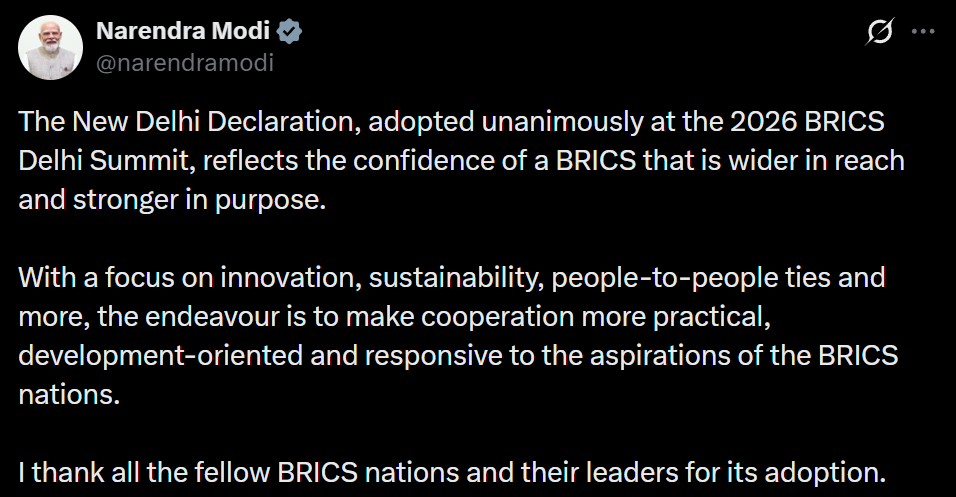
Prime Minister Narendra Modi confirmed the declaration's adoption himself, posting that it reflects "the confidence of a BRICS that is wider in reach and stronger in purpose," with the group's focus now on innovation, sustainability, people-to-people ties, and making cooperation more practical and development-oriented.
He specifically thanked all the fellow BRICS nations and their leaders for getting it done.
BRICS Pay: The Alternative to SWIFT Is Moving Forward
This is probably the most concrete piece of this BRICS Summit 2026 news cycle, and it's worth slowing down on.
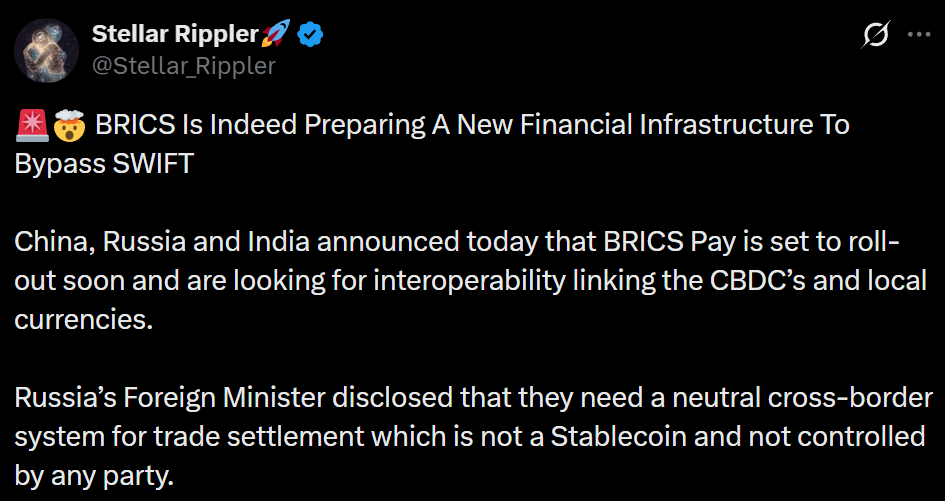
According to a post from Stellar Rippler, China, Russia, and India announced that BRICS Pay is set to roll out soon, and the group is actively working on interoperability that would link central bank digital currencies (CBDCs) with local currencies.
Source: Stellar Rippler on X
The same source reports that Russia's Foreign Minister explained the reasoning behind this: they want a neutral cross-border system for trade settlement, one that is specifically not a stablecoin and not controlled by any single party.
The post also mentions that Russian President Vladimir Putin signed Russia's own version of a "Clarity Act" and said the Western financial system is outdated, arguing that advanced blockchain solutions can help other countries avoid having the dollar and SWIFT weaponized against them.
The framing used was building "a new global neutral asset bridging every currency."
It's worth noting this specific claim about Putin signing a domestic law comes from that single source and hasn't been independently corroborated elsewhere, so treat that particular detail with some caution.
BRICS vs G7: Who's Actually Bigger?
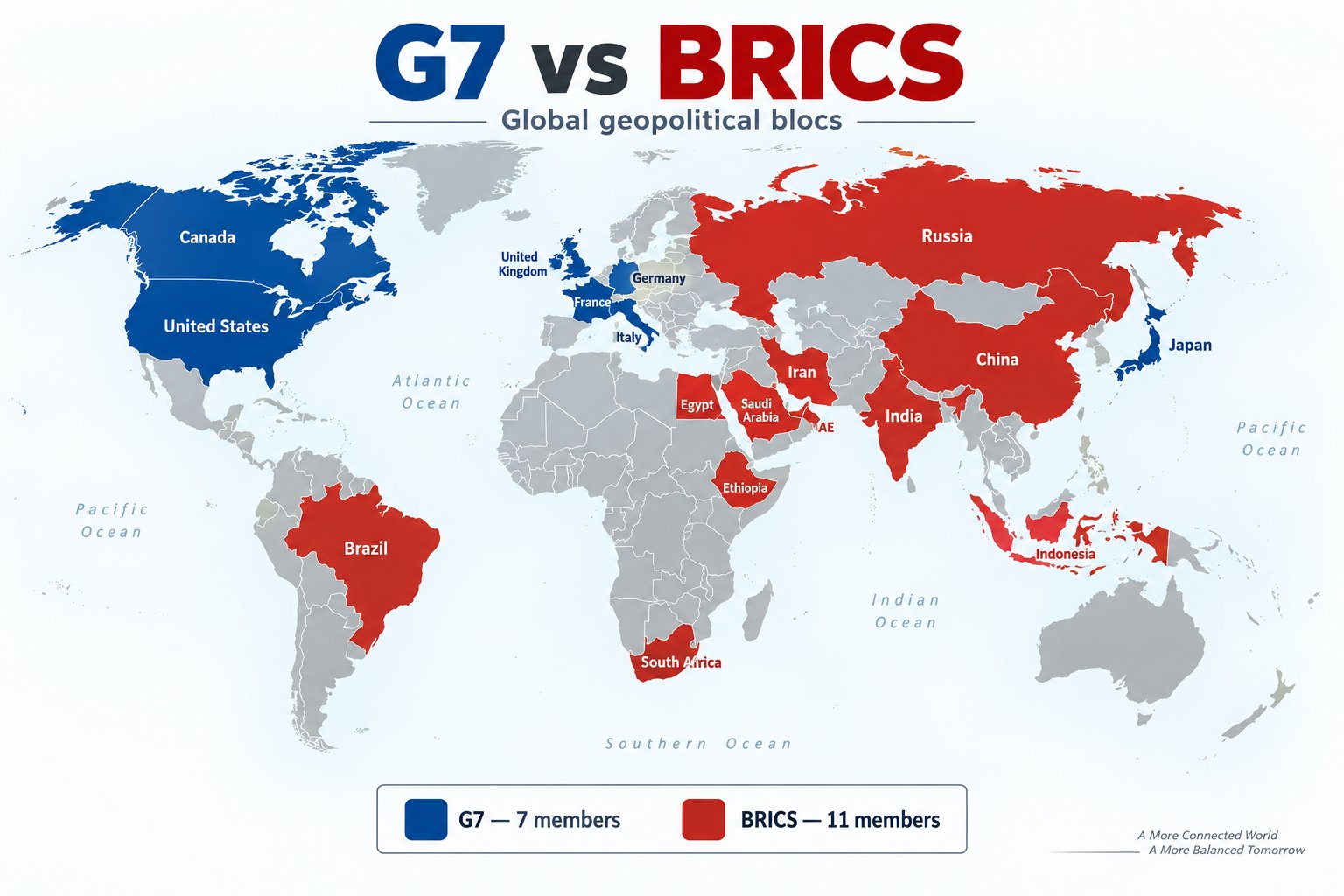
A separate thread of BRICS Summit 2026 News making the rounds compares the raw economic size of the two blocs, and the numbers are genuinely interesting.
According to a breakdown shared by an account tracking global economic shifts, here's how things stack up:
G7—roughly $55.3 trillion combined:
United States: $32.38 trillion
Germany: $5.45 trillion
Japan: $4.38 trillion
United Kingdom: $4.26 trillion
France: $3.60 trillion
Italy: $2.74 trillion
Canada: $2.51 trillion
BRICS (11 members)—roughly $35.2 trillion combined:
China: $20.85 trillion
India: $4.15 trillion
Russia: $2.66 trillion
Brazil: $2.64 trillion
Indonesia: $1.54 trillion
Saudi Arabia: $1.39 trillion
UAE: approximately $0.62 trillion
South Africa: approximately $0.48 trillion
Egypt: approximately $0.43 trillion
Iran: approximately $0.30 trillion
Ethiopia: approximately $0.20 trillion
According to that same post, since an earlier comparison point in October 2023, G7 nominal GDP rose from $45.9 trillion to about $55.3 trillion, while BRICS expanded from $30.8 trillion to roughly $35.2 trillion.
So in raw dollar terms, the gap between the two blocs actually got wider, mostly because of how much the U.S. economy grew on its own.
But here's the twist: in purchasing-power-parity terms, which adjusts for cost of living and what money actually buys in each country, the picture flips entirely.
IMF figures for 2025 put BRICS at about 40.5% of world output, compared to just 28.3% for the G7.
Source: The Epic Map
Why All of This Matters Together
Reading these three pieces of the BRICS Summit 2026 News side by side, a pattern starts to emerge.
You've got a political declaration pushing back hard against sanctions and Western-dominated institutions, a genuine technical effort to build payment infrastructure that doesn't run through the dollar or SWIFT, and economic data showing the bloc is already a massive force when measured by what people can actually buy with their money, even if it still trails the G7 in raw dollar GDP.
None of these three things happened by accident in the same week; they're clearly part of a coordinated push by the bloc to position itself as a serious counterweight on the world stage.
What to Watch Next
Given how early-stage BRICS Pay still is, the next real signal to watch for will be whether an actual pilot launches and which countries participate first.
The New Delhi Declaration's language on sanctions and Palestinian aid will also likely shape how BRICS nations vote and speak at the UN and other international forums in the coming months.
And as GDP figures keep getting updated, it'll be worth watching whether the purchasing-power-parity gap between BRICS and the G7 keeps widening in the bloc's favor.
Conclusion
This round of BRICS Summit 2026 News shows a bloc that's clearly not just meeting for a group photo anymore.
Between a detailed 140-point declaration taking direct aim at unilateral sanctions, a real push on BRICS Pay and CBDC interoperability backed by China, Russia, and India, and economic numbers that put the group ahead of the G7 in purchasing-power terms, this year's summit in New Delhi looks like one of the more substantive gatherings the bloc has held.
Whether the payment infrastructure actually gets built and used at scale will be the real test of how much of this translates from declaration into practice.
Disclaimer
This article is for educational and informational purposes only and should not be considered financial or investment advice. Always conduct your own research before making investment decisions.