Thailand SEC Stablecoin Rules Propose $150K Daily Transfer Cap

Thailand SEC Opens Public Consultation on Stablecoin Transfer Limits
Thailand's Securities and Exchange Commission (SEC) opened a public consultation on September 11, 2026, on new Thailand SEC stablecoin rules for digital asset operators. The proposal targets how licensed platforms handle stablecoin deposits and withdrawals.
The regulator said the plan aims to reduce risks tied to money laundering, cybercrime, and the circumvention of international money transfer rules. The consultation follows a board meeting held earlier in September 2026.
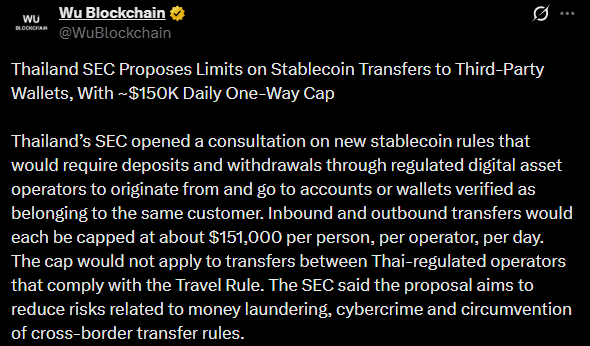
Source: WuBlockchain X Post
What the Draft Rules Propose
Under the draft, stablecoin transfers through licensed operators must move only between accounts or wallets verified as belonging to the same customer. Transfers into or out of another person's account would not be allowed.
Rule Area | Proposed Requirement |
Wallet ownership | Source and destination wallets must belong to the same client. |
Daily transfer cap | About 5 million baht (roughly $150,000) per person, per operator, per day |
Travel Rule | Applies to both source and destination accounts |
Screening | Checks for mock accounts and high-risk or watchlisted wallets |
The daily cap would not apply to Thai-to-Thai operator transfers where both sides use the Travel Rule. Three exemptions from the cap were also listed:
Businesses transferring stablecoins in their own name as part of core operations
Entities authorized by the Bank of Thailand on a case-by-case basis
Market makers moving stablecoins to manage liquidity in baht trading pairs
Off-platform trades by digital asset brokers and dealers would also face a minimum transaction value, currently proposed at 3 million baht.
These businesses would need to publish trading prices for verification and would be barred from arranging trades directly between clients outside the platform.
Rules for Market Makers, Liquidity Providers, and Source Exchanges
The consultation also covers market makers (MMs) and liquidity providers (LPs). Exchanges would need to publish which MMs support liquidity for each asset, along with added screening of MM transaction sources.
For brokers, the draft would ban LPs from stablecoin-to-baht trades. Any LP used would need to operate under supervision that meets Financial Action Task Force (FATF) standards for anti-money laundering. Brokers would also need to disclose LP identities and any conflicts of interest to clients.
Source exchanges supplying digital assets to Thai platforms would face similar screening, benchmarked against the same standards proposed for LPs.
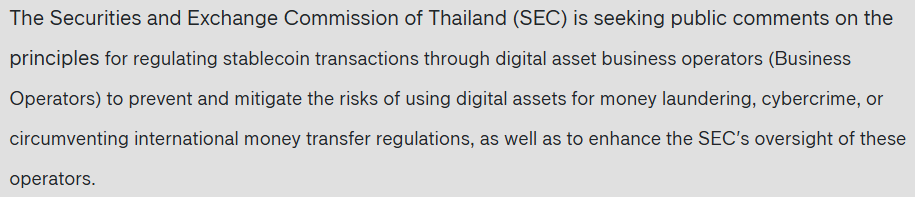
Source: Official Report
Why the Consultation Matters
The Thailand SEC stablecoin rules consultation reflects a broader push to close gaps that could let bad actors move funds through off-platform channels or unverified wallets.
Officials said current oversight makes it harder to trace stablecoin flows tied to cybercrime or cross-border transfers that skip standard banking checks.
The proposal would give regulators power to order operators to fix compliance gaps within a set deadline. If an operator does not comply, further action could follow to keep data reporting accurate.
Public Comment Period and Next Steps
A consultation document was published on the official website and on Thailand's central legal listening portal. Stakeholders can submit feedback through either site or by email until September 25, 2026.
No final rule has been issued as of September 13, 2026. Any requirements, including the exact transfer cap, could change based on public feedback before the Thailand SEC stablecoin rules are finalized.
Conclusion
Thailand's SEC has opened its stablecoin oversight plan to public input rather than finalizing it outright, giving operators, market makers, and liquidity providers a chance to respond before any rule takes effect on September 25, 2026.
The Thailand SEC stablecoin rules aim to bring tighter wallet verification and transaction transparency across licensed platforms.
If adopted, the changes would reshape how digital asset businesses handle stablecoin transfers, off-platform trades, and third-party liquidity arrangements in Thailand. The coming weeks of public comment will likely determine how much of the current draft survives into a final rule.
YMYL Disclaimer: This article is for informational purposes only and does not constitute financial, legal, or investment advice. Readers should verify regulatory details directly through official channels before making decisions based on this content.