CFTC Prediction Market Rules Move Closer to a Major US Shift


CFTC Prediction Market Rules Head to White House for Final Review
Here's genuinely significant crypto news today for anyone following the prediction market space in the US.
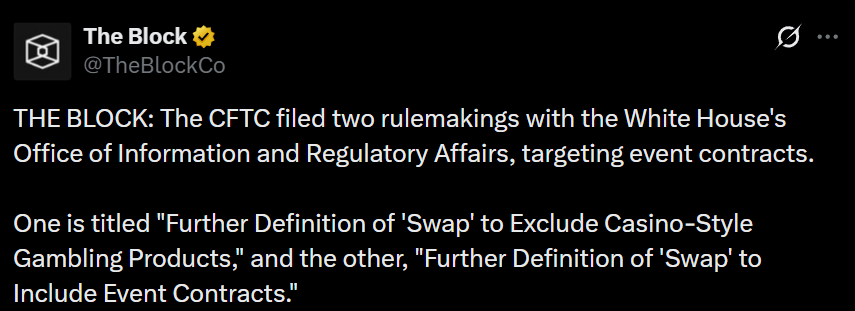
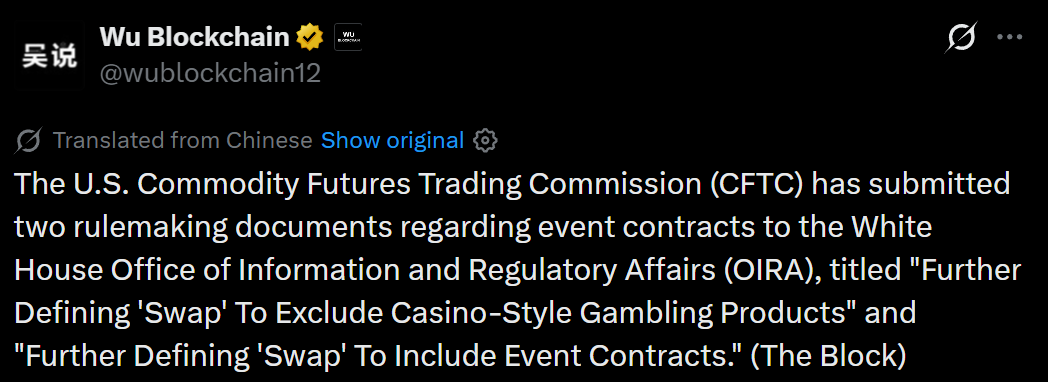
The Commodity Futures Trading Commission has submitted two formal rulemaking documents to the White House's Office of Information and Regulatory Affairs, marking a real, dated step toward finally drawing clear legal lines around event contracts, the yes-or-no wagers that platforms like Kalshi and Polymarket have built their businesses around.
Source: The Block
What the CFTC Actually Filed
According to official records from reginfo.gov, the CFTC submitted two separate rulemakings, both received by OIRA on September 28, 2026:
| Rule Title | RIN | Rule Stage |
| Further Definition of "Swap" to Include Event Contracts | 3038-AF82 | Proposed Rule |
| Further Definition of "Swap" to Exclude Casino-Style Gambling Products | 3038-AF81 | Interim Final Rule |
Both filings are tied to the Dodd-Frank Wall Street Reform and Consumer Protection Act, and neither is currently flagged as economically significant. One notable detail: the two rules aren't at the same stage.
The event contracts definition is still a proposed rule, meaning it will likely go through public notice and comment before finalization.
The casino-style gambling exclusion, however, is listed as an interim final rule, a designation that typically allows a rule to take effect more quickly, sometimes even before the comment period concludes.
Source: Wu Blockchain on X
Why the "Swap" Definition Actually Matters
This might sound like dry legal terminology, but it has real consequences for how prediction markets operate.
Under the Commodity Exchange Act, how a financial product gets legally classified determines which rules apply to it, who can offer it, and what registration and compliance requirements come into play.
By working to further define what counts as a "swap," specifically to include event contracts while separately excluding casino-style gambling products, the CFTC is drawing a formal regulatory boundary between legitimate, CFTC-regulated prediction markets and traditional gambling products that fall under different state and federal oversight entirely.
Why Two Separate Rules, Not One
Splitting this into two distinct rulemakings appears to be a deliberate structural choice.
A few reasons this separation makes sense:
-
It lets the CFTC move the casino-exclusion piece faster as an interim final rule, since it may require less extensive public input
-
It keeps the event contract inclusion as a full proposed rule, allowing broader public and industry comment given its wider impact
-
It creates a clearer legal distinction for regulators, platforms, and courts going forward, rather than bundling two separate questions into one document
This structure suggests the CFTC is trying to move efficiently on the narrower, less contentious piece while giving the more consequential event contracts the fuller rulemaking process it likely needs.
What Happens Now That These Are at OIRA
Submitting a rules to OIRA for review under Executive Order 12866 is a standard, required step before any federal rules can be published for public comment or take effect.
OIRA's review process typically examines a rule's costs, benefits, and consistency with other federal regulations before clearing it to move forward. Both filings currently sit in this review stage, meaning they haven't yet been published in the Federal Register and the official comment period for the event contracts rules hasn't started.
Why This Matters for the Broader Prediction Market Industry
This development lands at a pivotal moment for the prediction market industry, which has grown rapidly over the past year while operating in a regulatory environment that's often been described as unsettled.
A clear, finalized federal definition of what counts as an event contract, and explicit confirmation that casino-style gambling products are treated separately, would give platforms, investors, and state regulators a far more stable legal foundation than the current patchwork of interpretations and ongoing legal disputes.
For an industry that's seen explosive growth in daily trading volume this year, having the CFTC formally move on this classification question is a meaningful signal that federal rules are finally catching up to the market's actual scale.
Conclusion
These two CFTC prediction market rulemakings mark a genuine, dated step toward real regulatory clarity, not just talk about it.
With one moving as a faster interim final and the other proceeding through the fuller proposed rule process, both are now sitting at the White House for the standard review every federal regulation must clear before reaching the public comment stage.
Exactly how long that review takes, and what the final published rules actually say once OIRA clears them, will be the next major checkpoint to watch for anyone following where US prediction market regulation is headed.
Disclaimer
This article is for educational and informational purposes only and should not be considered financial or investment advice. Always conduct your own research before making investment decisions.














