White House Crypto News: CLARITY Act Stalls, But Witt Pushes On


White House Crypto News: What Happens After the CLARITY Act Stalls?
Fresh White House crypto news is making the rounds after the Digital Asset Market Clarity Act failed to advance in the Senate last week.
Patrick Witt, the administration's top crypto adviser, isn't backing down.
Speaking at Georgetown University, he made clear the Trump administration plans to keep pushing for regulatory clarity, whether or not Congress delivers a full legislative fix anytime soon.
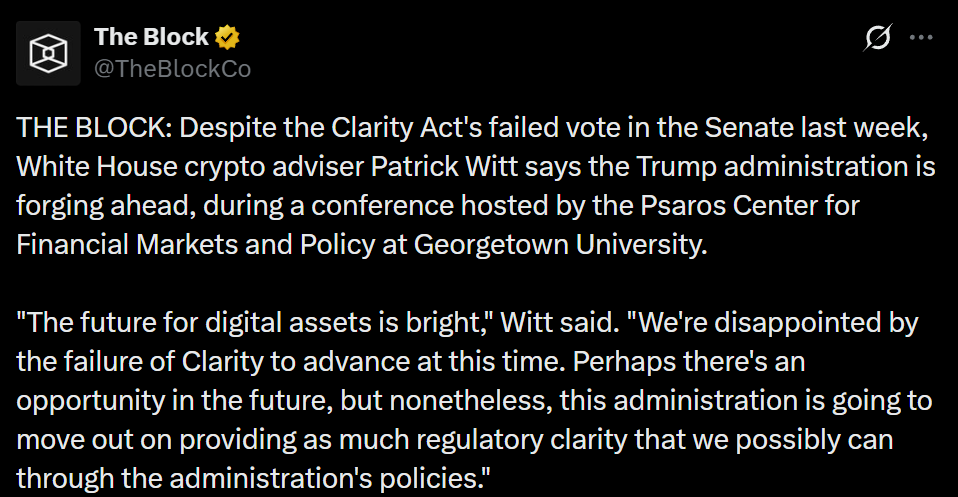
Source: The Block's coverage
What Witt Actually Said
Witt spoke during a conference hosted by the Psaros Center for Financial Markets and Policy at Georgetown University, where he said plainly, "The future for digital assets is bright."
He acknowledged the setback directly, saying the administration was "disappointed by the failure of Clarity to advance at this time," while adding that "perhaps there's an opportunity in the future," but that regardless, the administration intends to "move out on providing as much regulatory clarity that we possibly can through the administration's policies."
Why the CLARITY Act Actually Failed
To understand why this White House crypto news matters, it helps to know what happened in the Senate.
The bill needed 60 votes to clear an initial procedural hurdle and didn't get there.
The sticking point wasn't really about market structure policy itself; it centered on ethics concerns tied to President Trump's own crypto holdings and business interests.
Key details from the negotiation process:
-
Trump reportedly agreed to two unprecedented ethics provisions during talks, including a potential requirement to divest his crypto assets or place them in a blind trust
-
The administration was also willing to let state attorneys general sue if federal authorities failed to act on ethics violations
-
Banking industry lobbyists separately opposed the bill over concerns that stablecoin rewards could pull deposits away from traditional banks
-
Witt described Republicans as having accepted roughly 95% of the Democratic negotiating team's demands before the vote still fell short
Witt Pushes Back on Criticism at Georgetown
Beyond just expressing disappointment, Witt used his Georgetown appearance to directly defend the administration's approach.
He argued that Democrats had turned the process into a political fight rather than a policy debate, pointing out that a recent housing bill passed without facing the same kind of intense ethics scrutiny despite Trump's background as a real estate developer.
He also pushed back on the idea that Trump had an improper conflict of interest, noting what he called irony in the criticism given that some senators on banking committees hold and actively trade stocks in financial companies they themselves regulate.
Is the Bill Actually Dead?
This is where the situation gets genuinely uncertain. At the same Georgetown event, Tyler Williams, a former Treasury Department adviser who worked on the administration's digital-asset policy, described the market structure effort as "mostly dead, but not entirely dead," giving its chances of passing this Congress a "low percent chance."
Witt himself stopped short of declaring the legislation dead outright, but he did acknowledge the process had been personally difficult, saying at one point that the outcome was "still raw" for him.
It's worth noting the September 15 Senate action was specifically a procedural vote on whether to even bring the bill up for consideration, not a final vote on the legislation itself.
What This Means Going Forward
Even with the legislative path looking shaky, Witt's comments signal the administration doesn't plan to simply wait around for Congress.
A few takeaways from this round of White House crypto news:
-
The administration says it will lean on existing regulatory and policy tools to provide clarity where legislation has stalled
-
Witt left the door open for a renewed legislative push later, rather than framing this as a permanent defeat
-
Ongoing disagreements over stablecoin yield rules and ethics safeguards remain the core obstacles to any future deal
-
With Congress facing a shrinking political calendar, any near-term path forward will likely depend on how quickly negotiators can resolve these same underlying disputes
Conclusion
This latest round of White House crypto news shows an administration determined to keep moving on digital asset policy even after a real legislative setback.
Whether the CLARITY Act eventually finds new life in Congress or the administration ends up relying primarily on executive and regulatory action instead, Witt's message at Georgetown was clear: the push for crypto clarity isn't stopping, even if the path there just got a lot less certain.
Disclaimer
This article is for educational and informational purposes only and should not be considered financial or investment advice. Always conduct your own research before making investment decisions.