China Economy Growth August: Loan Growth Hits Record 27-Year Low

China Economy Growth August Why Did Loan Growth Crash to a Record Low?
China Economy Growth August data just delivered the weakest credit reading on record, and it's landing alongside a strikingly different read from Beijing's own central bank.
Outstanding yuan lending slowed to 4.9% year-over-year, the lowest figure in data stretching back to 1998, according to Trading Economics.
That single number is doing a lot of work in this China Economy Growth August story, and it's worth breaking down exactly what sits behind it.
The Headline Number
Per Trading Economics , citing the People's Bank of China, the pace of new lending in August came in at 4.9%, down from 5.1% in July and far below the 34.44% peak hit in June 2009, right after the global financial crisis.
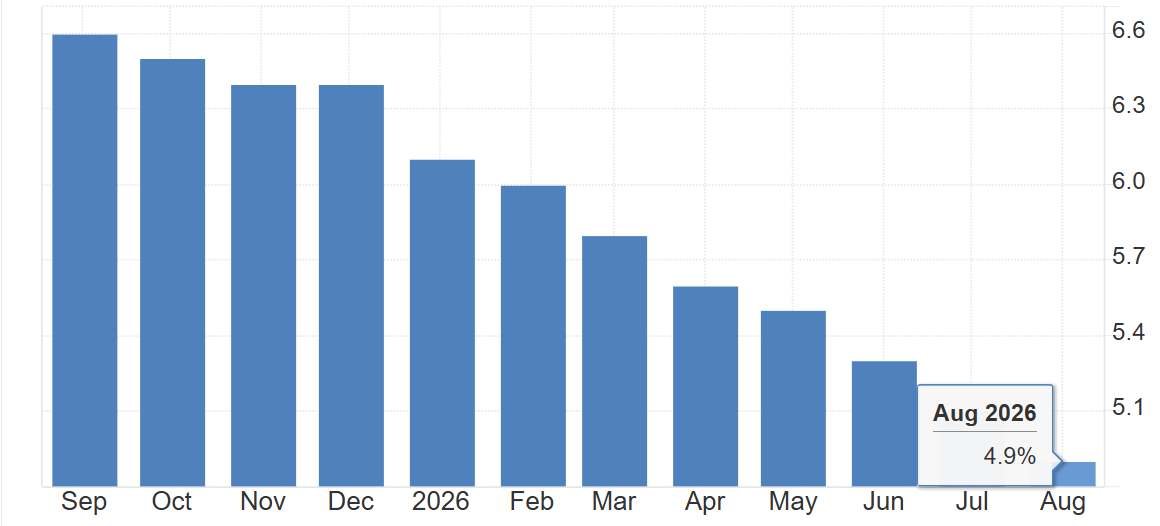
That August figure now stands as a record low across nearly three decades of data, and it anchors the entire China Economy Growth August narrative circulating this week.
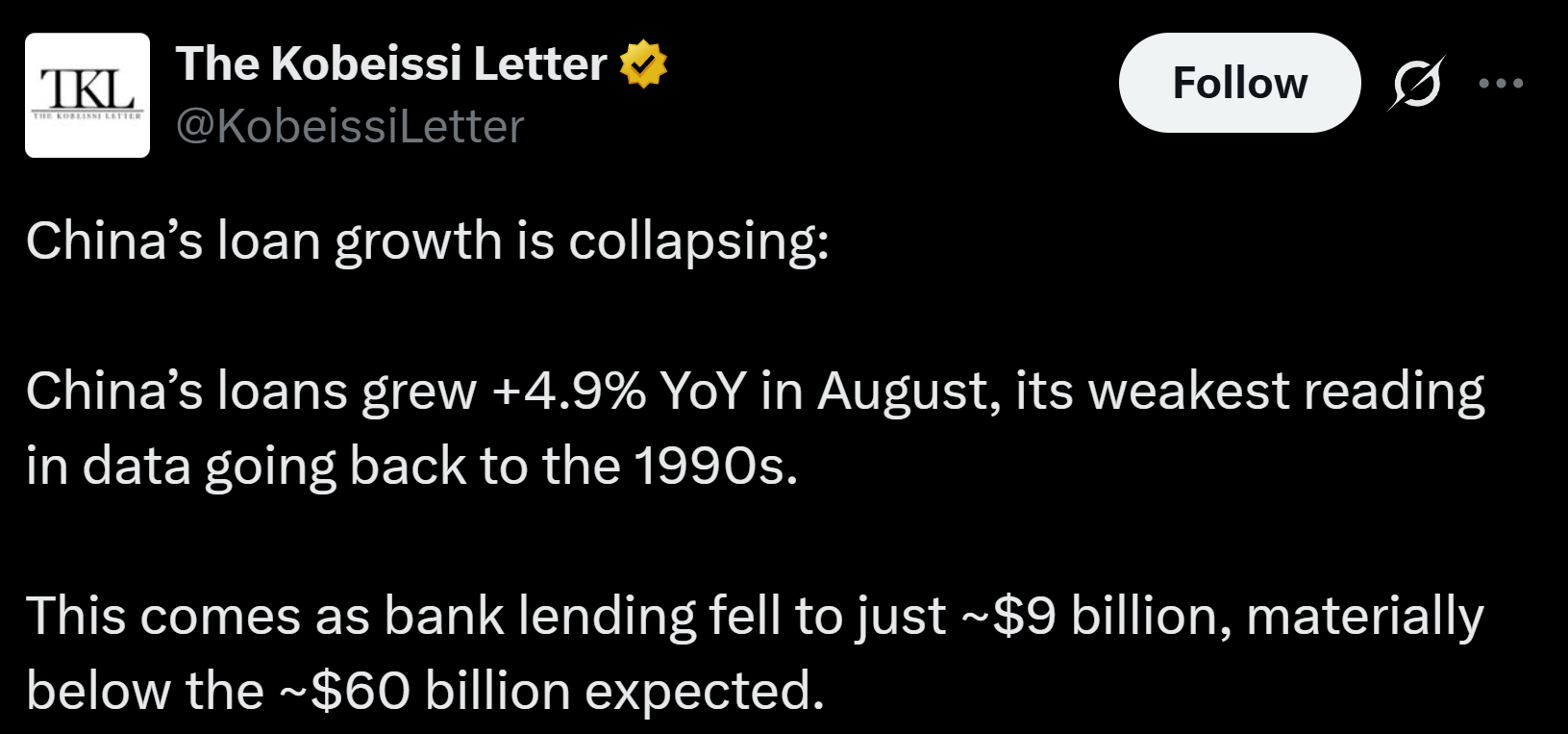
Source: The Kobeissi Letter on X
-
August loan growth: 4.9% YoY, a record low since 1998
-
July reading: 5.1%
-
All-time high: 34.44%, June 2009
-
Bank lending: roughly $9 billion, versus roughly $60 billion expected
Where The Miss Came From
The shortfall wasn't confined to one metric. Aggregate financing, a broader measure covering bank loans, bonds, and off-balance-sheet credit, rose by $247 billion during the month, well under the $314 billion economists had penciled in, per the same source.
| Metric | Actual | Expected |
| New Bank Lending | ~$9B | ~$60B |
| Aggregate Financing | +$247B | +$314B |
| Loan Growth (YoY) | 4.9% | 5.0% (consensus) |
Weak demand from both sides of the economy drove the gap.
Household mid- and long-term borrowing shrank for a fifth separate month this year, while comparable corporate loans have fallen to more than 50% below where they sat back in 2023.
The Slowdown Isn't New, It's Years In The Making
This isn't a single bad month. Lending has trended steadily lower for years, and this China Economy Growth August reading is simply the latest, lowest point on that longer curve.
The gap between today's 4.9% and the 34%-plus peak from 2009 reflects a structural shift away from the debt-fueled expansion that followed the financial crisis, not a one-off data blip.
Years of gradual deceleration, rather than a sudden shock, is what makes this particular reading harder to dismiss as noise.
Beijing's Own Read On The Same Data
Official state media framed the identical numbers quite differently. Per Xinhua, yuan-denominated loans still rose by 10.44 trillion yuan, about $1.54 trillion, across the first eight months of 2026, with outstanding loans reaching 282.35 trillion yuan by month's end.
Peking University's Tian Xuan called the pace "reasonable," adding that social financing conditions have stayed "relatively loose."
The central bank itself said it plans to keep a moderately loose monetary policy through the rest of the year, aiming to boost credit toward tech firms and private enterprise specifically.
Structural monetary policy tools are expected to see further price cuts and expanded coverage aimed at supporting tech firms and private enterprises specifically, according to Wang Qing, chief macro analyst at Golden Credit Rating, cited in the same official report.
-
M2 money supply: up 7.5% YoY
-
M1 money supply: up 4.1% YoY
-
Aggregate financing to the real economy: 464.8 trillion yuan, up 7.2% YoY
What This Means Going Forward
Two very different stories are being told from the same dataset. Western analysts see a slowdown serious enough to call the world's second-largest economy's credit engine broken, while Beijing's own framing stresses stability and continued policy support.
Whichever read proves closer to reality, the underlying figures, a 27-year low in loan growth alongside a fifth straight month of shrinking household borrowing, aren't easy to argue away.
This kind of contested economic data tends to ripple outward fast, shaping everything from currency markets to crypto news today, given how closely global risk appetite tracks major China news out of Beijing.
Disclaimer
This article is for educational and informational purposes only and should not be considered financial or investment advice. Always conduct your own research before making investment decisions.










