Why Kraken CEO Highlights EU MiCA Crypto Regulation After CLARITY Act?

Kraken CEO Says EU MiCA Crypto Regulation Leads As CLARITY Act Failed
Kraken Co-CEO David Ripley says Europe has pulled ahead of the United States in setting clear rules for the crypto industry. Speaking about the current state of digital asset policy, Ripley argued that the EU's Markets in Crypto-Assets Regulation, known as MiCA, has given the sector a level of regulatory clarity that US lawmakers have struggled to match.
His comments arrive at a moment when the US crypto market industry is still processing the collapse of the CLARITY Act, a bill meant to establish a clear market structure for digital assets.
At a Glance
-
Kraken Co-CEO David Ripley says the EU MiCA framework gives crypto firms clearer rules than the US market
-
Ripley criticizes the "negative, adversarial" political climate around US crypto policy
-
The stalled CLARITY Act raises questions about future US leadership in financial innovation
-
Kraken holds a MiCA license from the Central Bank of Ireland, covering all 30 EEA states
Why Ripley Says EU MiCA Gives Crypto Firms More Regulatory Clarity
Market in Crypto-Asset Regulation is the European Union's unified framework for crypto-asset markets, designed to replace a patchwork of national rules with one common set of standards across member states. Ripley pointed to this consistency as a major advantage for firms trying to operate compliantly in Europe.
Rather than navigating separate licensing regimes country by country, companies authorization can generally offer covered services across the bloc under a single regulatory structure, which reduces uncertainty for both operators and users.
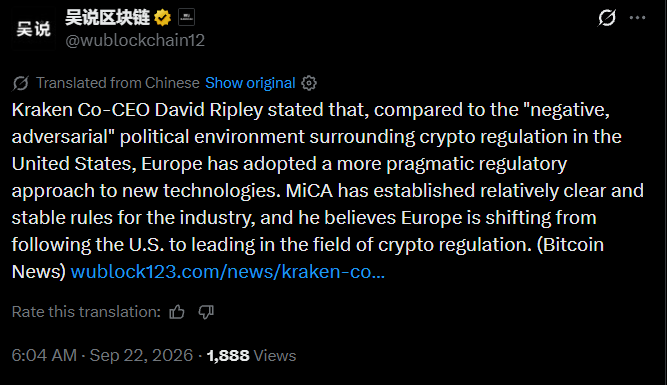
Source: Wu Blockchain
Europe's MiCA Approach vs. the US Crypto Regulatory Environment
Ripley drew a sharp contrast between how the two regions have approached crypto policy. He described the European process as more collaborative, characterizing it as regulators and industry working together to figure out how new technology should be governed.
He said the US environment, by comparison, has been shaped by a more combative political dynamic that has made steady progress harder to achieve.
| Area | European Union | United States |
| Main framework | MiCA | No single comprehensive crypto framework |
| Regulatory approach | Common rules for crypto-asset | Regulation split across multiple agencies and bills |
| Industry clarity | Defined rules for crypto activities | Framework still subject to ongoing legislative debate |
| Key issue per Ripley | Regulatory clarity and stability | Slow, politically contentious progress |
CLARITY Act Delay Raises Questions Over US Crypto Leadership
Ripley also addressed the CLARITY Act directly, noting that the bill had been in development for years without reaching the finish line. He said the slow pace was notable given how long the US has held a leading position in financial services more broadly.
In his view, continued delay risks handing that leadership role to regions, like the EU, that have moved faster to put comprehensive rules in place.
Kraken's MiCA License Opens Access Across 30 EEA Markets
Kraken's own experience in Europe reflects the trend Ripley describes. The crypto exchange received a MiCA license from the Central Bank of Ireland in June 2025, giving it the ability to provide regulated services across all 30 member states of the European Economic Area.
That single authorization replaced what would otherwise have required separate approvals across multiple jurisdictions.
What MiCA Means for Crypto Exchanges and European Users
For exchanges operating in Europe, a unified license structure can simplify compliance obligations and support faster market expansion. For users, it generally means dealing with platforms that operate under a consistent set of consumer protection and operational standards, rather than a mix of rules that vary from one country to the next.
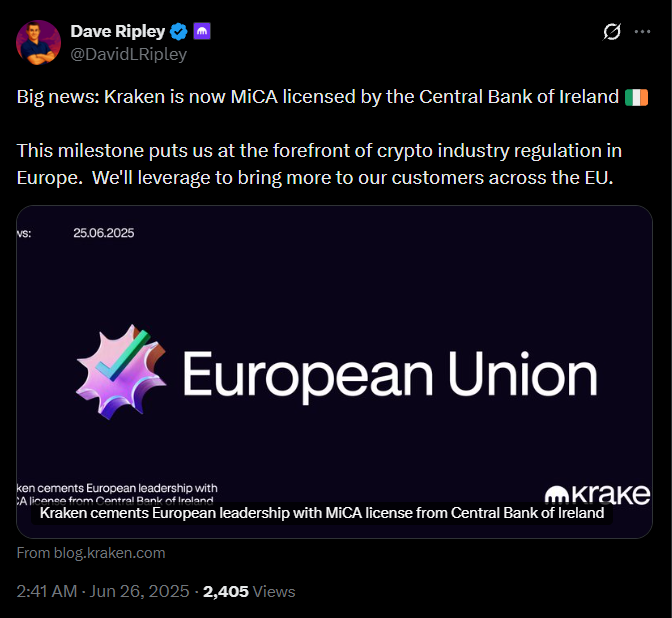
Source: Dave Ripley Post of 26 June 2025
EU MiCA Crypto Regulation Timeline: From Framework to Kraken License
| Date | Development |
| 2023 | It entered into force, establishing the EU's common crypto-asset framework |
| 2024 | Major provisions began applying, including rules for stablecoins and crypto-asset service providers |
| June 2025 | Kraken received its license from Ireland's Central Bank |
| Sept 22, 2026 | Ripley highlighted Europe's regulatory approach, saying it is shifting from following the US to leading |
What Europe's MiCA Lead Could Mean for the Global Crypto Market
The divergence between EU and US approaches could shape where crypto firms choose to expand and how they build out compliance operations going forward.
As regulators in different regions compete to set the standard for digital asset oversight, Ripley's comments suggest that Europe, once seen as a follower on crypto policy, may now be setting the pace that other jurisdictions are measured against.
Conclusion
Ripley's remarks add to an ongoing conversation about where global crypto regulation is headed next. With this set of rules already in force and the CLARITY Act still unresolved, the coming months may reveal whether the US narrows the gap or whether Europe's head start becomes a lasting advantage.
Disclaimer: This article is for informational purposes only and does not constitute financial, investment, or legal advice. Cryptocurrency markets are volatile and involve significant risk. Readers should conduct their own research and consult a qualified professional before making financial decisions.









