China Gold Reserves News: Why Asia Is Quietly Buying More Gold

China Gold Reserves News: Why 21 Months of Buying Matters
The latest China gold reserves news confirms a real and significant shift underway: China's central bank has now bought gold for 21 straight months, while its U.S. Treasury holdings have slid to their lowest level on record.
Together with a new Hong Kong gold-clearing system and South Korea's return to gold buying after 13 years, these verified developments point to a genuine, if gradual, reserve diversification trend across Asia.
Source: Stern Drew on X
PBoC's Gold Buying Streak Confirmed at 21 Months
According to the World Gold Council's official China market update, the People's Bank of China (PBoC) added 20 tonnes of gold in July 2026, its largest single monthly purchase since October 2023, extending its buying streak to 21 consecutive months, the longest on record.
That brings official PBoC golds holding to 2,366 tonnes, representing 8% of China's total foreign exchange reserves.
At current gold-prices, that stockpile is worth in the range of $300 billion, a figure broadly consistent with claims circulating about China's gold-reserves surging past $300 billion in value.
Treasury Holdings Hit a Record Low, But Not a Single $70 Billion Dump
Here's where the picture needs correcting. Official U.S. Treasury TIC data shows China's Treasury holdings fell to $633.4 billion in June 2026, down from $659.3 billion in May, a decline of roughly $26 billion in that one month, and a new record low since the data series began in 2011.
That is a real and notable drop, part of a much longer decline from China's 2013 peak of $1.317 trillion. But it does not match claims of a single "$70 billion dump" being "the biggest sell-off since 2008."
The actual monthly TIC figures show a steady, multi-year grind lower rather than one dramatic sell event.
Metric | Verified Figure | Source |
PBoC gold buying streak | 21 consecutive months | World Council |
July 2026 gold addition | 20 tonnes (largest since Oct 2023) | World Council |
Total PBoC gold holdings | 2,366 tonnes (8% of reserves) | World Council |
China Treasury holdings, June 2026 | $633.4B (record low) | U.S. Treasury TIC data |
China Treasury holdings, May 2026 | $659.3B | U.S. Treasury TIC data |
One-month change | -$26B | U.S. Treasury TIC data |
Hong Kong's Gold Clearing System Is Real and Already Running
This part of the China gold reserves news story checks out in full. Hong Kong's government officially launched a trial run of its central gold clearing and settlement system on July 7, 2026.
The system is operated by the Hong Kong Precious Metals Central Clearing Company (HKPMCC), a wholly government-owned entity, and its board includes 11 banks.
A cross-border "Delivery Connect" mechanism now links Hong Kong directly to the Shanghai Gold Exchange, allowing two-way physical gold transfers between the two markets.
Hong Kong's Chief Executive John Lee described the system as a foundation for building a "comprehensive gold trading ecosystem" aimed at serving global investors seeking safe-haven assets.
South Korea Just Ended a 13-Year Gold Freeze
Another confirmed thread in this China gold-reserves news roundup involves South Korea.
On August 3, 2026, the Bank of Korea announced it would resume gold purchases for the first time since 2013, ending a 13-year pause.
The central bank has already begun buying overseas-listed spot gold ETFs and set up a framework, through the Korea Exchange and Korea Securities Depository, to purchase domestically produced physical gold.
As of June 2026, South Korea held just 104.4 tonnes of gold, only 1.1% of its $427 billion in total reserves, a notably low allocation compared to major economies.
What the Xi Jinping "Golden Decade" Comments Actually Meant
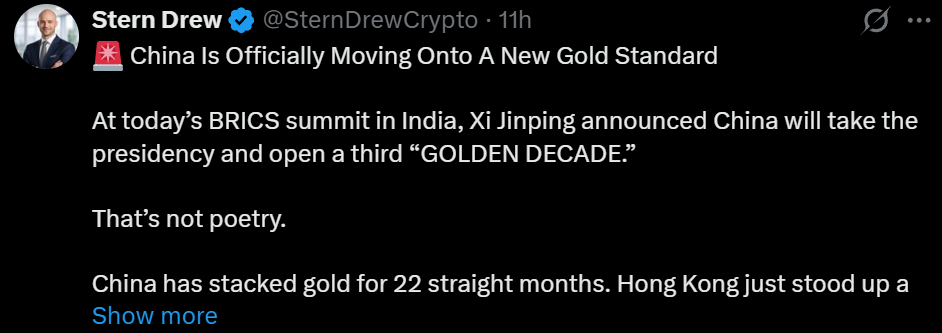
Separately, at the 18th BRICS Summit in New Delhi on September 13, 2026, President Xi Jinping did announce that China will take the BRICS rotating presidency next year and called for a third "golden decade" of BRICS cooperation.
However, official Chinese state media coverage of the summit makes no mention of a literal gold standard, a BRICS Pay settlement system, or any formal move away from the dollar.
The "golden decade" language refers to two decades of BRICS partnership, not a currency policy announcement.
Conclusion
The verified pieces of this China gold reserves news story are genuinely significant on their own: a record 21-month PBoC gold buying streak, a real Treasury holdings low, a live Hong Kong-Shanghai gold clearing link, and South Korea's return to the gold market after 13 years.
But claims of a single $70 billion Treasury "dump," a formal gold standard, or a gold-backed BRICS Pay system launched at the summit go beyond what official data and state coverage currently support.
The underlying trend, gradual reserve diversification toward gold, is real; the more dramatic framing around it is not.
Disclaimer
This article is for educational and informational purposes only and should not be considered financial or investment advice. Always conduct your own research before making investment decisions.










