Best Low Cap Crypto August 2026 Monthly: Risk-Checked List


Best Low Cap Crypto August 2026: Risk-Checked List
Chasing whatever coin is trending on a timeline is not a strategy. It is how most people lose money on low-cap tokens before they even understand what the project does.
This monthly shortlist takes a different approach. Every pick gets a market cap check, a real utility test, and a stated risk level, so you can see exactly why something made the list and exactly where it could go wrong.
Four projects made the cut this month, spread across data infrastructure, institutional lending, decentralized cloud compute, and cross-chain messaging, with levels ranging from moderate to genuinely severe.
In short, this month's picks are OriginTrail (TRAC), Maple Finance (SYRUP), Flux (FLUX), and the honorable mention Celer Network (CELR). Each carries a different tier based on drawdown from its all-time high, liquidity, and how concentrated its token looks.
These picks are not ranked from best to worst. Instead, they have been selected to represent different sectors within the low-cap market, with each project offering a distinct utility, adoption profile, and level of risk.
Readers should view this as a diversified monthly watchlist rather than a performance ranking.
How We Selected These Picks (BEST Low Cap Crypto August 2026 Monthly)
A monthly shortlist like this needs a filter, or it is just a list of tickers someone liked recently. Here is what each project had to clear before making the cut.
Market capitalization: For this article, we classify projects with a market capitalization of approximately under $500 million as low-cap cryptocurrencies. While some market participants consider projects below $100 million as micro-cap and $100 million to $1 billion as small-cap, we use the broader under-$500 million range to identify projects that still offer meaningful growth potential while remaining below large-cap valuations.
Verified pricing data: Every figure below is checked against CoinMarketCap, not estimated.
Real utility: The token has to do something inside its own ecosystem, not just exist as a speculative chip.
Supply concentration: Checked circulating versus max supply for signs of heavy future dilution.
Track record: How long the project has operated, and whether it has shipped anything recently.
We also scored each pick on a simple risk basis: moderate, high, or very high, based on drawdown from the all-time high, liquidity, and how concentrated the token supply looks.
This method will not catch every risk. A project can pass every filter here and still fail for reasons outside any checklist, including a hack, a regulatory action, or a founder simply walking away. Treat the risk tiers below as a starting framework, not a guarantee.
The Shortlist at a Glance
This month's shortlist spans four sectors that rarely get grouped together: AI-linked data infrastructure, real-world asset lending, decentralized cloud computing, and cross-chain interoperability.
Diversifying across sectors is a basic form of risk management, though it does not remove risk entirely.
OriginTrail (TRAC): decentralized knowledge graph for supply chain and AI data
Maple Finance (SYRUP): on-chain institutional lending and real-world-asset credit
Flux (FLUX): decentralized cloud infrastructure, an alternative to centralized hosting
Celer Network (CELR): honourable mention, cross-chain messaging, with a severe risk flag
Pick 1: OriginTrail (TRAC), Overview and Risk
OriginTrail runs a decentralized knowledge graph that verifies supply chain and data authenticity across industries, according to the project's documentation.
It has been used by institutions including the British Standards Institution and Swiss Federal Railways, which sets it apart from projects that only have a white paper and a roadmap.
Token Utility
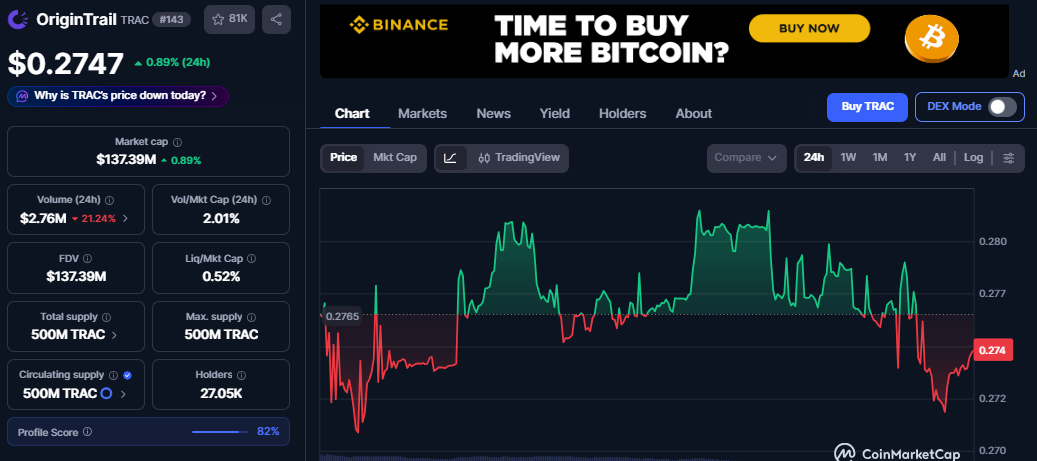
According to CoinMarketCap OriginTrail (TRAC) has a market capitalization of approximately $137.39 million, with its entire 500 million token supply already in circulation.
Metric | Value |
Current Price | $0.2747 |
Market Cap | $137.39M |
Circulating Supply | 500M TRAC |
Max Supply | 500M TRAC |
Strengths: Genuine enterprise adoption, EU-backed research funding, and a use case that does not depend on crypto-native hype cycles.
Risks: TRAC trades roughly 92% below its all-time high, trading volume is thin relative to its market cap, and the AI data infrastructure niche is getting more crowded by the month.
Risk Tier: Moderate. Suits readers who want infrastructure exposure with real-world users behind it.
Pick 2: Maple Finance (SYRUP), Overview and Risk
Maple Finance connects institutional borrowers with on-chain lenders through an overcollateralized credit marketplace, based on details published on the project's own site. It was named to Fortune's list of top crypto innovators for 2026, a rare mainstream nod for a DeFi lending protocol.
Token Utility
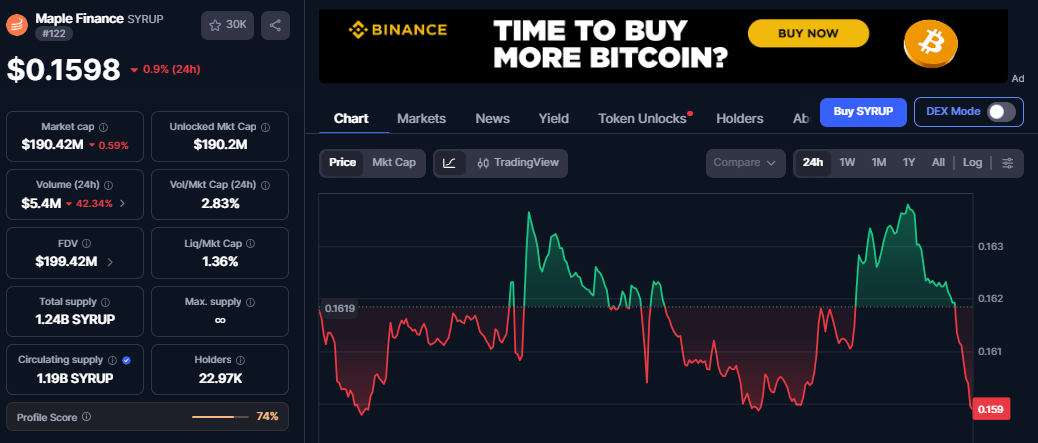
According to CoinMarketCap Maple Finance (SYRUP) has a market capitalization of approximately $190.42 million, with 1.19 billion SYRUP tokens currently in circulation out of a maximum supply of 1.24 billion.
Metric | Value |
Current Price | $0.1598 |
Market Cap | $190.42M |
Circulating Supply | 1.19B SYRUP |
Max Supply | 1.24B SYRUP |
Strengths: Institutional-grade positioning, real revenue from lending fees, and mainstream press recognition beyond crypto media.
Risks: SYRUP's price has swung heavily across recent weeks; it sits near the upper edge of the low-cap band, and RWA lending carries counterparty risk if a borrower defaults.
Risk Tier: Moderate. This pick fits readers who already understand DeFi credit markets rather than complete beginners.
Pick 3: Flux (FLUX), Overview and Risk
Flux offers decentralized cloud infrastructure, positioning itself as an open alternative to centralized hosting providers such as AWS. That is a specific, concrete category, not a vague crypto-plus-AI narrative.
Token Utility
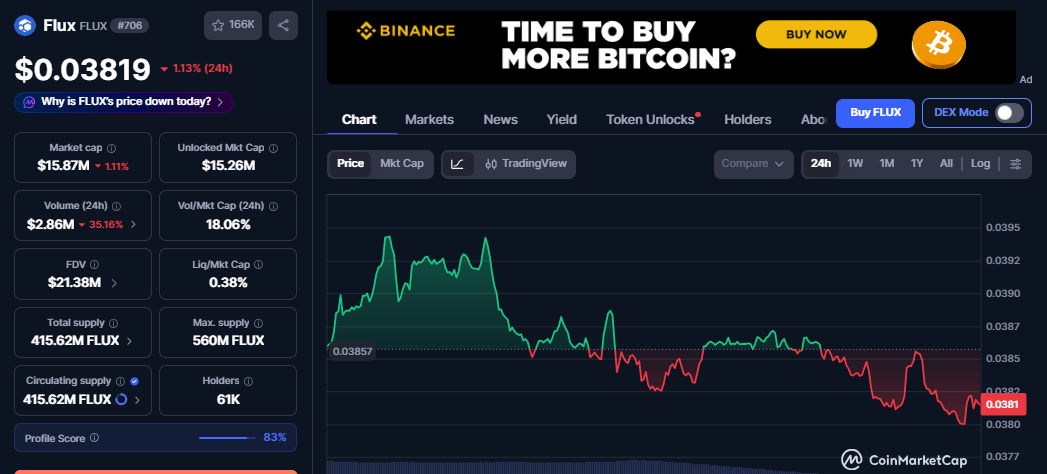
According to CoinMarketCap Flux (FLUX) has a market capitalization of approximately $15.87 million, with its entire 415.62 million token supply already in circulation.
Metric | Value |
Current Price | $0.03819 |
Market Cap | $15.87M |
Circulating Supply | 415.62M FLUX |
Max Supply | 415.62M FLUX |
Strengths: A clear, understandable use case and direct competition against a real, large addressable market in cloud computing.
Risks: FLUX trades roughly 99% below its all-time high, trading volume is modest, and decentralized cloud services still need to prove reliability at scale against entrenched providers.
Risk Tier: High. A true micro-cap that suits readers comfortable with sharp price swings.
Honourable Mention: Celer Network (CELR), Severe Risk Flag
Celer Network provides cross-chain messaging infrastructure through its cBridge product and counts Pantera Capital and YZi Labs among its backers. We are including it as an honorable mention only, with a serious caveat attached.
Token Utility:
According to CoinMarketCap Celer Network (CELR) has a market capitalization of approximately $12.06 million, with 7.8 billion CELR tokens currently in circulation out of a maximum supply of 10 billion. 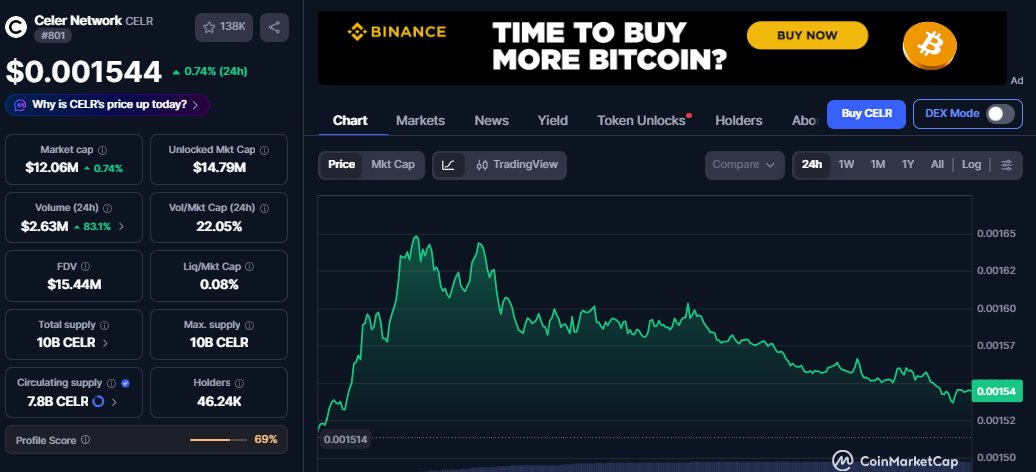
Metric | Value |
Current Price | $0.001544 |
Market Cap | $12.06M |
Circulating Supply | 7.8B CELR |
Max Supply | 10B CELR |
Risk Tier: Very High. Position sizing matters more here than almost anywhere else on this list.
Comparison Table: Key Metrics Side by Side
Coin | Sector | Market Cap | Core Utility | Risk Tier |
OriginTrail (TRAC) | AI/data infrastructure | $137.39M | Data verification, staking | Moderate |
Maple Finance (SYRUP) | RWA lending | $190.42M | Institutional credit yield | Moderate |
Flux (FLUX) | Decentralized cloud | $15.87M | Compute payments, staking | High |
Celer Network (CELR) | Cross-chain messaging | $12.06M | Bridging, staking | Very High |
Figures move constantly. Always cross-check against CoinMarketCap before acting on any number here.
Who Each Pick Suits
Not every name on a low-cap watchlist fits every reader. Matching a pick to your own risk tolerance matters more than chasing whichever coin moved the most this week.
Infrastructure-focused readers may prefer OriginTrail, given its enterprise adoption track record and real institutional users.
DeFi-native readers comfortable evaluating credit risk may look at Maple Finance, since institutional lending requires understanding counterparty exposure.
Higher-risk traders willing to accept sharp drawdowns might track Flux for its concrete, understandable use case.
Only very risk-tolerant readers should consider Celer Network, and only as a small position given its supply and price history.
Risks and What Could Go Wrong
Liquidity risk. Thin order books on smaller-cap tokens mean a modest sell order can move price sharply.
Drawdown risk. Three of the four picks here trade more than 90% below their all-time highs.
Execution risk. Roadmaps are promises, and delays are common across this entire category.
Correlation risk. Low-cap tokens typically fall harder than Bitcoin during broad market downturns.
Concentration risk. When a small number of wallets hold most of a token's supply, a single large sale can crash the price regardless of the project's fundamentals.
Regulatory risk. Policy shifts around lending protocols or cross-chain infrastructure can change a project's trajectory with little warning.
Position sizing and time horizon matter more here than trying to identify a single winner in advance.
Glossary
Market capitalization: token price multiplied by circulating supply.
Circulating supply: tokens currently available and tradable.
Staking: locking tokens to support a network in exchange for rewards.
Drawdown: the percentage decline from a token's highest recorded price.
Expert View
Analysts covering the low-cap segment generally note that genuine enterprise or institutional adoption, as seen with OriginTrail and Maple Finance, tends to reduce volatility compared with tokens that rely purely on retail trading interest.
That said, even adoption-backed projects remain exposed to broader market swings, and a small allocation approach is typically recommended over concentrating in any single low-cap position.
Disclaimer: This article is for educational and informational purposes only and should not be considered financial or investment advice. Cryptocurrency prices are highly volatile. Always conduct your own research before making investment decisions.





.jpg)