8 Best Metaverse Tokens to Buy in 2026 With Real Use Cases

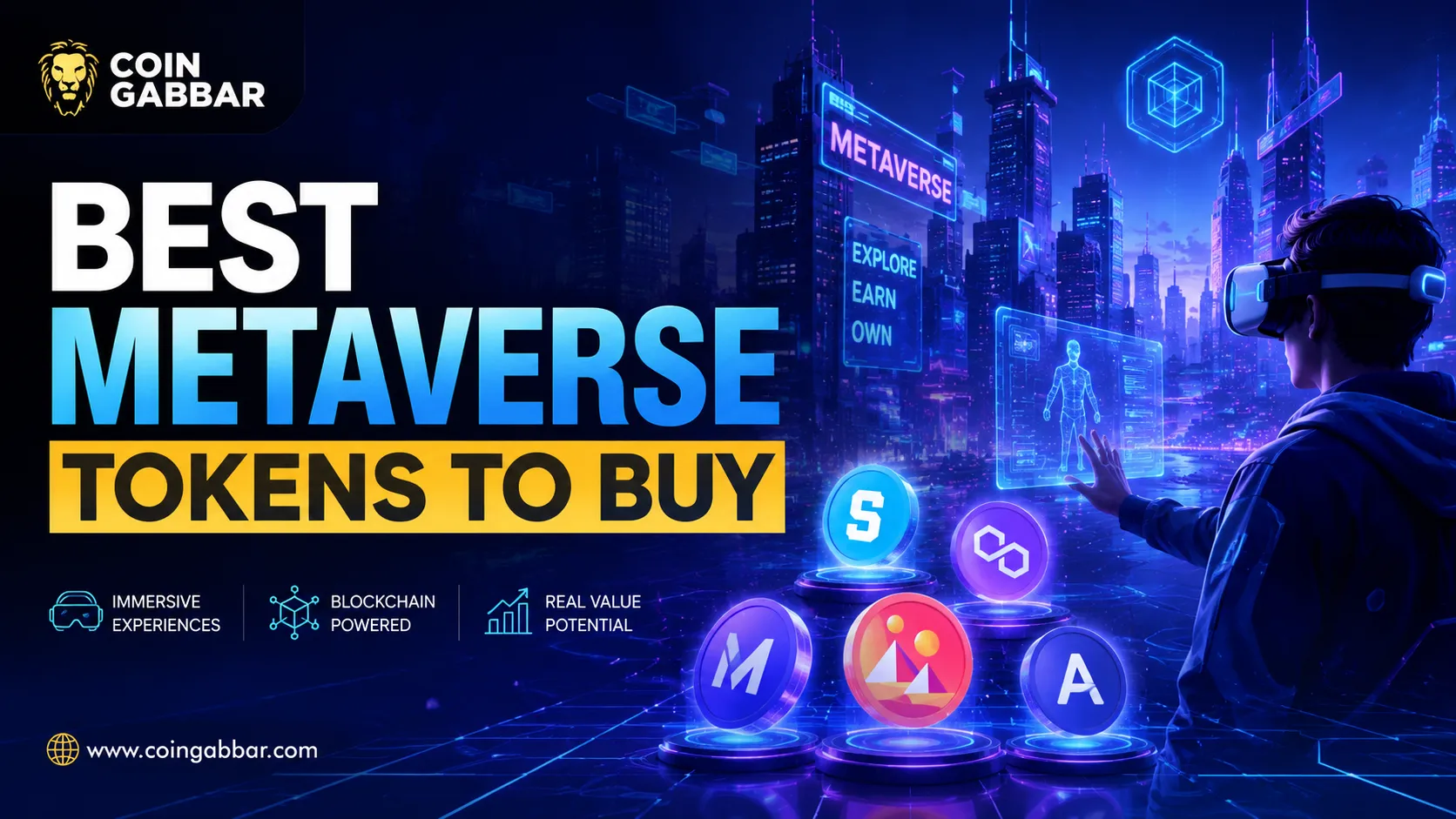
Best Metaverse Tokens to Buy in 2026: The Complete Guide
The metaverse is no longer a concept confined to science fiction — it is a live, expanding digital economy where millions of users own land, trade assets, earn rewards, and govern virtual worlds using cryptocurrency tokens. If you are searching for the best metaverse tokens to buy in 2026, you are entering a market that analysts estimate will surpass $1 trillion in value by 2032, according to forecasts published by multiple industry research firms. Affordable VR headsets now available below $300, the rise of AI-powered virtual experiences, and growing enterprise adoption from brands like Adidas, Warner Music Group, and JPMorgan have collectively reignited serious interest in metaverse infrastructure.
This best metaverse tokens to buy guide covers the top metaverse tokens, what each one does, how it generates value, where it trades, and what you need to know before making any decisions. We cover what the metaverse is for newcomers, and for experienced investors we go deep on tokenomics, staking mechanics, and ecosystem developments across every major project.
Before reading further, note that the cryptocurrency market is highly volatile. Nothing in this article is financial advice. Every figure quoted is informational only. Always conduct your own research before committing any capital.
What Are Metaverse Tokens and Why Do They Matter?
Metaverse tokens are the native cryptocurrencies of virtual world platforms built on blockchain technology. Unlike traditional game currencies that exist inside a closed server controlled by a company, metaverse crypto coins live on public blockchains — primarily Ethereum — which means users truly own them and can transfer, sell, or stake them freely.
These tokens serve multiple functions within their ecosystems. They act as the medium of exchange for purchasing virtual land, wearables, in-game items, and avatar customisations. They power decentralised governance, where token holders vote on platform upgrades and treasury allocations through Decentralised Autonomous Organisations (DAOs). They enable staking, where locking tokens earns yield. And in infrastructure projects like Render Network, they compensate real-world GPU node operators for processing complex 3D rendering tasks.
The metaverse sector currently contains over 40 distinct tokens tracked by major data platforms. However, most value and genuine utility is concentrated in a handful of projects with active user bases, sustained development, and institutional backing. That concentration is exactly where this guide focuses.
You can explore the full range of metaverse tokens on CoinGabbar, including live prices, market cap rankings, and daily performance data across the entire category.
How to Evaluate a Metaverse Token Before Buying
Not every project with the word \"metaverse\" in its marketing deserves your attention. Before using any best metaverse tokens to buy list, here are the criteria that separate genuinely strong metaverse blockchain projects from hype-driven speculation.
Real Utility and Active User Base
The most important filter is whether people are actually using the platform. Daily active users, secondary market trading volume for in-world NFTs, and developer SDK activity are all more meaningful than token price alone. Projects like The Sandbox attract daily creators because of their no-code Game Maker tool. Decentraland hosts brands and events in its virtual districts. Axie Infinity, despite a difficult 2022, rebuilt its player base through a revised economic model. If the token has no active ecosystem behind it, its price is driven purely by speculation.
Tokenomics and Supply Design
Study how tokens are distributed, whether there is inflation or a burn mechanism, and what percentage of supply is locked by the team or investors. MANA burns tokens to mint LAND NFTs, creating a deflationary mechanism tied to ecosystem growth. GALA implemented a token burn programme that eliminated 40% of its supply. These are healthy supply design signals. Conversely, projects with unlocking schedules that dump large amounts onto retail buyers are a red flag.
Staking and Passive Income Potential
Several metaverse tokens with staking rewards offer holders a way to earn yield without selling. AXS offers staking that distributes revenue from the Axie Infinity ecosystem. APE vaults offer double-digit staking yields tied to Otherside DAO treasury activity. ENJ staking reduces circulating supply, supporting price floors. When evaluating any token, determine whether staking yield comes from genuine protocol revenue or from newly minted inflation — the former is sustainable, the latter is not.
Exchange Listing and Liquidity
A token only has real value if you can exit your position. Ensure the token you are considering trades on at least two Tier 1 centralised exchanges — such as Binance, Coinbase, or Kraken — and has meaningful daily trading volume. Thin-liquidity tokens can look attractive on a chart but become impossible to sell during market stress. Check the latest metaverse token listings on CoinGabbar to see which tokens are gaining centralised exchange access.
Partnership and Institutional Backing
Brand partnerships validate that a platform has real-world commercial appeal. The Sandbox has onboarded Adidas, Snoop Dogg, Warner Music Group, and The Walking Dead. Decentraland has hosted virtual fashion weeks with luxury brands. Render Network has integrated Hollywood studio workflows for 3D asset production. These partnerships are direct demand drivers for the underlying tokens.
The Best Metaverse Tokens to Buy in 2026
For this best metaverse tokens to buy selection, the following eight tokens represent the most established, utility-rich, and actively developed projects in the metaverse crypto coins landscape. They are presented in no particular order of recommendation — each serves a different purpose and appeals to a different investor profile.
1. Decentraland (MANA) — The Pioneer Virtual World
Decentraland launched in 2017 with a $24 million ICO and became publicly accessible in 2020. It is one of the oldest and most recognised names among virtual world crypto tokens. Built on Ethereum, the platform contains 90,601 fixed land parcels sold as ERC-721 NFTs. MANA is the ERC-20 utility token used for all in-world transactions: purchasing land, acquiring wearables, customising avatars, and accessing premium event experiences.
What makes MANA unique among virtual real estate crypto tokens is its dual-token model. Users burn MANA to mint LAND — creating a direct deflationary mechanism tied to platform growth. The more land that is developed, the more MANA is consumed and permanently removed from circulation. Governance is handled entirely by a community DAO, making Decentraland one of the most decentralised metaverse platforms in existence.
Prime locations near Genesis Plaza and high-traffic cultural districts have historically commanded premium prices, with some parcels reaching over $500,000 during peak market periods in 2021 to 2022. By 2026, valuations have stabilised significantly, offering a more accessible entry point for investors who believe in long-term virtual real estate appreciation. Decentraland hosts brand activations, art galleries, concerts, educational experiences, and fashion events — giving MANA genuine use-case depth beyond simple speculation.
Key facts: ERC-20 token | Ethereum blockchain | 90,601 fixed LAND parcels | DAO governance | burns to mint LAND | partners include Samsung, Sotheby's, and major fashion labels.
2. The Sandbox (SAND) — The Creator-First Virtual World
The Sandbox is Decentraland's primary rival and arguably its superior in the gaming and creator economy segment. Built on Ethereum with Polygon Layer 2 support for lower transaction fees, The Sandbox offers 166,464 LAND parcels in a voxel-based environment designed to feel like a programmable Minecraft.
SAND is the platform's utility and governance token. It powers all marketplace transactions, creator rewards, and DAO votes. The platform's three integrated tools — VoxEdit for asset creation, Game Maker for building experiences without coding, and the Marketplace for trading assets — give SAND a wide utility surface that few other top metaverse coins 2026 can match. SAND started trading at $0.03 in 2020 before peaking at $8.44 in November 2021. It has retraced substantially since, creating a historically wide discount from its all-time high for long-term-oriented buyers.
The Sandbox's corporate partnerships are among the most impressive in the sector. Adidas, Snoop Dogg, Warner Music Group, and The Walking Dead all own and operate virtual presences on The Sandbox. These branded neighbours drive organic foot traffic to nearby user-owned parcels, creating a compelling case for virtual land investment in their vicinity. The platform also implements a SAND staking mechanism where token holders can earn yield proportional to their stake and ecosystem activity.
LAND prices in The Sandbox generally trade at a 30 to 50% discount to comparable Decentraland parcels as of 2026, partly due to the larger total supply, making it a more accessible entry point for new investors exploring metaverse virtual land investment.
Key facts: ERC-20 with Polygon L2 | 166,464 LAND parcels | voxel-based creator environment | brand partners include Adidas, Warner Music, Snoop Dogg | Game Maker requires no coding | all-time high $8.44.
MANA vs SAND: Which Is Right for You?
Both are among the best metaverse cryptocurrency options for virtual real estate exposure, but they serve different user types. MANA suits investors who want a governance-first, brand-activated virtual world with a realistic 3D aesthetic. SAND suits creators, gamers, and investors who want exposure to a voxel-based creator economy with deeper gaming integration. They are not mutually exclusive — many metaverse investors hold both.
3. Axie Infinity (AXS) — The Play-to-Earn Pioneer
Axie Infinity, developed by Sky Mavis and built on the Ronin Network, pioneered the play-to-earn model that introduced millions of people to blockchain gaming — particularly in Southeast Asia and the Philippines. AXS is the governance and staking token of the ecosystem, while SLP (Smooth Love Potion) serves as the in-game breeding currency.
The Axie Infinity story includes both triumph and serious adversity. At its peak in 2021, the game had 2.7 million daily active users and generated hundreds of millions in monthly revenue. In March 2022, the Ronin bridge was hacked for $625 million — the largest crypto hack in history at the time — causing daily active users to collapse to under 50,000. Sky Mavis responded by rebuilding the bridge with enhanced security, reimbursing affected users, and redesigning the game's economic model to reduce over-reliance on SLP inflation.
By 2026, Axie Infinity has reestablished itself with arena-mode competitive gaming, zk-Rollup integration for smoother gameplay, and a revenue-sharing model that distributes DEX trading fees to AXS stakers. The Ronin Network, originally built just for Axie, has expanded into a general-purpose gaming blockchain hosting dozens of additional titles. AXS staking continues to attract long-term holders who believe in the ecosystem's recovery trajectory.
For investors considering Web3 gaming tokens, AXS represents one of the highest-risk, potentially highest-reward positions in the sector — a project with proven peak demand but a significant rebuilding story still in progress.
Key facts: Ronin Network | play-to-earn pioneer | $625M Ronin hack in 2022, fully rebuilt | 2.7M peak daily active users | zk-Rollup integration | DEX fee sharing to stakers.
4. Render Network (RNDR) — The Infrastructure Token
Render Network occupies a unique and increasingly critical position in the metaverse tokens list: it is not a virtual world you inhabit, but the infrastructure that makes high-quality virtual worlds possible. RNDR connects artists and creators who need GPU rendering power with node operators who have spare GPU capacity, creating a decentralised marketplace for 3D rendering, AI workloads, and visual effects production.
Originally an ERC-20 token on Ethereum, RNDR migrated to Solana in 2023 for lower fees and higher throughput, while maintaining cross-chain bridges. Hollywood studios now integrate RNDR workflows into their asset production pipelines. AI-generated video demand has driven sustained growth in node utilisation. The RenderToken model compensates node operators per job completed, creating a direct relationship between platform activity and token demand.
RNDR's market cap exceeded $2 billion at peak, making it the largest cap among metaverse infrastructure tokens. CoinDesk's infrastructure token coverage frequently highlights RNDR as one of the few metaverse-adjacent assets with genuine non-speculative demand — you can read their analysis of the RNDR Solana migration for technical context. Its investment case differs fundamentally from pure virtual world tokens: it is a bet on the computational demand for 3D content broadly — not on any single metaverse platform's adoption. As the metaverse, AI video, and immersive content industries all grow simultaneously, RNDR benefits from all three demand streams at once.
For investors who want metaverse tokens with utility that extend beyond gaming and virtual land, RNDR offers the most institutionally credible value proposition in the sector.
Key facts: Solana blockchain | decentralised GPU rendering marketplace | Hollywood studio integrations | AI content demand driver | cross-chain via bridges | $2B+ peak market cap.
5. ApeCoin (APE) — The Otherside Metaverse Token
ApeCoin serves as the governance and utility token for the Otherside metaverse — a massive virtual world built by Yuga Labs, the studio behind the Bored Ape Yacht Club (BAYC) and CryptoPunks NFT collections. APE is an ERC-20 token managed by the ApeCoin DAO, which governs a treasury with approximately $1 billion in assets.
The Otherside project made headlines with a $560 million land mint, revealing extraordinary demand from the NFT collector community. The Nexus hub launched in late 2025 as a social and exploration hub bridging multiple virtual environments. DAO votes continuously refine ecosystem features, event programming, and expansion roadmaps. APE staking vaults offer double-digit yields tied to DAO treasury activity — one of the more attractive passive income opportunities among blockchain gaming tokens.
APE's investment case is tightly coupled to the broader NFT market and the BAYC brand's cultural reach. In bull markets, that coupling produces outsized returns as BAYC holders use APE for land purchases and ecosystem participation. In bear markets, the same coupling can amplify drawdowns. APE/USDT trades below all key EMAs as of 2026, with consolidation near the $0.09 level and RSI approaching neutral — a technical setup that some traders read as a potential mean-reversion opportunity.
Key facts: ERC-20 | $1B DAO treasury | $560M Otherside land mint | Nexus hub live since late 2025 | double-digit staking yields | tied to BAYC and CryptoPunks brand.
6. Enjin Coin (ENJ) — The NFT Gaming Standard
Enjin Coin predates the 2021 metaverse boom — it was founded in 2017 and raised $18.9 million in its ICO. ENJ has built a reputation as the gold standard for metaverse NFT tokens designed for gaming interoperability. Unlike most gaming tokens that are platform-specific, ENJ backs the value of NFTs across more than 200 titles and experiences, making it one of the most widely integrated tokens in the sector.
ENJ-backed NFTs carry provable on-chain value: each NFT minted on the Enjin ecosystem contains a set amount of ENJ locked inside it. Destroying or melting the NFT releases the ENJ back to the holder, creating a value floor that pure cosmetic NFTs do not have. This mechanism is what differentiates Enjin from competitors and gives ENJ its persistent utility demand.
The Efinity network, Enjin's own parachain built on Polkadot, dramatically reduces minting and transaction fees, making ENJ practical for high-volume gaming NFT deployments. JumpNet processes thousands of transactions daily. Developers access a comprehensive toolkit through the Enjin Platform API. Staking reduces ENJ's circulating supply, supporting price stability over time. ENJ hit an all-time high market cap of $3.75 billion in November 2021 before retracing, making its current valuation significantly below peak for investors with a long horizon.
Key facts: Ethereum + Efinity parachain (Polkadot) | 200+ integrated games | ENJ locked inside every NFT | Enjin Platform API | JumpNet for high-volume transactions | all-time high market cap $3.75B.
7. GALA (GALA) — The Gaming Metaverse Node Economy
GALA operates as the utility token of the Gala Games ecosystem — one of the largest Web3 gaming platforms by number of active titles and node operators. GalaChain, the project's proprietary blockchain, powers a growing library of games including Town Star, Spider Tanks, and Mirandus, while Music NFTs have diversified ecosystem revenue beyond pure gaming.
What sets GALA apart is its node model. Community members can purchase node licences to run Founder Nodes that validate GalaChain transactions and earn GALA rewards. This creates a decentralised infrastructure with economic alignment between the platform and its most committed users. GALA implemented an aggressive token burn programme that eliminated 40% of its supply, addressing earlier inflation concerns that had weighed on price. Community governance now controls 30% of the staked ecosystem.
Node licence sales fund ongoing game development, creating a self-sustaining funding model that does not rely solely on external venture capital. For investors interested in decentralized virtual world coins with an infrastructure angle, GALA's node economy offers a differentiated exposure to the gaming metaverse that goes beyond simple token holding.
Key facts: GalaChain proprietary blockchain | 40% supply burned | node licence model | Town Star, Spider Tanks, Mirandus | Music NFT vertical | community governance controls 30% of staked ecosystem.
8. FLOKI — The Meme-to-Metaverse Evolution
FLOKI began as a Dogecoin rival memecoin but has since executed one of the more credible pivots in the sector, building genuine metaverse utility through its Valhalla play-to-earn game and an extensive ecosystem that now includes TokenFi, a real-world asset tokenisation platform, and FLOKI University, a crypto education initiative.
Valhalla positions FLOKI directly in the play-to-earn metaverse tokens space, rewarding players through in-game asset ownership and tournament-style competitive events. FLOKI rewards its community through gaming events, staking programmes, and a merchandise brand that has achieved real-world visibility. The token has evolved from community meme energy into a multifaceted project, though it retains a large retail speculative component that contributes to higher volatility relative to more established metaverse tokens.
FLOKI's market cap and daily trading volume have ranked it consistently among the top 5 metaverse tokens by CoinGecko and CoinMarketCap metrics. It remains one of the most accessible cheap metaverse tokens to buy for retail investors because of its fractional price and broad exchange availability.
Key facts: Ethereum and BSC dual chain | Valhalla P2E game | TokenFi real-world asset platform | FLOKI University | consistent top 5 metaverse cap ranking | high retail community engagement.
Emerging and Presale Metaverse Tokens Worth Watching
Beyond the established eight above — all of which qualify as the best metaverse tokens to buy for their respective risk profiles — the presale market continues to produce early-stage metaverse projects that offer higher risk alongside higher potential reward. Presale tokens typically sell at a significant discount to their projected listing price, attracting investors willing to take on liquidity and execution risk in exchange for larger potential upside.
CoinGabbar tracks active and upcoming metaverse presale opportunities with analysis of team credibility, whitepaper quality, tokenomics, and vesting schedules. When evaluating any presale token, prioritise projects with a working demo over concept-only launches, transparent team identities, and vesting schedules that align team interests with long-term token performance.
You can also find curated top gaming and metaverse presale projects on CoinGabbar, regularly updated with new opportunities and risk assessments. Keep an eye on the metaverse ICO IDO IEO calendar for upcoming token sale dates.
Metaverse Tokens and the Exchange Ecosystem
For any best metaverse tokens to buy shortlist, understanding where and how metaverse tokens trade is as important as knowing what they are. The major Tier 1 centralised exchanges — Binance, Coinbase, Kraken, Bybit, and OKX — all list the established tokens covered in this guide. MANA, SAND, AXS, and RNDR are available on virtually every major platform. ENJ, GALA, and FLOKI trade on Binance, Huobi, and Gate.io among others.
Decentralised exchange liquidity is also significant: Uniswap v3 on Ethereum hosts deep liquidity pools for MANA and SAND. RNDR's migration to Solana added Raydium and Jupiter as key DEX venues. For investors outside major markets, DEX access via MetaMask or Phantom wallets offers an alternative route.
Always check trading pair availability and 24-hour volume before placing a large order. Slippage on thin metaverse token pairs can be significant during high-volatility periods. Monitor the latest exchange listings for metaverse tokens to stay ahead of new liquidity access points.
Metaverse Tokens and the Broader Web3 Ecosystem
The Role of NFTs in Metaverse Token Economies
Non-fungible tokens are the ownership layer of every serious metaverse platform. They represent land parcels, avatar customisations, in-game equipment, wearables, and collectible art. The utility token — MANA, SAND, APE, ENJ — is the currency used to acquire those NFTs. This creates a dual-market dynamic: the NFT market on OpenSea, Blur, or platform-native marketplaces, and the token market on centralised and decentralised exchanges. Savvy investors watch activity on both markets as leading indicators.
When NFT floor prices in a given metaverse rise, demand for the underlying utility token typically follows because buyers need it to transact. When NFT volume drops, token demand often weakens in parallel. This correlation makes metaverse token investing more nuanced than single-asset crypto exposure — you are effectively buying into an entire ecosystem economy.
AI and the Metaverse: A New Growth Driver
The convergence of artificial intelligence with the metaverse is producing new demand vectors that did not exist in the 2021 cycle. AI-generated virtual environments, NPC characters with genuine conversational intelligence, and procedurally generated content are all reducing the cost of building compelling metaverse experiences. Render Network (RNDR) is the most direct beneficiary, as AI content generation is highly GPU-intensive. But platforms like The Sandbox and Decentraland are also integrating AI-assisted creation tools that lower the barrier for new world-builders. This structural shift positions the best-established tokens for demand that is less dependent on pure hype cycles.
Web3 Events and the Social Metaverse
Metaverse platforms are increasingly hosting real-world brand activations and entertainment events in virtual form. Virtual fashion weeks, music concerts, corporate training simulations, and product launches all drive transaction volume in the underlying tokens. Stay updated on Web3 metaverse events and activations to identify demand catalysts ahead of the broader market.
Key Risks When Buying Metaverse Tokens
Metaverse tokens carry a risk profile that is distinct from holding Bitcoin or Ethereum. Investors must understand these risks clearly before taking any position.
Platform Adoption Risk
A metaverse token's value is entirely dependent on users choosing to spend time and money in that virtual world. If user numbers plateau or decline — as both Decentraland and The Sandbox experienced post-2021 — token demand weakens sharply. User activity metrics, event schedules, and developer SDK adoption are the early warning signals to watch.
Smart Contract and Bridge Security Risk
Axie Infinity's Ronin bridge hack demonstrated that cross-chain infrastructure introduces concentrated security risk. Approximately $625 million was stolen in a single attack. While the project recovered, not every protocol will. Evaluate the security audit history of any platform you invest in. Projects audited by firms such as Certik, Trail of Bits, or Quantstamp with no critical vulnerabilities outstanding carry materially lower smart contract risk.
Regulatory Risk
The global regulatory landscape for play-to-earn gaming tokens, virtual land NFTs, and DAO governance tokens remains unsettled. Some jurisdictions may classify certain metaverse tokens as securities. Monitor regulatory developments through the metaverse regulatory updates for updates that could affect token legality in your region.
Liquidity and Volatility Risk
Metaverse tokens are among the more volatile assets in the already-volatile crypto market. MANA and SAND both declined over 90% from their 2021 all-time highs during the 2022 bear market. APE's price remains well below peak levels. Position sizing should reflect this reality. Never allocate more than you are prepared to lose entirely on any individual metaverse token.
Technology Evolution Risk
The metaverse technology stack is evolving rapidly. A platform built on 2020-era Ethereum smart contracts may be outpaced by more capable, lower-cost infrastructure in the years ahead. Evaluate whether each project has an active development roadmap, competitive Layer 2 or alternative chain integration, and a demonstrated capacity to adapt to new technical requirements.
Top Metaverse Tokens Compared: A Quick Reference
The best metaverse tokens to buy table below summarises the key characteristics of each token covered in this guide to help you identify which profiles align with your investment thesis. For live market data and rankings across all metaverse tokens, the CoinMarketCap metaverse category page provides real-time pricing and market cap tracking.
| Token | Blockchain | Primary Use Case | Staking | All-Time High |
|---|---|---|---|---|
| MANA | Ethereum | Virtual land, DAO governance | No native staking | $5.90 (Nov 2021) |
| SAND | Ethereum + Polygon | Creator economy, virtual land | Yes | $8.44 (Nov 2021) |
| AXS | Ronin Network | Play-to-earn gaming, governance | Yes — DEX fee share | $164.90 (Nov 2021) |
| RNDR | Solana | Decentralised GPU rendering | Node rewards | $13.67 (Apr 2024) |
| APE | Ethereum | Otherside metaverse, DAO | Yes — double-digit yields | $26.70 (Apr 2022) |
| ENJ | Ethereum + Efinity | NFT gaming interoperability | Yes — supply reduction | $4.85 (Nov 2021) |
| GALA | GalaChain | Gaming ecosystem nodes | Node licence rewards | $0.83 (Nov 2021) |
| FLOKI | Ethereum + BSC | P2E gaming, RWA tokenisation | Yes | $0.000345 (Jan 2022) |
How to Buy Metaverse Tokens: A Step-by-Step Overview
Step 1 — Choose a Reputable Exchange
Select a centralised exchange operating in your jurisdiction that lists your target token. Binance, Coinbase, Kraken, and OKX collectively list all eight tokens covered here. Verify that the exchange is licensed or regulated in your country, requires KYC identity verification, and has a publicly audited proof-of-reserves programme.
Step 2 — Complete KYC Verification
Most regulated exchanges require you to verify your identity before allowing fiat deposits or withdrawals. Prepare a government-issued ID, proof of address, and in some jurisdictions a selfie verification. This process protects both you and the platform.
Step 3 — Fund Your Account
Deposit funds via bank transfer, debit card, or crypto transfer. Bank transfers typically carry the lowest fees. Avoid peer-to-peer platforms for your initial fiat deposit unless you are experienced with P2P trade security protocols. Check the metaverse crypto airdrop calendar to see if any project offers free token distributions that you can claim before purchasing.
Step 4 — Place Your Order
Use a limit order rather than a market order for metaverse tokens with thinner liquidity to avoid paying a wide spread. Set your price at or slightly below the current ask for a buy order. For larger positions, consider breaking them into multiple smaller tranches over several days to reduce timing risk.
Step 5 — Move to a Non-Custodial Wallet
For any holding you intend to keep longer than a few weeks, transfer your tokens to a self-custody wallet — MetaMask for Ethereum-based tokens, Phantom for RNDR on Solana, or a hardware wallet like Ledger for maximum security. This removes exchange counterparty risk and gives you full control of your assets for staking or platform interaction.
Metaverse Tokens and the Indian Crypto Market
Indian investors researching the best metaverse tokens to buy have shown consistent interest in metaverse and Web3 gaming tokens, particularly AXS during the play-to-earn boom and FLOKI due to its strong retail community presence. However, Indian crypto taxation rules — a flat 30% on gains with no loss offsetting between assets — make frequent trading of volatile metaverse tokens particularly expensive from a tax perspective. Long-term holding strategies that reduce taxable events are generally more efficient for Indian investors in this asset class.
WazirX, CoinDCX, Mudrex, and Giottus all support trading in MANA, SAND, and AXS pairs against INR. RNDR, ENJ, and GALA may require an intermediate conversion through a global exchange. Always verify the current legal status of any token in India before purchasing, as the regulatory environment continues to evolve.
Monitor the latest metaverse crypto news on CoinGabbar for India-specific regulatory updates and exchange availability changes.
The Long-Term Metaverse Investment Thesis
When building a portfolio around the best metaverse tokens to buy, the case for long-term holding rather than short-term trading rests on several structural trends that extend well beyond the speculative cycles of 2021 and 2022. VR headset prices falling below $300 are expanding the addressable user base from millions to potentially hundreds of millions. Enterprise metaverse adoption — from virtual corporate events to training simulations to digital twin manufacturing — is creating B2B demand for virtual infrastructure that the consumer market alone could never generate. AI integration is reducing the cost of content creation, enabling a richer user experience with lower developer budgets. And institutional investors, having observed the 2021 cycle and the subsequent infrastructure build-out, are making more deliberate allocations to metaverse infrastructure tokens like RNDR rather than pure speculative virtual land.
The metaverse market was valued at roughly $83 to $84 billion in 2023. Multiple research projections place it above $1 trillion by 2030 to 2032. Even modest participation in that growth trajectory, captured through well-researched token positions, represents a meaningful potential return. The risks are real and the timeline is uncertain — but for investors with a five-year horizon and appropriate position sizing, the best metaverse tokens to buy today offer exposure to one of the most structurally significant technology shifts of this decade.
Selecting the best metaverse tokens to buy for your specific goals — whether that is virtual land ownership, play-to-earn income, GPU infrastructure, or NFT gaming — requires matching each token's design to your investment thesis. Explore the full top metaverse tokens with high growth rate analysis on CoinGabbar for deeper fundamental breakdowns. You can also browse the complete metaverse crypto presale overview for early-stage opportunities and the broader metaverse crypto hub for live prices, events, and news.
Glossary of Key Metaverse Token Terms
Virtual Land (LAND NFT)
A non-fungible token representing ownership of a specific parcel within a blockchain-based virtual world. LAND NFTs in Decentraland and The Sandbox are finite in supply, publicly traded, and can be developed, leased, or sold on open marketplaces.
Play-to-Earn (P2E)
A gaming model where players earn cryptocurrency or NFT rewards for participating in, competing in, or contributing to a game. Axie Infinity popularised this model in 2021. Earnings are real and transferable to fiat currency, though they depend on the game's economic health.
DAO (Decentralised Autonomous Organisation)
A governance structure managed by token holders who vote on protocol changes, treasury allocation, and feature development. Decentraland, The Sandbox, and ApeCoin all use DAO governance. Token holdings typically determine voting weight.
NFT (Non-Fungible Token)
A blockchain-based digital asset that is unique and non-interchangeable. In the metaverse context, NFTs represent ownership of virtual land, avatars, wearables, in-game items, and collectibles. They are stored on-chain and transferable between wallets.
Tokenomics
The economic design of a cryptocurrency — including total supply, distribution schedule, inflation or deflation mechanisms, staking rewards, and burn mechanisms. Strong tokenomics align holder incentives with long-term platform health.
GPU Rendering (RNDR context)
The computational process of generating a 2D image from a 3D model — required for virtual worlds, film VFX, architectural visualisation, and AI-generated video. Render Network decentralises this process by connecting content creators with idle GPU capacity.
Staking
Locking tokens in a smart contract for a defined period in exchange for rewards — either in the same token (inflationary) or from protocol revenue (sustainable). AXS distributes DEX trading fees to stakers, making it a revenue-sharing model. Always verify the source of staking yield before committing.
Voxel
A three-dimensional pixel — the building block of The Sandbox's visual environment. Voxel graphics produce the Minecraft-like aesthetic that defines The Sandbox's creative style. They are simpler to render than photorealistic 3D, enabling browser-based accessibility.
ERC-20 Token
A fungible cryptocurrency token built on the Ethereum blockchain following the ERC-20 technical standard. MANA, SAND, APE, ENJ, and GALA are all ERC-20 tokens. They are compatible with any Ethereum wallet and trade on all major centralised and decentralised exchanges.
Bridge (Cross-Chain)
A protocol that allows tokens to move between two different blockchains — for example, moving RNDR from Ethereum to Solana. Bridges concentrate security risk at the transfer point. The Ronin bridge hack of 2022 ($625 million) is the most prominent example of bridge vulnerability in the metaverse sector.
Disclaimer
This article is published by CoinGabbar for informational and educational purposes only. Nothing in this article constitutes financial advice, investment advice, or a recommendation to buy, sell, or hold any cryptocurrency or digital asset. Cryptocurrency markets are highly volatile and speculative. The value of any metaverse token can fall to zero. Past price performance is not indicative of future results. All-time high prices referenced in this guide reflect historical data and do not imply any price target or expectation of recovery. Investors should conduct thorough independent research, assess their personal risk tolerance, and consult a qualified financial adviser before making any investment decisions. CoinGabbar is not responsible for any financial losses incurred as a result of actions taken based on information published on this platform.