Best Time to Sell Airdrop Tokens: A Complete Guide


When to Sell Airdrop Tokens: A Complete Guide 2026
Getting a crypto airdrop feels great, but the free tokens create a new problem right away. Most recipients do not know the best time to sell airdrop tokens, so they either sell too early or hold on for too long.
This matters because token prices often move fast right after launch. A wrong decision on day one can turn a solid reward into a small profit, or even a loss.
If you are still deciding whether to claim your tokens at all, it helps to first read how to sell airdropped tokens step by step.
This guide goes one level deeper. It focuses only on timing: when selling makes sense, when holding makes sense, and what data says about both choices.
There is no single best time to sell airdrop tokens that works for every project.
As a general rule, selling a portion soon after listing locks in value while the token still has strong liquidity, while holding the rest makes sense only if the project has real usage, low unlock pressure, and a clear long-term case.
What Happens to Airdropped Tokens After Launch
Most airdropped tokens go live through a token generation event, known as TGE. On this day, the token becomes tradable for the first time.
Prices tend to be volatile in the first hours and days. Early recipients often sell at once, which adds selling pressure. This is why claim day prices can look very different from prices seen weeks or months later.
Some tokens also carry vesting schedules. This means only part of the allocation unlocks at TGE, while the rest unlocks over time.
Unlock dates can affect price too, since more supply entering the market often pushes prices down.
Why Timing Matters More Than Most People Think
Airdrop timing is not just a minor detail. It can decide whether your reward turns into real profit.
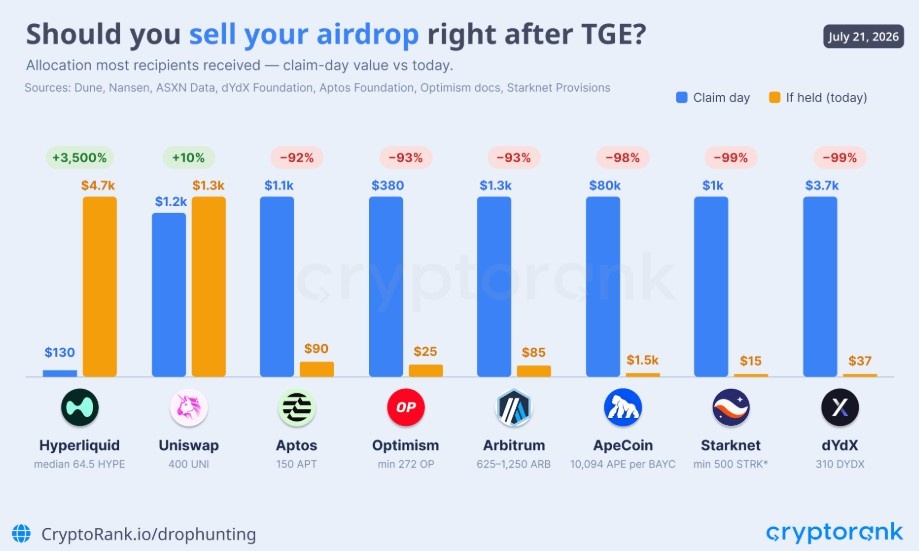
A recent analysis by CryptoRank looked at eight major airdrops. It compared the value of a typical wallet allocation on claim day against the value of holding that same allocation until 22 July 2026. The results show a clear pattern.
HYPE (Hyperliquid): claim-day value near $130 grew to about $4.7K, a gain of roughly 3,500%
UNI (Uniswap): claim-day value near $1.2K moved to about $1.3K, a gain of roughly 10%
APT (Aptos): claim-day value near $1.1K fell to about $90, a drop of roughly 92%
OP (Optimism): claim-day value near $380 fell to about $25, a drop of roughly 93%
ARB (Arbitrum): claim-day value near $1.3K fell to about $85, a drop of roughly 93%
APE (ApeCoin): claim-day value near $80K fell to about $1.5K, a drop of roughly 98%
STRK (Starknet): claim-day value near $1K fell to about $15, a drop of roughly 98%
DYDX (dYdX): claim-day value near $3.7K fell to about $37, a drop of roughly 99%
Source: CryptoRank.io X Post
According to CryptoRank's analysis of eight major airdrops, which compared claim-day value against the value of holding until 22 July 2026.
In CryptoRank's sample, Hyperliquid was the only project where long-term holding significantly outperformed selling on claim day, while most other airdrops lost a substantial share of their initial value.
This does not mean holding is always wrong or selling is always right. It shows that outcomes vary a lot between projects, so a single rule does not fit every airdrop.
Sell vs Hold: Quick Comparison
Factor | Selling Soon After Listing | Holding Long-Term |
Liquidity | Usually higher right after listing on major exchanges | Can drop if hype fades and volume slows |
Price Risk | Locks in value at a known price | Exposed to unlock-driven price drops |
Upside Potential | Limited to claim-day price levels | Higher if the project grows usage over time |
Best Suited For | Tokens with weak utility or heavy upcoming unlocks | Tokens with real usage, staking, or governance value |
Historical Outcome | Avoids the average drop seen across most airdrops | Paid off only for a few projects, like Hyperliquid, per CryptoRank data |
Effort Required | Lower one decision, done | Higher requires ongoing tracking of unlocks and sentiment |
Note: Past performance does not guarantee future results. The examples above illustrate how different airdrops have performed historically and should not be interpreted as predictions for future token prices.
Signs It Might Be the Best Time to Sell Airdrop Tokens
A few signals point toward selling soon after listing rather than waiting.
Strong liquidity right after listing. Once a token lands on major exchanges with deep order books, selling gets easier and prices stop swinging as wildly.
A sharp price spike at or after TGE. These pumps rarely last. Early sellers usually exit fast, and the price cools off soon after.
A large unlock or vesting cliff coming up. More supply hitting the market almost always adds downward pressure on price.
Weak long-term utility. A token with no real use case beyond trading is riskier to hold, since demand has less to stand on.
Hype already fading. When social buzz and trading volume start dropping, it is usually a sign that demand is cooling too.
Signs You Might Want to Hold Instead
Sometimes the setup looks different, and holding makes more sense than selling.
The project shows real usage. Active users, ongoing transactions, or actual revenue give a token a stronger case for holding.
There is utility beyond speculation. Staking, governance rights, or fee-sharing give holders reasons to stay beyond just price movement.
Circulating supply is still low. Some tokens are early in price discovery, which leaves more room for growth later on.
You have researched the roadmap. Long-term conviction only holds up when it comes from actual research, not from hope.
FDV vs Circulating Market Cap
Fully diluted valuation, or FDV, shows what a token would be worth if every token that will ever exist were already in circulation.
Circulating market cap only counts tokens currently available to trade. A large gap between the two often signals heavy future unlocks, which can pressure the price once those tokens enter the market.
Any user can check FDV or circulating market cap via CoinMarketCap, Coingecko, and other tracking websites.
Common Airdrop Selling Strategies
Rather than treating it as all-or-nothing, most experienced holders take a mixed approach.
Selling in tranches is one option. Selling a portion at a time avoids the risk of dumping everything at the worst possible price.
Limit orders help too. Setting a target price in advance means you can sell automatically, without staring at charts all day.
Another common approach is selling part of the allocation and holding the rest. This locks in some profit right away while keeping upside if the project does well later.
Whatever the approach, avoiding emotional decisions matters most. A sudden run of green or red candles can trigger impulsive moves that a pre-set plan would have prevented.
Key Factors to Check Before You Sell
A few practical checks can improve your decision.
Liquidity depth is the first thing worth looking at. It shows how easily you can sell without moving the price, and low liquidity often leads to slippage, where your actual sale price ends up worse than expected.
Tokenomics and unlock schedules matter just as much. They show how much new supply is headed for the market, and a big unlock right after your planned sale window can be a warning sign worth watching.
Market sentiment plays a role too. Selling during strong demand usually fetches a better price than selling during a downturn, so timing around broader market mood is worth a glance.
Do not overlook fees either. Trading fees, gas costs, and withdrawal charges may look small individually, but they add up and quietly eat into your final profit.
Tax rules deserve attention as well. Selling airdropped tokens counts as a taxable event in many countries, so it helps to keep records of both the claim-day value and the eventual sale price.
Note: The strategies discussed are educational examples and should not be considered investment recommendations. Choose an approach that matches your financial goals and risk tolerance.
Checklist Before Selling Airdrop Tokens
Check the token's liquidity depth on major exchanges before placing a large sell order.
Look up the next unlock or vesting date to see if new supply is about to enter the market.
Check current market sentiment and trading volume for the token.
Calculate total fees, including trading fees, gas costs, and withdrawal charges.
Confirm the tax treatment of airdropped tokens in your country and keep a record of claim-day value.
Mistakes to Avoid When Timing an Airdrop Sale
Even experienced users make these errors.
Selling immediately without checking data. Some tokens continue rising after listing, so an instant sale can mean missed gains.
Ignoring fees. Small fees add up, especially when selling in multiple parts.
Using the wrong network for a transfer. This is one of the most common ways users lose funds by mistake.
Trusting unverified platforms. Fake exchanges and phishing sites often target new airdrop recipients.
Holding out of hope rather than research. As the CryptoRank data shows, most of the tokens studied lost significant value over time, so blind holding is not automatically the safer path.
Tools to Track Airdrop Token Performance
A few tools make it easier to judge timing.
Price tracking platforms show live price movement and historical charts.
Portfolio managers track your full holdings and unrealized profit or loss in one place.
Unlock calendars showing upcoming vesting events that could affect supply.
Exchange dashboards display live liquidity and trading volume for a token.
Using these tools together gives a fuller picture than checking price alone.
Why Most Airdrops Dump After Listing
Airdrop recipients usually receive their tokens for free, so many sell as soon as trading opens rather than wait. This creates heavy selling pressure right at TGE, often before real demand has had time to build.
Combined with vesting unlocks that add more supply over time, this is why claim-day prices for many airdrops tend to fall rather than hold steady.
Expert Opinion
The gap between claim day value and later value across recent airdrops points to a specific pattern rather than random luck.
Tokens with active unlock schedules and limited real-world usage tend to face steady selling pressure long after TGE, which explains why most of the projects in the CryptoRank sample lost value over time.
Hyperliquid's result stands out because it combined strong usage with lighter early unlock pressure, not because holding alone was the winning strategy.
This suggests the more useful question is not simply "sell or hold," but "do these specific tokens have usage and supply conditions that support holding?"
Applying that filter before deciding, rather than defaulting to a fixed rule, is likely to produce better outcomes across different airdrops.
Final Thoughts
There is no single best time to sell airdrop tokens that works for every project. The right choice depends on liquidity, unlock schedules, project fundamentals, and how much risk you are willing to take.
Data from real airdrops shows that holding does not always pay off, and neither does selling immediately. A measured approach, selling in parts, using limit orders, and checking the data before deciding, tends to produce better outcomes than an emotional, all-or-nothing decision.
For a full walkthrough of the selling process itself, see selling airdropped tokens step by step. You can also explore the latest crypto airdrops to track new opportunities.
Glossary
TGE (Token Generation Event): The day a token first becomes tradable.
Vesting: A schedule that releases tokens gradually instead of all at once.
Liquidity: How easily a token can be bought or sold without moving its price.
Slippage: The difference between the expected sale price and the actual price received.
FDV (Fully Diluted Valuation): A token's value if its entire max supply were in circulation today.
Disclaimer: This content is for informational purposes only and does not constitute financial advice. Cryptocurrency involves risk, and users should conduct their own research before making any investment or trading decision