Top AI Coins: Leading Projects Transforming Crypto Innovation

Top AI Coins: High Potential Projects For Future Growth
Every crypto cycle has its theme, and this one belongs to artificial intelligence. Wallets, exchanges, and social feeds are flooded with new AI cryptocurrency launches, but most lists just repeat the same three or four household names. This piece looks at a mixed basket of top AI coins, some established, some smaller and faster-moving, using real-time price and market data to show how differently this niche can behave from day to day.
What Are AI Coins?
AI coins are tied to projects that use artificial intelligence somewhere in their core product, rather than tokens that simply borrow the "AI" label for marketing. Broadly, they fall into a few groups: AI agent infrastructure, decentralized memory or data layers for AI systems, AI-powered information and analytics platforms, and AI-assisted content or game creation tools. Recognising which group a token belongs to matters more than its ticker symbol when judging whether it's genuinely building something.
AI Coins vs Traditional Cryptocurrencies
AI coins vs traditional cryptocurrencies is a comparison worth pausing on. Traditional coins like Bitcoin are largely valued as stores of value or payment networks. AI tokens, on the other hand, derive value from usage: how many agents are deployed, how much data moves through a network, or how much attention and content a platform processes. That makes AI tokens more tied to product adoption, and in turn more sensitive to shifts in adoption numbers or sentiment around the AI narrative.
How We Selected These AI Coins
This list evaluates AI crypto projects using four practical filters rather than picking names at random: market capitalization (ranging from under $100 million to over $2 billion, to show both established and early-stage tokens), 24-hour liquidity relative to market cap, coverage across different AI crypto sub-sectors so the list isn't repeating similar projects, and publicly available product or partnership updates that can be checked on the project's own website or listing pages. Price and volume figures below are sourced from CoinGecko at the time of writing; figures shift quickly, so always check a live source before acting on them.
Snapshot: Five AI Tokens Worth Watching
Coin | Price | 24h Change | Market Cap | 24h Volume | Circulating / Max Supply |
NEAR Protocol | $1.85 | +3.3% | $2.411B | $99.475M | 1.302B / Uncapped |
Talus (US) | $0.04685 | +2.5% | $468.494M | $4.404M | 10B / 10B |
Unibase (UB) | $0.1455 | +14.1% | $363.856M | $15.383M | 2.5B / 10B |
Akedo (AKE) | $0.003604 | +12.5% | $82.16M | $14.691M | 22.796B / 100B |
KAITO | $1.16 | +12.6% | $279.791M | $82.091M | 241.389M / 1B |
1. NEAR Protocol: The Established Layer-1 Betting Big on AI
NEAR Protocol is a long-running layer-1 blockchain known for its sharded architecture, built to handle high transaction throughput without sacrificing decentralization. In recent cycles, the NEAR ecosystem has leaned into an "AI-first" narrative, positioning its infrastructure for user-owned AI agents and data.
The NEAR token is used for network transaction fees, staking, and on-chain governance across the ecosystem.
At $1.85, NEAR is up 3.3% in the past 24 hours, with a market cap north of $2.4 billion and daily trading volume near $99.5 million. Its circulating supply of roughly 1.302 billion tokens has no fixed maximum cap, according to its public tokenomics.
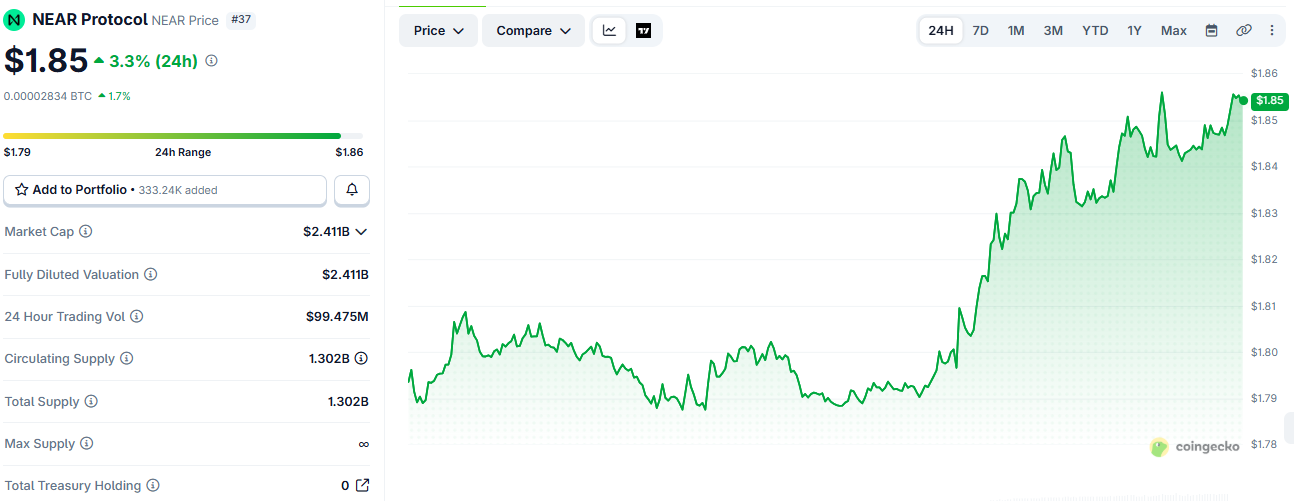
Source: CoinGecko data
Risk to watch: As an older project, NEAR's price already reflects years of prior hype cycles, so fresh upside likely depends on whether its AI pivot translates into measurable developer adoption rather than messaging alone.
2. Talus: Betting on Autonomous AI Agents
Talus Network is a newer layer-1 project built with Move-based technology, designed to let developers deploy autonomous, on-chain AI agents that can manage assets and execute workflows without a central operator. According to the project's public announcements, it has received investment from funds including Polychain Capital, alongside partnerships tied to the Sui and Walrus ecosystems. Its $US token is used for agent execution fees and staking-based participation.
Trading at $0.04685, Talus is up 2.5% over the past day, with a market cap of roughly $468.5 million against a fixed total and max supply of 10 billion tokens, but comparatively thin daily volume of about $4.4 million.
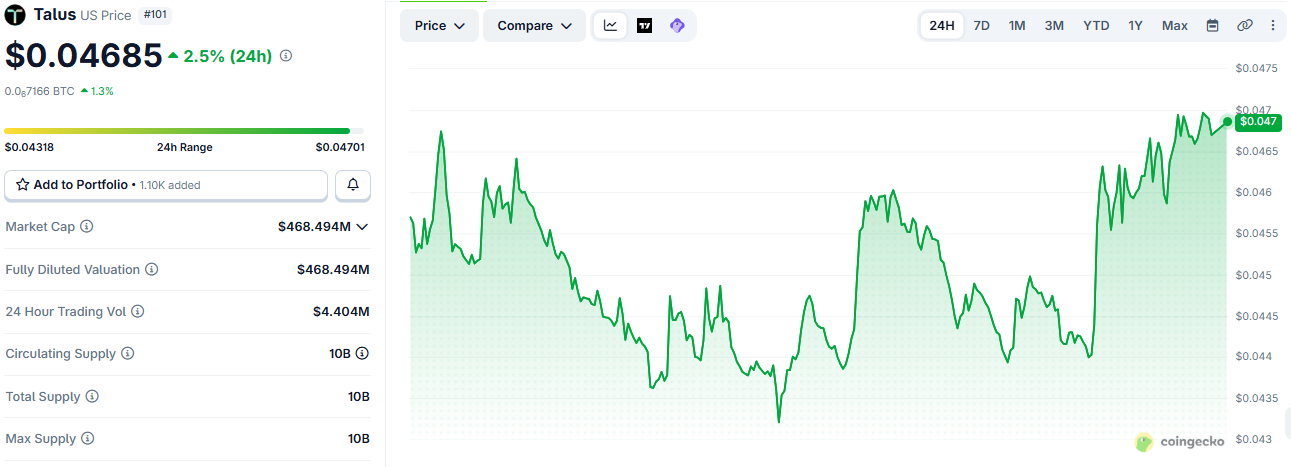
Source: CoinGecko official
Risk to watch: Lower trading volume relative to market cap can mean sharper price swings on smaller trades, and the project's long-term value still depends on attracting real developers to build and sustain agents on the network.
3. Unibase: The Memory Layer for AI Agents
Unibase positions itself as a decentralized "memory layer" that gives AI agents long-term, cross-platform memory, something most AI systems currently lack since they reset after every session. Its publicly documented architecture includes a storage module (Membase), an agent communication and identity protocol, and a data availability layer built specifically for AI workloads. The UB token is used to pay protocol fees, support governance through locked staking, and reward network participation.
Unibase is currently priced at $0.1455, up a sharp 14.1% in 24 hours, with a market cap of $363.9 million, healthy volume near $15.4 million, and 2.5 billion of its 10 billion max-supply tokens in circulation.
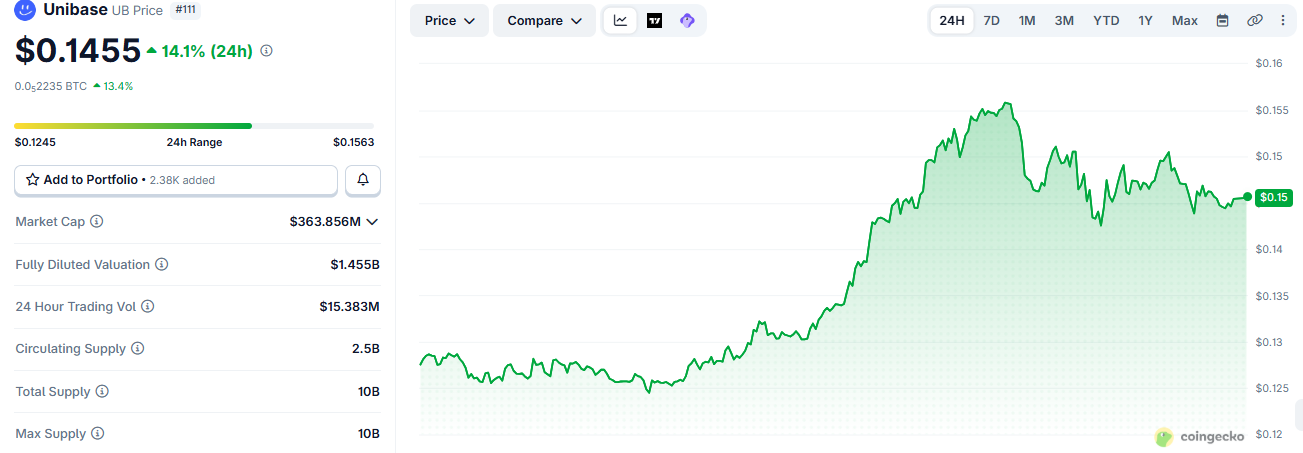
Source: Unibase price chart
Risk to watch: Double-digit daily moves like this often reflect early-stage speculation around new listings or feature launches, so pullbacks after a rally are common for tokens at this stage of adoption.
4. Akedo: AI-Powered Game Creation Meets Web3
Akedo uses multiple specialized AI agents, each handling a different task such as world-building or game balancing, to let creators build simple games from natural language prompts without coding skills. Alongside its game-creation tools, Akedo Games also runs Telegram-based play-to-earn experiences built on TON blockchain infrastructure. The AKE token is used for in-platform creation fees, staking, and liquidity for games launched on the platform.
The token trades at $0.003604, up 12.5% on the day, with a market cap of $82.16 million, 24-hour volume of $14.7 million, and roughly 22.8 billion of its 100 billion total supply currently circulating.
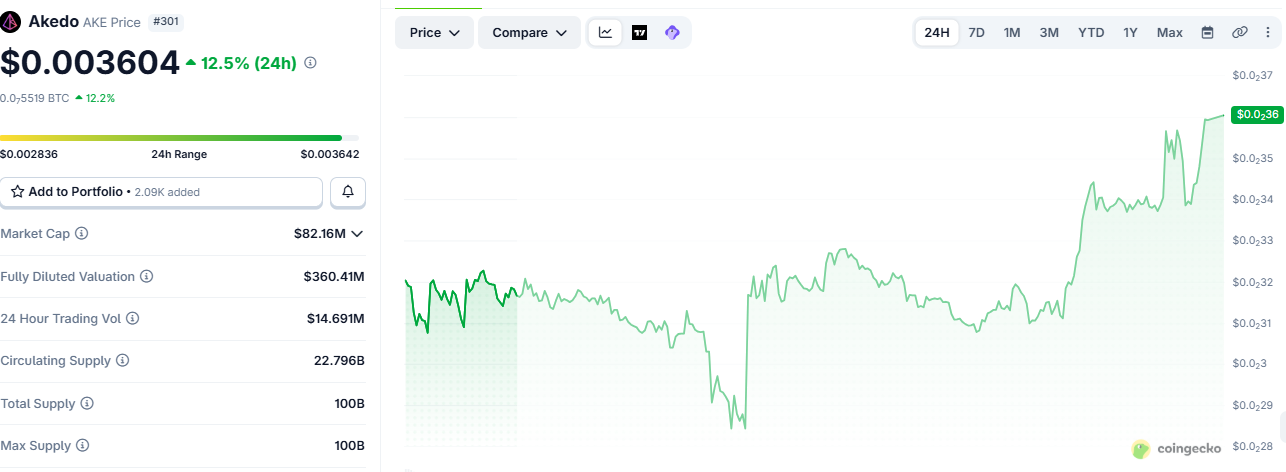
Source: Akedo price chart form CoinGecko
Risk to watch: Akedo operates in the crowded GameFi space, and its low unit price combined with a large total supply means percentage moves can look dramatic while the actual dollar value shift stays modest.
5. KAITO: AI Meets Crypto Information and Attention
KAITO takes a different route from the other tokens on this list: instead of building blockchain infrastructure, its team built an AI-powered search and analytics engine for the crypto industry, indexing social media, research, and news to surface insights for traders and builders. Its "Yaps" system also tokenizes and rewards quality content contributions, a model the project refers to as InfoFi.
KAITO is priced at $1.16, up 12.6% in the past day, with a market cap of $279.8 million and one of the strongest volume-to-cap ratios on this list at $82.1 million traded in 24 hours, against a max supply of 1 billion tokens.
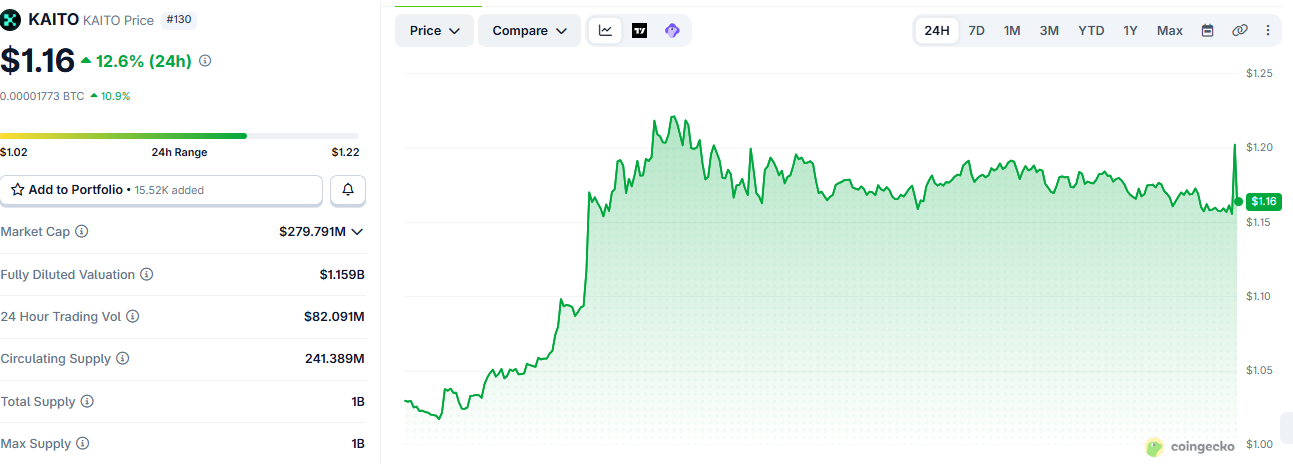
Source: CoinGecko price chart
Risk to watch: Because KAITO's value is closely tied to attention and engagement metrics, its price can be more sentiment-driven than tokens backed by infrastructure that has clearer, harder usage numbers.
How to Evaluate AI Crypto Projects
Before adding any AI token to a watchlist, it helps to check a few things beyond price charts: what specific problem the project solves, whether its token has real utility inside the product or is mostly used for speculation, how much of the total supply is already circulating versus locked for future unlocks, and whether daily trading volume is healthy enough to enter or exit a position without major slippage. Projects with public documentation, active development activity, and disclosed funding sources are generally easier to research and verify than anonymous or unverified launches.
AI Coin Risks
AI tokens carry all the usual crypto risks, plus a few specific to this category. Valuations can run ahead of actual product usage during narrative-driven rallies, since the "AI" label alone tends to attract speculative capital. Smaller-cap tokens, like Akedo or Talus in this list, often have thinner liquidity, which can amplify both gains and losses. Regulatory treatment of AI-related tokens is also still developing in many jurisdictions, adding a layer of uncertainty on top of normal market volatility.
Which AI Coin Will Grow Next?
This is the question every trader in this space eventually asks, and honestly, nobody can answer it with certainty. What can be said is that projects addressing a real technical gap, such as Unibase's memory layer or Talus's agent infrastructure, may have stronger fundamentals if adoption and development continue at their current pace, compared with tokens riding on narrative alone. Watching daily volume alongside price, rather than price in isolation, is one practical way to gauge genuine interest.
AI Crypto Market Outlook
The broader AI cryptocurrency sector remains an early, fast-moving corner of the market, sitting somewhere between genuine infrastructure buildout and recurring speculative cycles. As more AI agents, memory systems, and information platforms move from testnet to real usage, the gap between projects with active users and those relying purely on branding is likely to become clearer over time. That makes ongoing research, not a one-time list, the more useful habit for anyone following this space.
Best AI Coins for Investment: A Few Practical Pointers
If you are exploring the best AI coins for investment, spreading attention across a mix of established names and smaller, higher-risk tokens is a common approach among experienced traders, rather than concentrating on a single project. Checking a project's actual usage numbers, such as deployed agents or active wallets, tends to say more than a chart alone. Among the best artificial intelligence crypto projects, those tied to a concrete infrastructure gap generally carry a different risk profile than those riding pure social momentum.
For anyone specifically looking at AI coins with high growth potential among smaller tokens, remember that a low price and small market cap can just as easily mean a longer road ahead as it can mean an early opportunity.
Conclusion
The top AI crypto coins in 2026 span everything from established layer-1 chains to brand-new agent infrastructure and AI-driven information platforms, and their price action this week shows just how differently they can move. There is no single "best" pick here, only different risk levels tied to different stages of development, and ongoing research matters more than any single snapshot.
Disclaimer
This article is for informational purposes only and does not constitute financial or investment advice. Cryptocurrency markets are highly volatile and speculative; always do your own research before investing.