VERY Network Tokenomics Distribution: How the 10B Supply Splits

Very Network Tokenomics Explained: VERY Supply and Splits
Before putting time or money into any crypto project, understanding network tokenomics and how its token supply is actually divided tells you more than almost anything else. Very Network has published a clear breakdown of this for VERY, its native token, and it's worth walking through in detail rather than skimming past it.
What Is Very Network and Why It Exists in Crypto
Very Network is a blockchain project built around VERY, with VeryChat, a Web3 messaging app, serving as its main product where everyday activity earns users the token.
The underlying chain, Verychain, is fully EVM-compatible, using Solidity and running on the EVM, so developers familiar with Ethereum can build on it directly. Worth noting too: moving mined VERY into a usable wallet requires completing KYC first, run in periodic rounds tied to wallet migration.
Most crypto tokens struggle with a basic problem, getting real people to actually use them rather than just trade them. Very Network's answer is building the token directly into a product people already open daily. Every layer of VeryChat, sending messages, growing channels, and staying active, feeds back into VERY demand, rather than relying purely on speculative buying to hold value.
What Is Tokenomics and Why Does It Matter?
Tokenomics is the economic design behind a coin. It covers three things: how many tokens will ever exist, how they get split among different groups, and the rules for when those tokens unlock. A project can have strong tech behind it, but weak tokenomics can still hurt it. If insiders or early holders get to sell large amounts too soon, the price can crash for everyone else.
Token Economy and Network Incentives
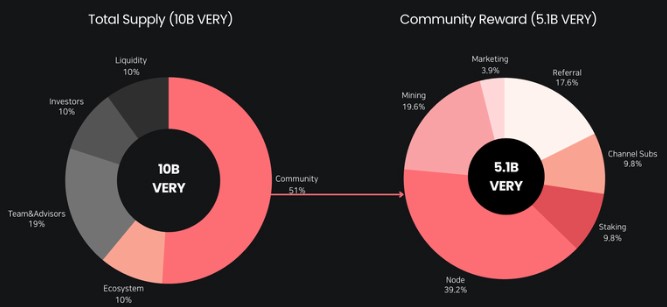
According to Very Network, it has a fixed total supply of 10 billion tokens. Here's exactly how that supply is divided:
Token overviewAllocation | Share | Purpose |
Community Rewards | 50% | Chat rewards, invitations, mining, and general user incentives |
Node Validation Rewards | 20% | Distributed to 8,000 nodes securing Layer 1, plus a share of future ad revenue |
Investor and Funding Allocation | 20% | Includes a KOL round, vested over pre-listing and post-listing stages |
Team and Founding Members | Remaining share | Vested over four years following the first exchange listing |
Allocation | Share | Amount | Purpose |
Layer Node Rewards | 20% | 2 billion | Paid to validators securing Very Mainnet through proof of node |
Verychat Referral Rewards | 9% | 900 million | Grows VeryChat's user base and wider ecosystem |
Verychat Fruit Rewards | 10% | 1 billion | Boosts retention through VeryChat's in-app mining feature |
Channel Subscription Rewards | 5% | 500 million | Activates and grows channels within VeryChat |
Staking Rewards | 5% | 500 million | Supports liquidity providers like VerySwap |
Marketing Rewards | 2% | 200 million | Funds promotion for the Network and VeryChat |
Finance and Ecosystem | 10% | 1 billion | Supports dApps built on Very Network, partly recycled from advertiser spend |
Investors | 10% | 1 billion | Reserved for VC and strategic investor partnerships |
Liquidity Provision | 10% | 1 billion | Manages exchange spreads without inflating real liquidity |
Team and Advisory | 19% | 1.9 billion | Retains team members and advisors long-term. |
Community (51% - 5.1 billion VERY)
This is the largest bucket by far, and it's split further across six specific reward types:
Layer Node Rewards (2 billion VERY) go to validators participating in proof of node on Very Mainnet, the layer 1 chain. This is the biggest single reward type in the entire community bucket, tying network security directly to token ownership.
VeryChat Referral Rewards (900 million VERY) exist to grow the user base. Every new person invited into VeryChat draws from this pool.
Verychat Fruit Rewards (1 billion VERY) funds the in-app mining mechanic that keeps people opening the app regularly, aimed at retention rather than just new sign-ups.
Channel Subscription Rewards (500 million VERY) activate channels within VeryChat, essentially paying to keep content creators and community spaces active.
Staking Rewards (500 million VERY) go to liquidity providers, VerySwap being the named example, supporting trading infrastructure around VERY itself.
Marketing Rewards (200 million VERY), the smallest of the six, cover direct promotion of Very Network and VeryChat.
Finance/Ecosystem (10% - 1 billion VERY)
This bucket supports dApps built on Very Network. It works a little differently from the rest, since VERY spent by advertisers inside the platform gets partly redirected back into this fund, making it self-replenishing rather than a one-time payout.
Investors (10% - 1 billion VERY)
Reserved for venture capital and strategic investor partnerships, sitting entirely outside the community-facing side.
Liquidity Provision (10% - 1 billion VERY)
Set aside mainly to manage spreads on centralized exchanges, rather than to directly boost real market liquidity.
Team/Advisory (19% - 1.9 billion VERY)
The single largest allocation of the five main buckets is reserved for hiring and retaining team members and advisors and is larger than any individual reward type inside the Community bucket.
Grouped differently, the community-facing side, node rewards, referrals, fruit rewards, channel rewards, staking, and marketing combined add up to 51% of the total supply, over half the entire token going toward users and ecosystem participants rather than insiders. The remaining 49% splits fairly evenly across ecosystem funding, investors, liquidity, and the team.
One detail worth flagging on the finance and ecosystem allocation specifically is that it isn't a simple one-time distribution. Token spent by advertisers inside the ecosystem gets partly redirected back into this fund, meaning it's designed to be replenished by actual platform activity rather than only drawn down over time.
In simple terms, Layer 1 is the blockchain itself, Very Mainnet in this case, where transactions get finalized and security is enforced directly. Layer 2 sits on top of that, handling transactions faster and cheaper before settling the final records back on Layer 1. Network's version of this is Very Fastnet.
Conclusion
Network's tokenomics stand out for one clear reason: over half the total supply goes directly to the people using the network, mining, referring friends, staking, and running channels rather than sitting with investors or the founding team. Its EVM-compatible chain and revenue-linked reward structure give a more grounded utility case than many mobile-first tokens.
That said, a well-designed distribution table is only half the picture. Actual token value will come down to whether VeryChat keeps growing its user base, whether the KYC and migration process runs smoothly, and whether the advertising revenue loop generates enough real activity to sustain rewards long-term.
Disclaimer
This article is for educational and informational purposes only and should not be considered financial or investment advice. Always do your own research before making any investment decisions.