Zaviron Valuation: What the Listing Target Implies


Zaviron Valuation: What the Listing Target Implies
Crypto presales often promote a listing price without explaining how that number connects to actual value.
This article breaks down Zaviron valuation using official numbers only, so you can see the math instead of just the marketing line.
Understanding Zaviron valuation matters because a listing price alone tells you nothing. What actually matters is fully diluted valuation, circulating market cap, and how token unlocks affect both after launch.
This piece walks through each of these using figures published on Zaviron's own website and whitepaper.
What Is Zaviron
Zaviron describes itself as a digital commerce ecosystem. It combines a marketplace, a payments system called Zaviron Pay, a rewards program, and a mobile wallet, all built around the ZVR token.
According to the project, ZVR is designed to power payments, staking, rewards, and future governance across this ecosystem, factors the project says are intended to support long-term Zaviron token value.
The total supply of ZVR is fixed at 10,000,000,000 tokens. The project states this supply cannot increase, which it says supports predictability for anyone assessing Zaviron valuation over time.
Presale FDV: The Starting Point
Zaviron FDV, or fully diluted valuation (FDV), is simply the token price multiplied by the total supply of ZVR tokens. It assumes every token is in circulation, even ones still locked.
Formula: FDV = Token Price × Total Supply
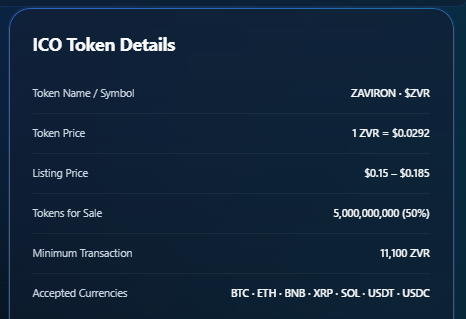
According to the project's official site, the current presale price is $0.0286 per ZVR.
Metric | Value |
Presale price | $0.0292 |
Total supply | 10,000,000,000 ZVR |
Presale FDV | $292,000,000 |
According to the project's official website, the current presale price is $0.0292 per ZVR. Based on the fixed total supply of 10 billion tokens, the implied ZVR fully diluted valuation is approximately $292 million.
Target FDV: What $0.15–$0.185 Implies
Zaviron's official homepage lists a ZVR listing price target range of $0.15 to $0.185.
This is a project target, not a guaranteed listing price. No presale project can promise where a token opens once it hits an exchange order book.
Applying the same FDV formula to this target range:
Scenario | Price | FDV |
Low target | $0.15 | $1,500,000,000 |
High target | $0.185 | $1,850,000,000 |
So the project's stated target implies a ZVR implied valuation of roughly $1.5 billion to $1.85 billion, assuming the token reaches the stated listing target.
Compared to $292 million at the presale stage. That is a theoretical 5.2x to 6.5x jump from presale FDV to target FDV, assuming the token actually reaches that price.
Circulating Market Cap: A More Realistic Number
FDV assumes full circulation, which rarely happens at listing. A more useful metric for investors is the ZVR market cap, which is based only on tokens expected to be circulating and tradable at launch.
Formula: Circulating Market Cap = Circulating Supply × Token Price
The project's official website and whitepaper currently show different allocation percentages for the Presale/Public Sale and Liquidity & Exchange Listings categories.
Because these figures differ, the illustrative circulating market cap calculations below vary depending on which official source is used.
The homepage lists Presale/Public Sale at 50% and Liquidity & Exchange Listings at 12%.
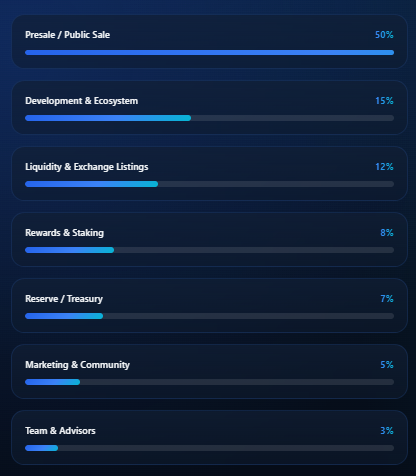
The whitepaper lists Presale & Public Sale at 25% and Liquidity & Exchange Listings at 20%. These two official documents do not match, and this inconsistency should factor into any Zaviron valuation you calculate yourself.
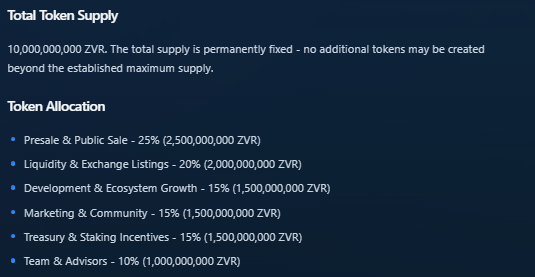
The project's website and whitepaper currently show different allocation percentages for the presale/public sale and liquidity categories.
Using both versions, here is the circulating market cap range at listing, assuming only presale and liquidity tokens are unlocked at launch:
Source | Circulating Supply (Presale + Liquidity) | At $0.15 | At $0.185 |
Website figures (50% + 12% = 62%) | 6,200,000,000 ZVR | $930,000,000 | $1,147,000,000 |
Whitepaper figures (25% + 20% = 45%) | 4,500,000,000 ZVR | $675,000,000 | $832,500,000 |
Depending on which official document you use, the Zaviron circulating market cap at listing could range from roughly $675 million to $1.15 billion.
This is widespread, and it exists purely because of the mismatch between Zaviron's two official sources.
Liquidity Needs at Listing
A listing price only holds up if there is enough liquidity behind it. Thin liquidity pools next to a large stated market cap tend to produce sharp price swings in either direction, since even moderate buy or sell orders can move the price significantly.
Liquidity and exchange listings account for either 12% (website) or 20% (whitepaper) of total supply, according to official Zaviron sources.
Neither document specifies exact liquidity pool size in dollar terms or which exchanges will list ZVR. Until this is confirmed, any Zaviron valuation model should treat post-listing price stability as uncertain rather than assumed.
Unlock Sensitivity: Why Vesting Matters
Circulating supply does not stay fixed. As more tokens unlock, circulating market cap rises even if the price does not move, which puts natural downward pressure on price if demand does not grow at the same pace.
According to the whitepaper, Team & Advisors tokens (10% of supply) follow a 12-month cliff with 48-month linear vesting. Development, treasury, and marketing allocations release on multi-year, milestone-based schedules, though exact dates are not specified.
This means:
Circulating supply is likely to increase steadily for at least four years after the team's cliff period ends.
Each unlock event adds new sell-side supply to the market.
A stable or rising ZVR price depends on demand growing faster than these scheduled unlocks.
Any long-term Zaviron valuation should account for this dilution effect because the ZVR token unlock impact may influence circulating supply and long-term market performance.
Risk Notes
A few points are worth flagging before treating any of these numbers as reliable:
Tokenomics mismatch: Zaviron's website and whitepaper report different allocation percentages for both presale/public sale and liquidity & exchange listings. This directly changes any circulating market cap calculation.
No confirmed exchange listings: Exchange logos shown on the official site do not, by themselves, confirm a listing agreement. No specific exchange has been named in the whitepaper.
Anonymous team: The whitepaper states that founder and executive information "will be maintained through official ecosystem communication channels," meaning no individual team members are named as of this writing.
Target, not guarantee: The $0.15–$0.185 range is described by the project as a listing target. It is not a confirmed or guaranteed opening price on any exchange.
Final Thoughts
Zaviron valuation, based purely on the project's own published numbers, shows an FDV jump from about $286 million at presale to a targeted $1.5–$1.85 billion at listing.
Circulating market cap at listing is harder to pin down precisely, landing somewhere between roughly $675 million and $1.15 billion depending on which official document's allocation figures are used.
Unlock schedules extending several years beyond launch add further uncertainty to how that valuation holds up over time.
Investors should therefore distinguish between the project's target valuation and any estimate of Zaviron ZVR fair value, which depends on actual market conditions after launch.
Disclaimer: This article is for educational and informational purposes only and should not be considered financial or investment advice. Always conduct your own research before making investment decisions.





.jpg)