Zaviron Price Prediction: $ZVR Forecast, Listing & Risk Scenarios


There is a presale token trying to convince buyers its listing price is basically locked in. That claim deserves a second look before anyone commits capital.
Why This ZVR Presale Is Suddenly Everywhere
Zaviron price prediction searches have picked up as the project's pre-sale clock keeps ticking down and its social accounts keep reposting the same message: buy now, price goes up later. It's a pattern that shows up across most active crypto presale listings, not just this one.
That kind of pressure is exactly when a buyer needs a calm, math-first read of what a token is actually worth, not what a countdown timer wants them to believe.
So we built one. What does the presale-to-listing math actually say once you strip out the marketing language and run the numbers yourself?
Zaviron price prediction work has to start with a plain fact: ZVR is not trading on any open market yet, so nobody can point to a live chart and call it a trend. What we can do is take the project's own pre-sale price, its own tokenomics, and its own supply schedule and build honest bear, base, and bull scenarios around them. That is the only responsible way to talk about a pre-listing token.
Anyone quoting you a confident current price for ZVR right now is quoting you a pre-sale rate, not a market price, and the difference matters more than it sounds. We will get into supply math, the presale-to-listing multiple, unlock risk, and a hard invalidation level below, all timestamped and sourced to the project's own Zaviron whitepaper and its live pre-sale site.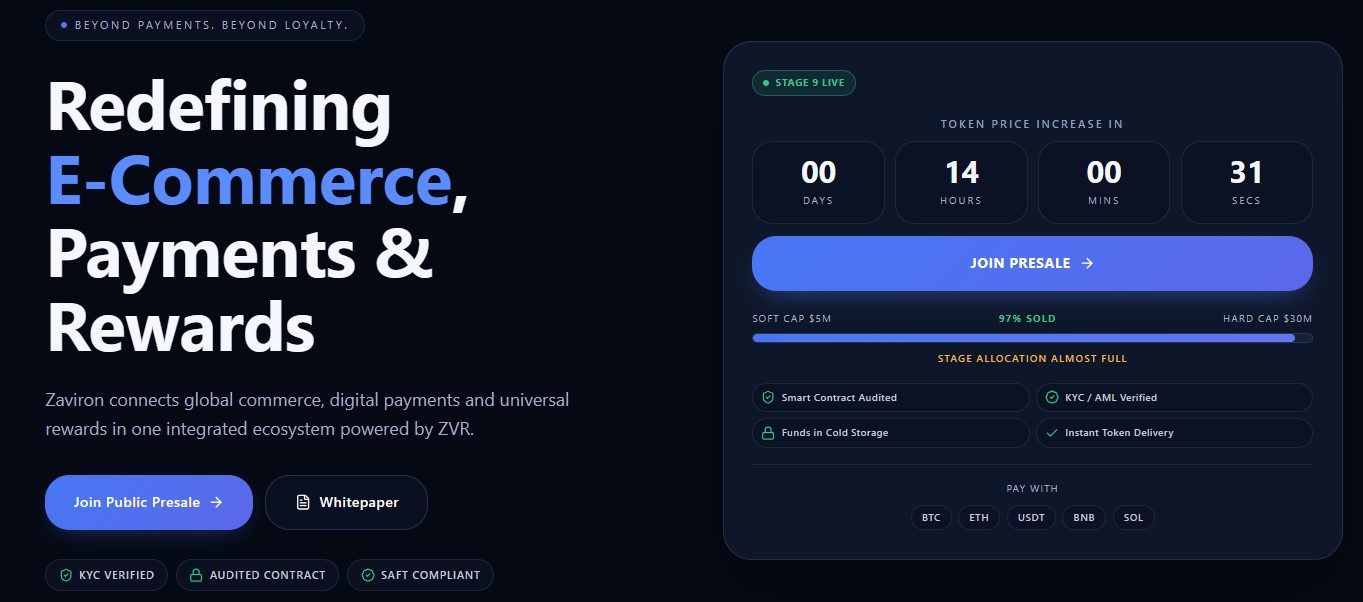
Key Takeaways
-
ZVR has no live trading market as of this writing. Every number below is either the pre-sale rate or a scenario, never a live quote.
-
The pre-sale rate sits at 1 ZVR = $0.0286, with the project's own stated listing range of $0.15 to $0.185.
-
That listing range is the project's target, not an independent forecast, and this article treats it that way throughout.
-
Total supply is fixed at 10,000,000,000 ZVR, so every price scenario below is paired with its Fully Diluted Valuation (FDV).
-
Base case for a realistic post-listing settling price sits well under the project's own listing target once normal presale-to-listing compression is priced in.
-
The project's own tokenomics disclosures conflict between its website chart and its whitepaper text, a red flag worth reading in full before you buy.
Table of Contents
-
Where Zaviron Stands Right Now
-
What Zaviron Actually Is
-
Pre-sale Price to Listing Price: The FDV Math
-
Supply, Allocation and a Data Conflict Worth Flagging
-
Liquidity Ratio: Why "97% Sold" Is Not the Same as "Liquid"
-
Zaviron Price Prediction: Bear, Base and Bull Scenarios
-
Unlock Sensitivity and Vesting
-
Risk Factors
-
Methodology and Data Sources
-
Forecast Table
-
Glossary
Where Zaviron Stands Right Now
As of July 23, 2026, 3:32 PM IST (data captured from the project's own whitepaper PDF and its live presale site; the whitepaper does not itself specify the timezone of its listed timestamp, so this capture time reflects when our team recorded it), Zaviron is in Stage 9 of its presale, listed as 97% sold with roughly 3% of that stage's allocation left. The pre-sale rate is 1 ZVR = $0.0286. The project states a target listing price band of $0.15 to $0.185. As of this writing, no exchange name, official listing announcement, trading pair, listing date, deposit-opening time, initial liquidity amount, or market-maker commitment has been publicly disclosed, so this figure should be read strictly as the project's own stated target, not a confirmed listing price.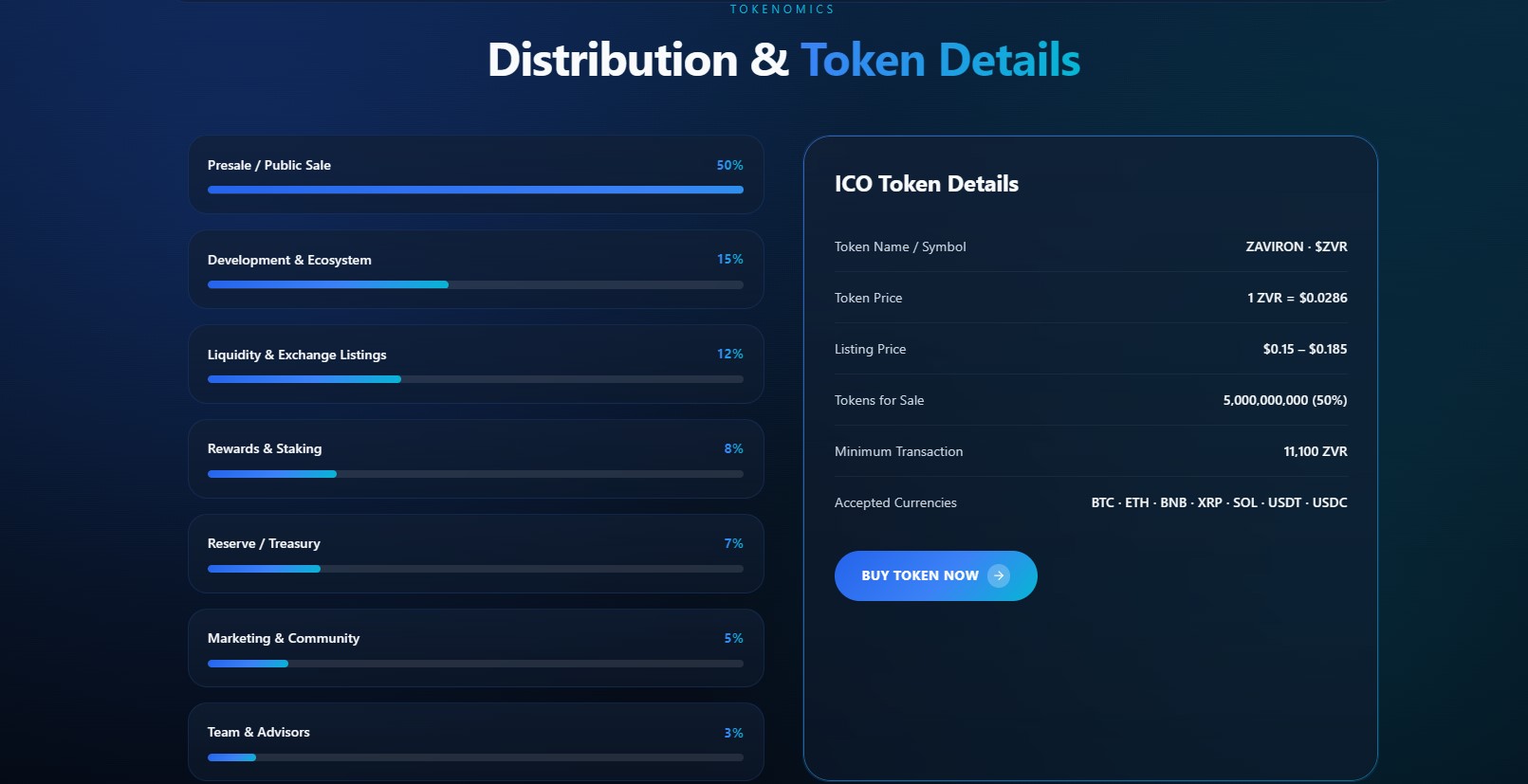
That is a presale snapshot for live-market comparisons. Once a chart actually exists, our broader crypto price prediction coverage is a useful reference point.
Here's the thing: a presale rate and a listing target are promises about the future, not facts about today. Our base case, explained fully in the scenarios section below, is that a realistic post-listing price lands meaningfully below the project's own $0.15 to $0.185 target once normal sell pressure from presale buyers is priced in. The primary invalidation level we're using for the bull case is a sustained close below the presale rate, $0.0286, for more than a few trading sessions after listing. Separately, the bear scenario itself is invalidated if price sustains a close above $0.04 (see the Forecast Table below for the full activation/invalidation breakdown by scenario).
What Zaviron Actually Is
Zaviron describes itself as a commerce ecosystem that bundles a marketplace, a payments rail called Zaviron Pay, a loyalty layer called Zaviron Rewards, a wallet, and a physical Touch and Pay card, all tied together by the ZVR token. We covered the full breakdown of these pieces in our Zaviron ecosystem overview, so this piece sticks strictly to price. The pitch here is that merchants get cheaper settlement and consumers get rewards that do not expire, a claim the project repeats often on its official Zaviron whitepaper page.
None of that is live yet. Per the project's own roadmap, the wallet beta is targeted for Q4 2026 and the marketplace MVP for Q1. Everything you read about utility today is a plan, not a product, and it's worth tracking those dates on a crypto events calendar rather than taking the roadmap on faith.
Pre-sale Price to Listing Price: The FDV Math
FDV, or Fully Diluted Valuation, is what you get when you multiply a token's price by its total supply, including tokens that are not yet unlocked or circulating. It is the cleanest way to sanity-check a price target before a token trades, because a price alone tells you nothing without knowing how many tokens exist.
Zaviron's total supply is fixed at 10,000,000,000 ZVR, per its own whitepaper tokenomics section. Run the math on that:
-
At the pre-sale rate of $0.0286, FDV is roughly $286 million.
-
At the low end of the project-stated listing target, $0.15, FDV is roughly $1.5 billion.
-
At the high end of the project-stated listing target, $0.185, FDV is roughly $1.85 billion.
That means the project is asking presale buyers to accept a listing target that implies a five to six and a half times jump in FDV, from around $286 million to somewhere between $1.5 billion and $1.85 billion, the moment trading opens. We're not saying that cannot happen. But a jump that size, on day one of trading, for a token with zero live products, is not a modest ask. It's a big one.
We pulled the raw presale-to-listing multiple ourselves rather than repeat the project's marketing framing, and the number is stark: 0.15 divided by 0.0286 is about 5.2x, and 0.185 divided by 0.0286 is about 6.5x. Multiples like that do sometimes happen at listing. They also frequently do not hold past the first trading week, a pattern worth comparing against our coverage of another presale launch countdown running through the same playbook right now.
Supply, Allocation and a Data Conflict Worth Flagging
Here's something most coverage of this pre-sale will not tell you: Zaviron's own materials disagree with each other on token allocation.
The live Zaviron site tokenomics chart shows Pre-sale and Public Sale at 50%, Development and Ecosystem at 15%, Liquidity and Exchange Listings at 12%, Rewards and Staking at 8%, Reserve and Treasury at 7%, Marketing and Community at 5%, and Team and Advisors at 3%.
The whitepaper tokenomics page tells a different story: pre-sale and public sale at 25%; liquidity and exchange listings at 20%; development and ecosystem growth at 15%; marketing and community at 15%; treasury and staking incentives at 15%; and team and advisors at 10%. We broke this comparison down further in our separate ZVR tokenomics breakdown.
Those two documents do not match, and both are published by the same project. That is not a rounding error. A pre-sale allocation of 50% versus 25% of total supply changes how much sell pressure hits the market at listing by a wide margin. Until Zaviron clarifies which figure is correct, treat any specific allocation number, including ours below, as directional rather than exact.
Liquidity Ratio: Why "97% Sold" Is Not the Same as "Liquid"
Liquidity ratio is not a single standardized metric; different analysts calculate it different ways. In this piece, we use it loosely to describe how much real trading capital sits behind a token's price versus how large its FDV is — for example, by comparing executable market depth or DEX-pooled liquidity against FDV. A token can have a huge FDV and almost no liquidity, which means even small buy or sell orders swing the price hard.
The project website reports Stage 9 as 97% sold. Without independently verifiable wallet or fundraising records, this should be treated as a project-reported sales metric rather than confirmed demand. Even taken at face value, it does not tell you how many dollars will actually sit in a trading pool the day ZVR lists. The whitepaper allocates either 12% or 20% of supply (again, the two documents disagree) to "Liquidity and Exchange Listings," but that is a token allocation, not a disclosed dollar amount of paired liquidity.
Until Zaviron publishes the actual dollar value locked in a liquidity pool at launch, nobody outside the team can calculate a real liquidity ratio. That is a gap, and it is one every pre-sale buyer should ask about directly before listing day, the same question worth asking about any project inside our altcoin market coverage.
Zaviron Price Prediction: Bear, Base and Bull Scenarios
We're not going to hand you a single number and call it a forecast. Here's a scenario framework instead, the same bull, base, and bear structure we use in our Bitcoin bull, bear, base case coverage, built off comparable presale-to-listing outcomes and the FDV math above, with a probability, timeframe, and invalidation level attached to each one. Note that these probability labels (low, moderate, high) are qualitative judgment calls based on comparable presale-to-listing patterns, not outputs of a statistical model or scoring system, and should be read as directional framing rather than calibrated odds.
Bear scenario, first 30 days post-listing. Price settles between $0.015 and $0.028, implying an FDV of roughly $150 million to $280 million. This happens when early presale buyers, sitting on a large paper gain even at these low levels, sell into the first days of liquidity faster than new demand arrives. Probability: moderate to high, given how thin disclosed liquidity appears to be. Activation: sustained trading below $0.0286. Invalidation of this bear scenario: a sustained close above $0.04.
Base scenario, first 30 to 90 days post-listing. Price settles between $0.04 and $0.08, implying an FDV of roughly $400 million to $800 million. This is what a modest, sticky premium over the pre-sale rate looks like once you account for genuine early adopters holding rather than flipping. Probability: moderate. Invalidation: FDV compresses back toward $286 million (the presale FDV) with no recovery over two full weeks of trading.
Bull scenario, 90 days and beyond. Price approaches or reaches the project's own $0.15 to $0.185 target, implying FDV near $1.5 billion to $1.85 billion. This requires the wallet and marketplace products shipping close to the Q4 2026 and Q1 roadmap dates, real merchant adoption, and no major regulatory setback. Probability: low in the near term, higher only if the roadmap is actually delivered on schedule. Invalidation: any roadmap slip past Q2 without a public update.
A quick reality check on all three: these are scenarios, not predictions of what will happen. Treat them as a range of outcomes worth planning around, not a target to anchor your expectations to.
Unlock Sensitivity and Vesting
The Zaviron whitepaper states the team and advisors' allocation follows a 12-month cliff with 48-month linear vesting after that. Development, treasury, and marketing allocations are released on multi-year, milestone-based schedules, without exact dates disclosed.
What is missing, and this matters a lot for a presale-heavy token, is a published unlock schedule for the presale buyers themselves. If most of that 50% (or 25%, depending on which document you trust) presale allocation unlocks at or shortly after listing, sell pressure could be immediate and heavy. If it's time-locked or staggered, the picture looks very different. Ask the project directly for this schedule before you buy. It is the single biggest unlock-risk variable in this whole presale.
Risk Factors
-
No live market yet. Every number in this piece is a scenario or a presale rate, never a live quote. Treat anyone claiming a current ZVR market price as wrong or misleading.
-
Conflicting tokenomics disclosures. The site and the whitepaper disagree on core allocation percentages. That is a transparency problem, full stop.
-
Undisclosed liquidity depth. A supply-side allocation percentage is not a dollar figure of paired liquidity, and Zaviron has not published one.
-
No unlock schedule for presale buyers. This is the single biggest swing factor for post-listing price action, and it isn't public.
-
Everything is a roadmap, not a product. The wallet, marketplace, card, and payments rail are all pre-launch as of this writing.
-
Regulatory risk. KYC, AML, and jurisdiction-specific rules for token sales can change the access or legality of ZVR in some regions without notice, and rules are shifting fast; see our recent EU MiCA regulation update for one example.
-
Broad market risk. A pre-launch token is not immune to wider sentiment swings; our coverage of the recent crypto market crash shows how quickly risk appetite can flip for altcoins waiting to list.
This is a sensitive topic for anyone putting real money into a pre-launch token, so if you are weighing a purchase here, treat this as informational research rather than a signal to act on, and do your own independent verification of every figure above before committing capital.
Methodology and Data Sources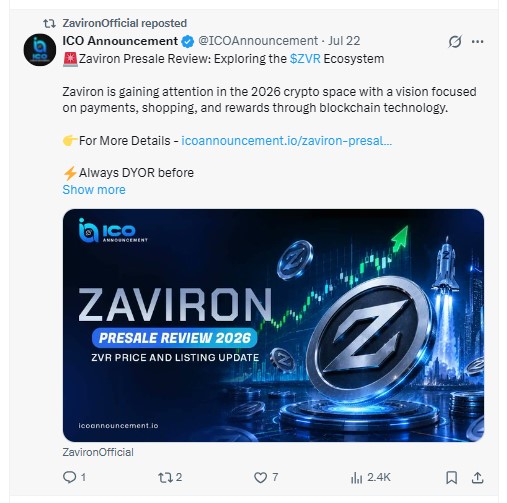
Figures in this piece come from Zaviron's own whitepaper PDF (dated with a July 23, 2026, 3:32 PM page timestamp); the project's live presale site tokenomics chart; and public social posts from the official ZavironOfficial account, including this specific presale update, plus third-party ICO announcement accounts, all captured on July 23, 2026. All price scenarios are original FDV-based calculations built from the project's disclosed presale rate and total supply, not lifted from any third-party forecast tool. This piece will be updated once ZVR has an active trading market, and detailed forecasting will move fully to this page and off the general Zaviron hub after listing.
Forecast Table
| Scenario | Timeframe | Price Range | Implied FDV | Probability | Activation | Invalidation |
|---|---|---|---|---|---|---|
| Bear | First 30 days post-listing | $0.015 to $0.028 | $150M to $280M | Moderate to high | Sustained trading below $0.0286 | Sustained close above $0.04 |
| Base | 30 to 90 days post-listing | $0.04 to $0.08 | $400M to $800M | Moderate | Stabilization between $0.04 and $0.08 | Sustained close below $0.0286 or above $0.08 |
| Bull | 90 days and beyond | $0.15 to $0.185 | $1.5B to $1.85B | Low near term | Sustained trade above $0.15 with adequate liquidity | Fall below $0.08, or a material roadmap slip past Q2 |
Note: “Sustained” throughout this table means a daily close held for at least three consecutive trading sessions, not a single intraday touch.
Glossary
-
FDV (Fully Diluted Valuation): price multiplied by total token supply, including locked or unvested tokens.
-
Liquidity ratio: an informal comparison of real trading capital (e.g., pooled DEX liquidity or order-book depth) to a token's FDV; not a standardized industry metric, and calculations vary by source. Low ratios generally mean bigger price swings on small trades.
-
Unlock or vesting cliff: a delay period before locked tokens start releasing to holders.
-
Invalidation level: the specific price or event that proves a stated scenario wrong.
-
Gini score: a measure of how concentrated token ownership is among wallets; unavailable here since ZVR has no public wallet data yet.
-
Presale rate: the fixed price early buyers pay before a token lists on any exchange.
For readers tracking similar early-stage token distributions, our crypto airdrops tracker is updated separately from presale coverage like this one.
Disclaimer: This article is for informational purposes only and is not financial, investment, legal, or tax advice. Zaviron is a pre-launch presale token with no live trading market as of the data-capture time noted above. All figures are sourced from the project's own public materials and independent FDV calculations, and all scenarios carry uncertainty. Digital asset presales carry a risk of partial or complete loss of capital. Do your own independent research and speak with a licensed financial advisor before making any purchase decision. If you are researching this topic because you are personally considering a financial decision under stress, consider stepping back and speaking with a trusted, independent source before acting.