Aave Asset Listing Framework: What ARFC Actually Proposes?

Aave Asset Listing Framework: What the ARFC Actually Proposes?
Is DeFi's largest lending protocol finally standardizing the way new assets get listed?
Aave Labs just published a new Request for Comment—ARFC—proposing a standardized listing framework for all assets seeking listing, continued listing, or material parameter expansion across V3, V4, and Aave Horizon. The proposal was published on the official governance forum at governance.aave.com on May 29, 2026, and announced via the official @Aave X account simultaneously.
This is a governance-level proposal — not yet a passed vote. But it signals a significant shift in how intends to manage quality and risk as its protocol expands across multiple versions and the new institutional lending product.
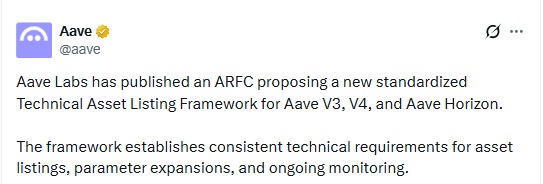
Source: X Account
What the ARFC Actually Proposes
Labs proposes adopting a standardized Technical Asset Listing Framework for seeking listing, continued listing, or material parameter expansion onV3, V4, and Horizon. The objective is to improve the existing asset listing and monitoring process by making the technical requirements consistent across all three protocol versions.
In plain terms, before this proposal, different assets could get listed under different technical standards depending on when and where they were added. The new framework creates a single consistent checklist that every asset must meet — whether it is being listed for the first time, having its collateral parameters expanded, or being reviewed for continued after market conditions change.
The framework addresses three specific scenarios:
New listings—defining the minimum technical bar an asset must clear before it can be added to any market.
Parameter expansions—setting requirements for when an already-listed asset seeks higher supply or borrow caps or changes to its collateral factor.
Ongoing monitoring—establishing what technical checks happen after list to catch emerging risks before they become protocol-level problems.
Aave Asset Listing Framework Covers V3, V4, and Horizon Protocol
The scope of this ARFC is notably broad—covering all three major infrastructure layers simultaneously.
V4 launched on mainnet on March 30, 2026, introducing a modular hub-and-spoke system for greater capital efficiency and support for new asset types. The initial deployment is conservative, with three hub types—Core, Plus, and Prime—and eleven spokes, featuring limited supply and borrow caps to prioritize security. The launch followed nearly two years of development and an extensive year-long security program involving multiple audit firms and a public bug bounty contest, with no critical vulnerabilities found.
Horizon, which enables institutions to borrow stablecoins against tokenized real-world assets like US Treasuries, crossed $580 million in net deposits. Horizon represents push into the institutional and RWA market—making a consistent list framework especially important as new asset classes like tokenized government bonds and corporate credit seek access to Aave's liquidity pools.
The timing of this proposal is not accidental. With V4 live and Horizon scaling rapidly, Aave now runs three parallel protocol environments that all need to handle asset listings. Without a unified standard, risk parameters could diverge across versions—creating inconsistent user protection and potential governance confusion about which technical bar applies where.
AAVE token holders participate in governance discussions and voting on proposals such as the ARFC. The governance token performs systemic risk functions for the protocol through the Safety Module—making the quality of listed assets a direct concern for every holder, not just protocol developers.
The proposal is now in the community feedback phase. Its governance typically moves from an ARFC to a Snapshot vote and then an on-chain vote—a process that can take two to four weeks depending on community engagement and feedback volume.
Why the Asset Listing Framework Matters for DeFi
A standardized listing framework matters for three reasons beyond itself.
First, it reduces the attack surface for bad-faith listings — assets with manipulated oracle prices or thin liquidity that have caused losses across DeFi protocols in the past. A consistent technical checklist makes it harder to push through low-quality assets under governance pressure.
Second, it supports Aave's institutional expansion. Stani Kulechov said in his 2026 roadmap post that "Aave will be home to new markets, new assets, and new integrations that have never existed before in DeFi"—but institutional partners require predictable, auditable processes before committing capital. A published framework gives those partners the documentation they need.
Third, it sets a benchmark that other DeFi protocols will likely follow. It is the largest DeFi lending protocol by TVL. When it formalizes a standard, the rest of the sector tends to adopt similar structures within months.
The ARFC is live on governance.aave.com. Community members can read the full proposal and submit feedback before the Snapshot vote opens.
YMYL Disclaimer: This article is for informational and educational purposes only. The Aave asset listing framework ARFC is a governance proposal—not a passed protocol change. This token and all DeFi protocol interactions carry significant financial risk, including smart contract risk and total loss of funds








