CLARITY Act News: Is Crypto Bill Really Dead Before September 15 Vote?


CLARITY Act News Today: Did Washington Lawmakers Abandon Crypto Bill?
Washington's crypto policy debate took a sharp turn this week after a prominent legal voice declared the effort to write federal digital-asset rules effectively over, just days before the Senate is due to test that claim on the floor.
At a Glance
-
Former federal prosecutor Renato Mariotti says Washington lawmakers and staff told him the crypto market-structure bill is "dead."
-
A make-or-break Senate cloture vote is scheduled for September 15, 2026, requiring 60 votes to proceed.
-
Republicans hold 53 seats, so at least seven Democrats must cross over for the motion to succeed.
-
Many Prediction markets now price 2026 passage at just 13-18%, down sharply from earlier in the year.
Cynthia Lummis said if the crypto bill is not passed this September 15, it will be paused until 2030
-
MidChains CEO Basil Al Askari says the outcome could ripple across global crypto investment and payments.
CLARITY Act Faces Fresh Uncertainty as "Dead" Claims Surface in Washington
Renato Mariotti, a former federal prosecutor, said this week that after meeting with multiple members of Congress and their staff in Washington, the consistent message he received was blunt: the bill is finished, and "Congress is entering a post-CLARITY era."
Mariotti has not pointed to an official vote count or public document to back the claim, and lawmakers have not confirmed it on the record, so it remains an informed observer's read on the mood in the Capitol rather than a confirmed outcome.
The real test arrives on September 15, when the Senate holds a procedural vote on the digital-asset market-structure package.
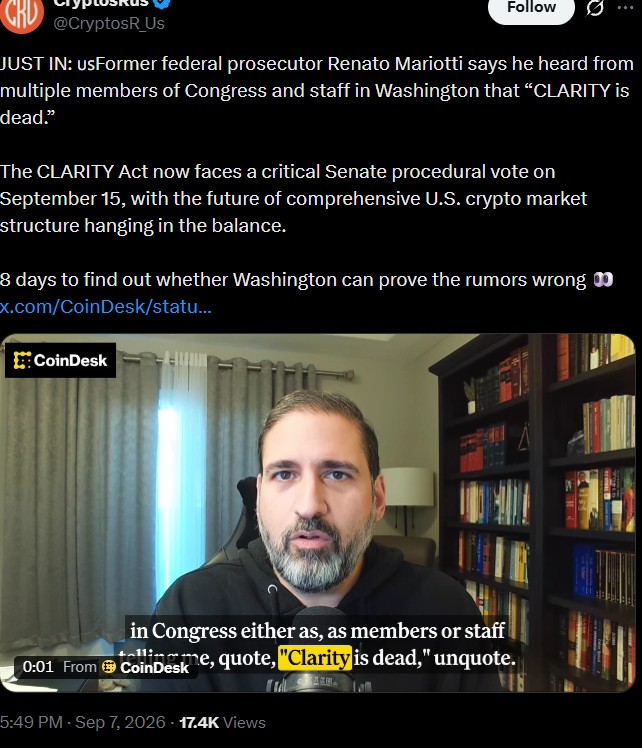
Source: CryptoRus X Post
Why the September 15 Vote Matters?
The Senate vote is a cloture motion on whether to begin debate, not a final passage, but it needs 60 "yes" votes to succeed. Republicans control 53 Senate seats, and leadership says it expects near-unanimous support from its own side, though a couple of senators have raised objections tied to community banking.
That still leaves the count short, meaning at least seven Democrats would need to join, the same bloc that declined to do so before the August recess. Success would open debate; failure would validate the skepticism now circulating in Washington.
What Is the Bill and What Would It Change for Crypto?
The legislation aims to end years of regulatory ambiguity by dividing oversight of digital assets between two agencies: the Securities and Exchange Commission for securities-like tokens and the Commodity Futures Trading Commission for digital commodities.
It also proposes new registration, disclosure, and anti-money-laundering requirements for exchanges and issuers. Supporters call it the most serious attempt yet at a permanent U.S. framework for the sector.
DeFi, Stablecoins and Ethics Rules Remain Key Points of Dispute
Unresolved fights over decentralized finance liability, stablecoin treatment, and lawmaker ethics provisions have made bipartisan agreement difficult. Negotiators reportedly stopped active talks in early August, narrowing the odds of a late compromise before the vote.
MidChains CEO Says the Bill Could Have Global Crypto Impact
Basil Al Askari, chief executive of Abu Dhabi-based exchange MidChains, argues that U.S. crypto regulatory clarity would extend well beyond American borders, shaping investment strategies, tokenization efforts, and payments activity worldwide given the size of the U.S. market.

Source: Midchains Interview
Timeline: From House Passage to the September 15 Vote
-
2025: House passes the market-structure bill
-
2025-2026: Senate committees advance their version
-
September 8, 2026: Mariotti's "dead" claim surfaces
-
September 15, 2026: Critical Senate cloture vote
-
After September 15: Path forward depends on vote outcome
What Happens If It Fails or Moves Forward?
Advancing the motion would let the Senate debate outstanding disputes without guaranteeing final passage. Stalling would leave the current provisional SEC-CFTC split in place without a permanent statutory foundation, and some lawmakers warn the next realistic window may not open for years. September 15 is the near-term answer to whether the "dead" diagnosis holds up.
YMYL Disclaimer: This article is for informational purposes only and does not constitute financial, legal, or investment advice. Legislative outcomes are uncertain, and readers should consult qualified professionals before making decisions based on regulatory developments. Cryptocurrency markets are volatile and carry significant risk. Nothing in this article should be construed as investment advice. Always do your own research before making any financial decisions.
Also read:









