CLARITY Act News: Could Senate Failure Delay Crypto Bill Until 2030?


CLARITY Act News: Why Are $1.5M in Bets Targeting Crypto Bill Failure?
Digital asset policy is back in the spotlight this week as lawmakers race toward a pivotal Senate vote. A long-anticipated market structure bill known as the Digital Asset Market Clarity Act is facing new uncertainty, with a leading Republican senator issuing a stark warning about what a stalled votes could mean for the industry's future. Here's a full breakdown of where things stand.
At a Glance
-
Senator Cynthia Lummis warns that a failed vote this Congress could push crypto market structure legislation back to 2030.
-
The Senate is set to hold a procedural vote on September 15, 2026, needing 60 votes to move forward.
-
Anonymous Polymarket Prediction bettors have reportedly wagered around $1.5 million against passage, with implied odds near 15%, down from roughly 82% in February.
-
Senate Banking Chairman Tim Scott has criticized Democratic negotiators over stalled talks and a bill that has grown well beyond its original length.
-
The legislation would split oversight of digital assets between the SEC and CFTC.
CLARITY Act News: Why Is Cynthia Lummis Warning of a 2030 Delay?
Senator Cynthia Lummis, who chairs the Senate Banking Digital Assets Subcommittee, recently cautioned that if the bill does not pass during the current Congress, lawmakers may not get another meaningful shot at comprehensive market structure legislation until 2030.
She argued that finishing the work now would help the country avoid losing out on years of job creation, investment, and tax revenue tied to a cleaner regulatory environment for digital assets.
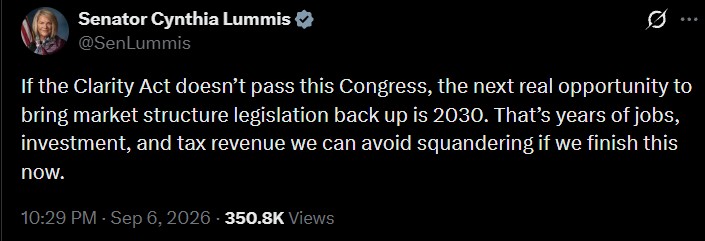
Source: Senator Cynthia X
CLARITY Act Vote: What Is Set to Happen on September 15?
The September 15 Senate vote is a cloture vote, meaning it only determines whether the Senate can begin formal debate on the bill rather than deciding its final fate. Advancing past this stage requires 60 votes.
With Republicans holding just 53 seats, at least seven Democratic senators would need to join in support for the measure to proceed. Passing this hurdle would not make the bill law; it would simply open the door to further debate and eventual passage attempts.
CLARITY Act Passage Chances Fall as Political Disputes Intensify
Prediction markets have shifted noticeably in recent months. Reports indicate that anonymous traders on Polymarket have placed roughly $1.5 million in bets against the bill's passage, with implied odds falling to about 15%, compared with roughly 82% back in February.
Tim Scott has pointed to Democratic negotiators, including those aligned with Senator Elizabeth Warren, as a key obstacle, suggesting that demands have shifted repeatedly during talks. These claims reflect one side's political framing and should be read as such rather than settled fact.
What Is Holding Up the CLARITY Act in the Senate?
According to Scott, the bill has ballooned from under 300 pages to more than 600 pages as negotiations have dragged on. Sticking points reportedly include ethics provisions, stablecoin oversight, and how decentralized finance platforms should be treated under the new framework. These unresolved disagreements are seen as the main barriers to securing the bipartisan support needed before the September 15 vote.

Source: WOLF Bitcoin X
What Does the CLARITY Act Actually Change for Crypto Regulation?
At its core, the bill proposes a clearer jurisdictional split for digital assets. Assets classified as securities would remain under SEC oversight, while digital commodities would fall under CFTC supervision.
| Key Area | CLARITY Act Proposal |
| Digital securities | SEC oversight |
| Digital commodities | |
| Capital raising | Tailored disclosure framework |
| Consumer protection | Additional statutory safeguards |
| AML | Compliance requirements |
| Bankruptcy | Specific treatment for digital assets |
The bill also includes tailored disclosure rules for companies raising capital through digital assets, along with anti-money laundering, bankruptcy, and consumer protection provisions aimed at replacing today's enforcement-driven approach with statutory clarity.
Timeline: From House Passage to the September 15 Senate Vote
-
July 2025: The bill passes the House with bipartisan backing.
-
May 2026: It clears the Senate Banking Committee on a 15-9 vote.
-
September 7, 2026: Lummis warns that failure could delay the next real opportunity until 2030.
-
September 15, 2026: The Senate holds its key procedural vote.
What Could Happen if the Bill Fails?
A failed cloture vote would not necessarily kill the bill outright, but it would likely stall momentum well past the midterm elections. Supporters warn that continued regulatory ambiguity could push crypto businesses, jobs, and investment capital toward jurisdictions with clearer rules. Lummis's 2030 reference reflects her own assessment of when the next serious legislative window might open, not a guaranteed deadline.
What Should Crypto Investors Watch Next?
In the coming days, market participants should watch whether the bill reaches the 60-vote threshold, whether a last-minute compromise emerges on stablecoins and DeFi provisions, and whether any changes are made to address Democratic concerns. Even if the vote succeeds, full passage into law would still require additional legislative steps.
Conclusion
The September 15 vote represents an early but important test for U.S. crypto policy. Whether or not it succeeds, the outcome will shape the pace of regulatory clarity for the digital asset industry in the years ahead.
YMYL Disclaimer: This article is for informational purposes only and does not constitute financial, legal, investment, or regulatory advice. Legislative outcomes, betting-market odds, and political statements referenced here are subject to change and should be independently verified before making any decisions. Cryptocurrency markets are highly volatile and involve significant risk. This content should not be taken as investment advice. Always conduct your own research before making any investment decisions.







