CLARITY Act News: House Exit Could Delay Crypto Bill Before Elections


CLARITY Act News Today: Tom Emmer Urges Senate to Act Before Elections
The push to regulate digital assets in the U.S. is entering its most consequential week in over a year. A procedural Senate vote on September 15 will decide whether the CLARITY Act news moves toward a final floor vote or stalls for the rest of 2026, as the House calendar shrinks and midterm campaigning approaches.
At a Glance
-
A cloture vote on the CLARITY Act is set for Sept 15, 2026, and needs 60 votes to succeed.
-
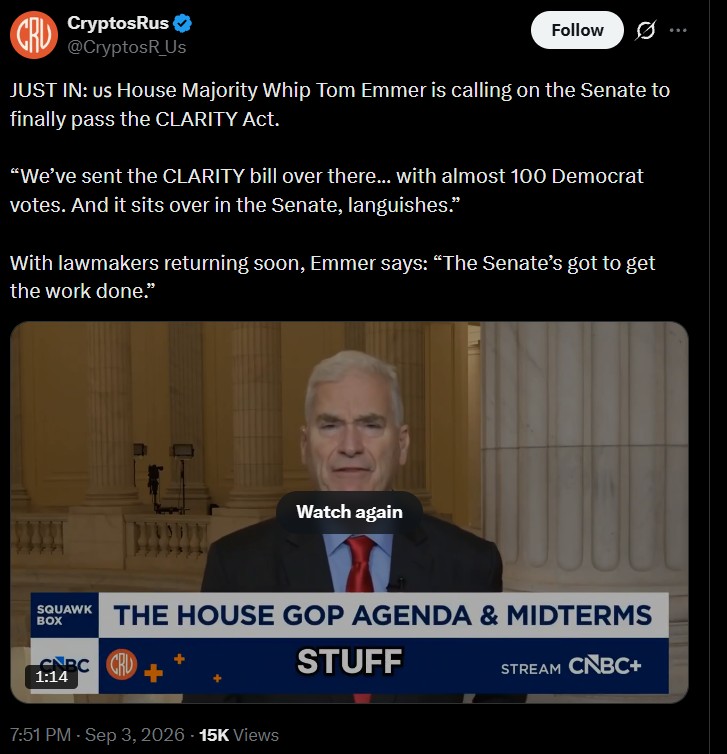
House Representatives Majority Whip Tom Emmer says the House already did its part and is pressing the Senate to act.
-
A shortened calendar: lawmakers may leave Washington around Sept 17 and not return until after the midterms, adds pressure to an already tight timeline.
CLARITY Act Faces a Narrow Window Before the Midterm Elections
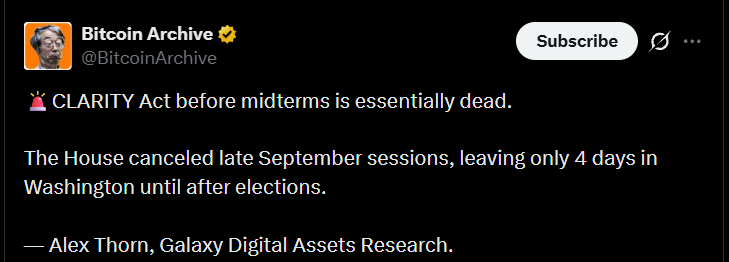
The Republican leadership has reportedly canceled its final planned September working days, trimming the legislative time left before lawmakers turn to campaigning.
Analysts say the House could depart Washington around Sept 17 and not reconvene until after the November elections, compressing an already tight window for final passage.
Source: CryptoRus X Post
What Happened With the CLARITY Act This Week?
House Majority Whip Tom Emmer renewed his public push this week, arguing that responsibility for the legislation now sits squarely with the Senate. Emmer noted the lawmakers passed it with nearly 100 Democratic votes and said the Senate "has got to get the work done."
Financial Services Chair French Hill echoed that message, calling it historic, nonpartisan digital-asset legislation. Separately, Solana Foundation President Lily Liu described the Crypto Bill as one of several active congressional efforts on crypto policy.
September 15 Senate Vote Could Decide the Bill's Next Step
The September 15 Senate vote is a cloture motion — a procedural step to end debate and open formal consideration — not a final passage vote. Senate Majority Leader John Thune filed cloture in early August before the chamber left for recess.
Because Republicans hold 53 seats, at least seven Democrats would need to join them to clear the 60-vote threshold. Coinbase CEO Brian Armstrong has voiced optimism that the bill will clear that bar, while prediction markets have grown more skeptical in recent weeks.
Source: Bitcoin Archive
Why the House Schedule Could Complicate CLARITY Act Passage
Even if they advances the bill on September 15, the chamber's own process could take one and a half to two weeks because of further procedural votes and possible amendments — risking a run past the House's expected September 17 departure.
If the House is gone first, any amended text would have to wait for Republicans' agreement, pushing final passage toward the post-election period.
CLARITY Bill Timeline: From House Passage to September 15
| Date | Development |
| July 17, 2025 | House passes the bill, 294–134 |
| May 14, 2026 | Senate Banking Committee advances its portion, 15–9 |
| July 22, 2026 | Combined Senate text released |
| August 8, 2026 | Thune files cloture ahead of recess |
| September 15, 2026 | Cloture vote target |
| September 17, 2026 | Republicans expected to leave Washington |
| Mid-November 2026 | Republicans potentially returns after elections |
What the CLARITY Act Would Change for Crypto Regulation
The crypto bill 2026 aims to give digital assets a clearer regulatory framework by dividing oversight between the Securities and Exchange Commission and the Commodity Futures Trading Commission, based on how a given token or platform functions. Supporters argue this would reduce the uncertainty crypto firms have faced under years of enforcement-driven regulation.
What Happens If the Senate Passes a Different CLARITY Act?
If Congress approves amended language, the representatives would need to agree to a single final version before it could reach the president. That reconciliation could still happen after the election, since Congress can keep working even while the House is out of session, but it adds another round of negotiation to an already compressed calendar.

Source: Diana
CLARITY Act Outlook: Can Congress Pass the Bill Before the Elections?
Where Things Stand
| Key Point | Current Status |
| House | Bill already passed |
| Senatees | Yet to advance the legislation |
| September 15 | Key procedural test |
| Votes needed | 60 to advance |
| Schedule | Expected to leave September 17 |
| Main risk | Senators' and Representatives timelines may not align |
| Final passage | Could move beyond the election |
Conclusion
Between Emmer's public pressure, a genuinely uncertain vote, and a calendar that may close before it finishes its work, the Act's fate before the midterms remains unresolved. A successful cloture vote keeps it alive; a failed one, paired with the shrinking schedule, would likely push any resolution into 2027.
Disclaimer: Cryptocurrency markets are volatile and involve significant risk. This content is for informational purposes only and should not be considered financial advice. Always conduct your own research before making investment decisions.
Also read:






