Latest CLARITY Act News Today: Will Banks Enter Crypto If Bill Passes?


Latest CLARITY Act News: Brian Armstrong Says Banks Could Enter Crypto
September could turn out to be a defining month for US crypto policy. The Digital Asset Market Clarity Act, better known as the CLARITY Act, faces its first real Senate test after months of delay, and the outcome will shape how digital assets are regulated for years. This CLARITY Act News roundup covers the timeline, the arguments for and against the bill, and related SEC moves that could reshape US market structure.
At a Glance
The Senate holds a cloture vote on the CLARITY Act on September 15, needing 60 votes to advance. Lawmakers and industry figures like Troy Downing and Brian Armstrong say the bill would give digital assets a clear regulatory home, while the SEC separately pushes changes that could make US markets more blockchain-compatible.
CLARITY Act Moves Toward a Key September Decision
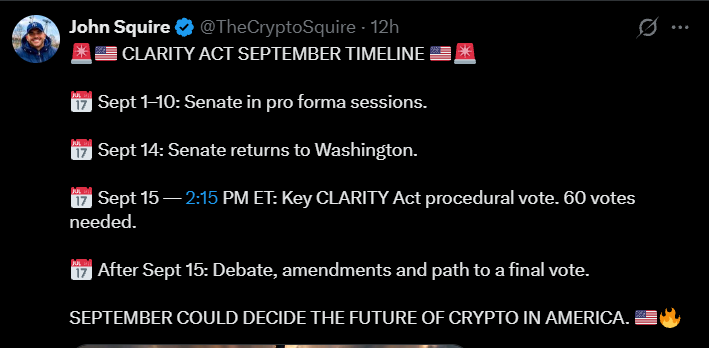
Senate Majority Leader John Thune filed cloture before the August recess, setting up a procedural vote for September 15 at 2:15 PM ET. The Senate returns to Washington on September 14, and lawmakers need 60 votes the next day to move the bill toward formal debate.
Republicans hold 53 seats, so at least seven Democrats would need to cross over. Passing cloture would not make the bill law; it would only end debate on the motion to proceed and open the door to amendments and, eventually, a final vote.
This part of the CLARITY Act News cycle is procedural, but it determines whether the legislation survives at all this year.
Source: The Martini Guy
What Is the CLARITY Act and Why Does Crypto Need It?
At its core, the bill tries to answer a question that has dogged the industry for years: which federal agency regulates a given digital asset. It would draw clearer lines between the SEC and the CFTC, spelling out when a token counts as a security versus a commodity.
Supporters say that without this framework, companies are left guessing which rulebook applies to them, a problem that became especially visible during the SEC's more aggressive enforcement years.
Troy Downing Calls for Clear Digital Asset Rules
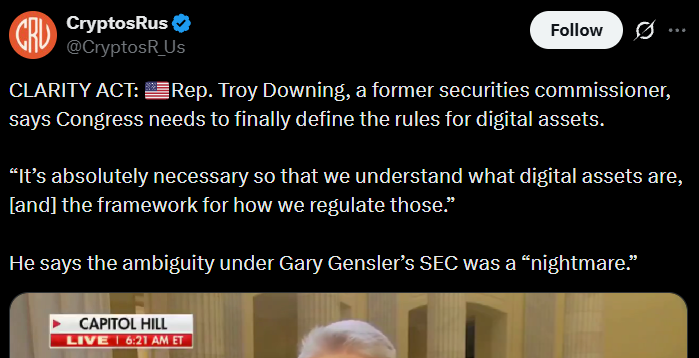
Rep. Troy Downing, a former state securities commissioner, is one of the more vocal advocates for the bill. He argues that Congress needs to settle, once and for all, what digital assets actually are and how they should be overseen.
Downing has described the regulatory uncertainty under former SEC Chair Gary Gensler as difficult for the industry, saying businesses were often left without a workable framework to operate inside.
His comments reflect a broader frustration among crypto firms that enforcement-driven regulation left too much open to interpretation.
Source: X
Brian Armstrong Says CLARITY Act Could Bring Banks Into Crypto
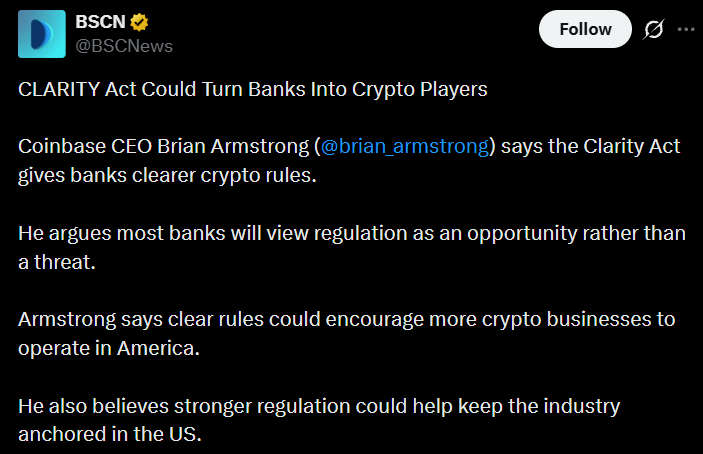
Coinbase CEO Brian Armstrong has argued that clearer rules would give banks a reason to engage with crypto rather than avoid it. He believes most banks will treat regulatory clarity as an opening rather than a threat, and that a defined framework could persuade more crypto market businesses to set up shop in the US instead of moving offshore.
Armstrong has told media outlets he expects passage, though he has acknowledged the outcome still depends on ethics provisions and banking industry concerns. Prediction markets have been more cautious, with some platforms pricing in odds well below a coin flip.
Source: BSCNews X Post
SEC Pushes Toward 24/7 Markets as Blockchain Rules Evolve
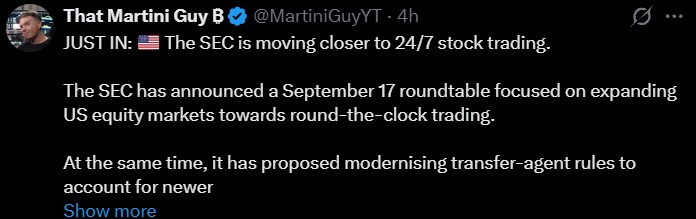
Separately, the SEC has scheduled a September 17 roundtable in Washington on moving US equity markets toward round-the-clock trading. Panelists are expected to include the NYSE, Nasdaq, Citadel Securities, and Robinhood, alongside firms like BlackRock and Charles Schwab.
The agency is also proposing updates to decades-old transfer-agent rules so blockchain-based recordkeeping can count as an official method for tracking securities ownership.
Together, these steps suggest US market infrastructure is being rebuilt in ways that could make it more compatible with blockchain technology.
CLARITY Act September Timeline: Key Dates to Watch
| Date | Development | Why It Matters |
| Sept. 1–10 | Senate in pro forma sessions | Limited legislative activity |
| Sept. 14 | Senate returns to Washington | CLARITY Act process can resume |
| Sept. 15 | Cloture vote at 2:15 PM ET | 60 votes needed to proceed |
| After Sept. 15 | Debate and possible amendments | Bill could move toward a final vote |
| Sept. 17 | SEC roundtable on 24-hour trading | Related market-structure shift for digital assets |
What Could Happen If the Bill Advances
If the bill clears its procedural hurdle and eventually passes, supporters expect clearer jurisdictional lines, more bank willingness to offer crypto services, and a stronger case for firms to base operations in the US instead of overseas. But the final text still matters.
Unresolved disputes over ethics language and banking pushback mean the legislation could look different by the time it reaches a final vote, if it gets there at all.
Source: CryptoRus
What to Watch Next?
The immediate catalyst is the September 15 US Senate vote, which will show whether Democratic support is materializing. From there, any surviving version of the bill would move into debate and amendments, with a narrow legislative calendar before midterm campaigning takes over.
The SEC's September 17 roundtable runs on a separate track but adds to a broader sense that US financial infrastructure is shifting toward digital-asset compatibility. Passing cloture would keep the bill alive for further CLARITY Act News coverage, but it remains a long way from becoming law.
Disclaimer: This article is for informational purposes only and does not constitute financial, legal, or investment advice. Cryptocurrency markets and pending legislation are subject to rapid change. Readers should conduct their own research and consult a licensed professional before making financial decisions.






