CLARITY Act News: What SEC New Crypto Proposal Means For Senate Vote?


CLARITY Act News: SEC Pushes Crypto Rules Ahead of September 15 Vote
Cryptocurrency policy in Washington is moving on two tracks at once, and both are converging around the same date. The Securities and Exchange Commission has put forward what its chairman calls one of the agency's most significant crypto-related proposals to date, while the Senate prepares for a procedural vote on the CLARITY Act, a bill meant to give digital-asset companies a clearer market-structure framework.
Together, this is the heart of CLARITY Act News today: a regulator and a legislature each trying to answer the same question — how does the United States keep crypto innovation onshore rather than watching it drift overseas?
At a Glance
-
The SEC has unveiled a new crypto-asset regulatory proposal aimed at reshoring digital-asset innovation to the United States.
-
Chairman Paul Atkins says the plan is meant to reverse an exodus of crypto builders who moved offshore in recent years.
-
The Senate is scheduled to hold a cloture vote on September 15, 2026, needing 60 votes to advance.
-
The SEC proposal is designed to work alongside the bill, not replace it, and remains open for public comment.
-
September 15 also coincides with the start of the Federal Reserve's FOMC meeting, giving markets two major catalysts in one window.
SEC Unveils New Crypto Regulatory Push
The SEC's new proposal is built to give crypto companies a more defined path to raise capital in the U.S. while remaining inside the boundaries of American securities law.
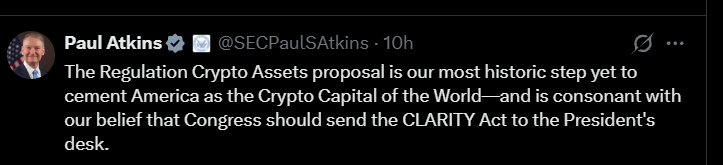
Chairman Paul Atkins discussed the plan on Fox Business, framing it as an attempt to make real on a broader White House goal of positioning the U.S. as the leading hub for digital assets.
The proposal is open for public comment, and the SEC has said it can rely on existing securities law even before any new legislation is finalized.
Paul Atkins' Reshoring Argument
Atkins argues that unclear rules over the past several years pushed crypto entrepreneurs to build and raise funds abroad.
He wants to bring back innovators who developed products and raised money outside the United States, arguing that regulatory clarity at home is what keeps that activity from leaving in the first place.
His broader point is practical: since investors can already move money globally online, keeping that activity under U.S. oversight protects both innovation and investor protections simultaneously.
Source: Paul Atkins
What the SEC's New Crypto Proposal Could Change
| Key Development | What It Means |
| SEC crypto proposal | Creates a clearer regulatory path for digital-asset firms |
| Capital raising | Could make it easier for crypto companies to raise funds in the U.S. |
| Public comments | Industry participants can weigh in before the rule is finalized |
| Existing securities law | SEC can act now, independent of new legislation |
| CLARITY Act | Would add statutory backing to a broader framework |
How the SEC Proposal Connects With the CLARITY Act
The SEC proposal and the crypto bill are separate efforts moving in parallel rather than one replacing the other. Atkins has said he expects and hopes the Senate advances so it can eventually reach President Trump's desk, while the SEC continues building its own rulebook in the meantime. That combination of agency rulemaking plus congressional legislation is designed to give the industry both near-term guidance and longer-term legal certainty.
September 15 Senate Vote: Why 60 Votes Matter
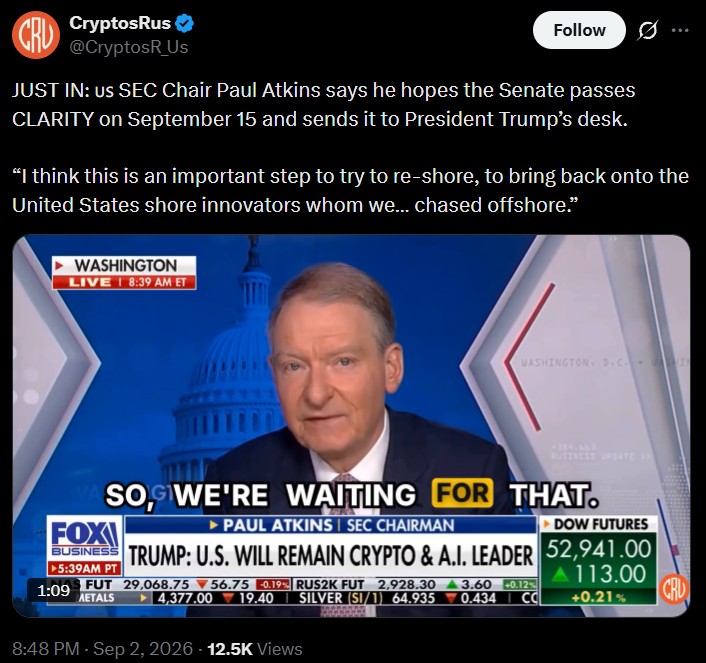
The Senate is scheduled to hold a cloture vote on the CLARITY Act on September 15, a procedural step that determines whether debate can even move forward, not final passage.
Cloture requires 60 votes, meaning bipartisan support is essential. If the vote fails, the bill could stall again, as it has faced delays tied to the Senate's broader legislative calendar.
Source: CryptoRus X Post
CLARITY Act Timeline: From Senate Vote to Potential U.S. Crypto Rules
| Date/Stage | Expected Development |
| September 15, 2026 | Senate cloture vote on the CLARITY Act |
| After Senate vote | Further debate and amendments if cloture succeeds |
| Next legislative stage | Possible movement toward final Senate passage |
| After congressional approval | Bill could move to President Trump for signature |
| In parallel | SEC continues its own proposal and comment period |
Later stages depend entirely on how the Senate vote unfolds and should not be treated as guaranteed outcomes.
What This Could Mean for Crypto Investors
For everyday investors, the practical significance of this CLARITY Act news is regulatory clarity itself. A defined market-structure law paired with an SEC framework could make it easier for exchanges, issuers, and asset managers to operate onshore with confidence, potentially widening the range of compliant products available to U.S. investors. It does not, however, reduce the underlying volatility or risk of digital assets.
What Happens Next
The next major checkpoint is the September 15 Senate vote, which will show whether the CLARITY Act has enough bipartisan momentum to continue moving. Simultaneously, the SEC's public comment period on its own cryptocurrency proposal remains open, meaning the regulatory picture could keep shifting on two fronts before any final rules take shape.
Conclusion
Nothing here is final yet — not the SEC's proposal, and not the crypto market structure bill 2026. But the alignment of a regulatory push and a legislative vote on the same date signals that Washington's approach to crypto is entering a more concrete phase.
Investors and companies watching CLARITY Act news today should treat September 15 as a milestone to watch, not a resolution to count on.
YMYL Disclaimer: This article discusses financial regulation and legislation and is provided for informational purposes only. It does not constitute financial, investment, legal, or tax advice. Regulatory and legislative outcomes described here are subject to change, and readers should consult a licensed financial or legal professional before making investment decisions.






