CLARITY Act News: Senate Faces Crypto Regulation Vote on September 15


CLARITY Act News: Bessent, Lummis Urge Senate to Advance Crypto Bill
The push to regulate digital assets in the United States is heating up again as lawmakers return from recess. Treasury Secretary Scott Bessent has renewed pressure on the Senate to take up crypto market-structure legislation commonly referred to in CLARITY Act news coverage, framing the moment as pivotal for both the industry's future and the government's ability to police it.
With a procedural vote reportedly on the calendar for mid-September, the coming days could shape how digital assets are overseen for years to come.
At a Glance
-
Treasury Secretary Scott Bessent renewed his push on September 9, 2026, asking the Senate to move the digital-asset bill forward.
-
The legislation aims to build a full regulatory framework for digital assets while sharpening tools against illicit finance.
-
A key procedural vote is expected in the Senate on September 15, 2026.
-
Officials tie the bill to national security, citing risks from bad actors exploiting digital-asset technology.
-
Senator Cynthia Lummis and industry groups, including the National Crypto Association, are publicly backing the effort.
Scott Bessent Urges Senate to Move Forward With Crypto Bill
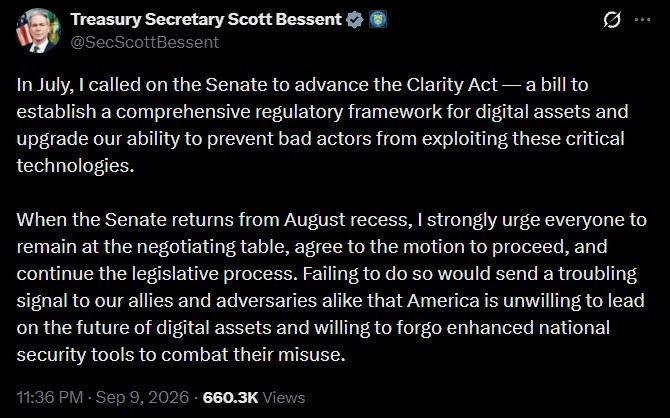
On September 9, 2026, Bessent reiterated a call he first made in July, pressing lawmakers to stay engaged rather than let the legislation stall. He specifically asked senators to agree to a motion to proceed once the chamber reconvened from its August break, describing this procedural step as necessary to keep the bill's momentum alive.
Bessent framed inaction as more than a legislative delay, suggesting it would send an unwelcome message to both partners and rivals abroad about America's willingness to lead on emerging financial technology.
Source: Sec Scott Bessent
What the Legislation Would Change for Digital Assets
At its core, the bill seeks to give digital assets a defined place within U.S. financial regulation. Rather than leaving companies to navigate a patchwork of state rules and unclear federal guidance, the legislation would establish clearer oversight structures intended to give the industry more predictability.
Proponents argue this kind of certainty is essential for keeping digital-asset businesses, talent, and capital anchored in the United States rather than relocating to friendlier jurisdictions overseas.
Why Officials Say the Bill Matters for National Security
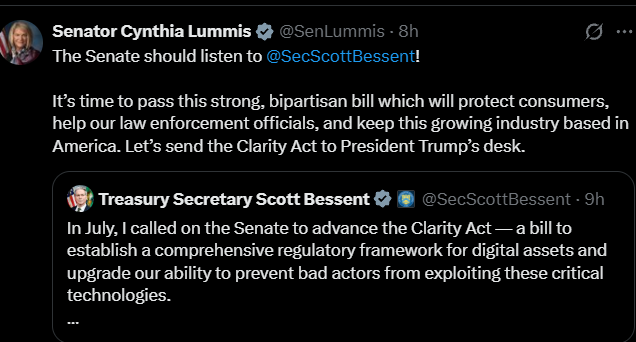
Beyond market structure, Bessent has repeatedly tied the bill to national security concerns. His argument centers on the idea that clearer rules would strengthen the government's capacity to identify and disrupt bad actors who might otherwise exploit weakly regulated corners of the digital-asset ecosystem. Leaving the current gaps in place, he suggested, limits the tools available to combat related illicit activity.
Source: X
Key Senate Vote Could Determine the Bill's Next Step
Commentary circulating around the crypto bill 2026 points to a procedural vote expected around September 15, 2026, that could determine whether the legislation advances further. A motion to proceed would open formal debate, moving the bill past the negotiating stage and into active Senate consideration.
Falling short of the needed support at this stage would likely stall the process rather than end it outright, since the measure has drawn attention from both parties.
Cynthia Lummis Backs the Push for Crypto Rules
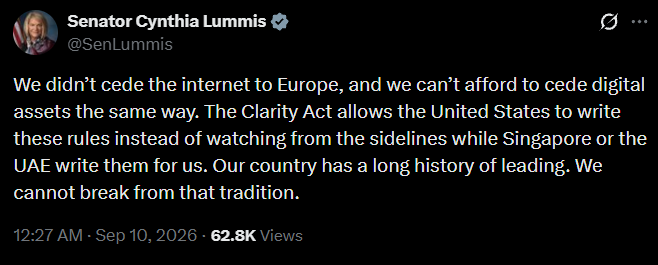
Senator Cynthia Lummis has been among the most vocal supporters, framing the bill as a chance for the U.S. to set global standards rather than cede that role to other financial centers. She has argued that America has historically led on shaping the rules for emerging technology and should not step back now, pointing to consumer protection and support for law enforcement as core benefits of the bill.
Source: Senator Lummis
Bill Would Add AML and Customer Due Diligence Requirements
Lummis has also highlighted a more technical piece of the legislation: digital-asset exchanges and brokers would be classified as financial institutions under the Bank Secrecy Act.
That reclassification would turn anti-money-laundering programs and customer due diligence checks into firm legal obligations rather than practices companies adopt voluntarily, closing a gap that critics say has allowed inconsistent compliance across the industry.
Industry Support Builds Ahead of the Vote
Advocacy for the bill has extended beyond Capitol Hill. The National Crypto Association reportedly ran advertisements in the Wall Street Journal ahead of the vote, citing the large share of Americans who own digital assets and encouraging undecided lawmakers to engage directly with the industry before casting their votes. The campaign reflects broader industry efforts to keep pressure on the Senate as the vote approaches.
What Happens If the Senate Fails to Advance the Bill?
Bessent's warnings center on what he sees as the cost of delay: continued regulatory uncertainty that could push companies, capital, and innovation toward jurisdictions with clearer rules, along with a missed opportunity to strengthen national security tools against digital-asset misuse. Supporters argue that failing to act now would leave the U.S. on the sidelines while other countries write the rules that eventually govern global digital-asset markets.
Timeline
-
July 2026: Bessent first called on the Senate to advance the legislation.
-
August 2026: The Senate entered recess while negotiations continued behind the scenes.
-
September 9, 2026: Bessent renewed his call, urging senators to remain at the table and agree to the motion to proceed.
-
September 15, 2026: The Senate is expected to hold a key procedural vote that could determine whether the bill moves forward.
-
After the procedural vote: If advanced, the bill continues through further Senate negotiation and consideration before it could become law
Conclusion: Bill Faces Key Test as Senate Returns
With Bessent's renewed appeal, Lummis' vocal backing, and industry groups mobilizing public support, the digital-asset legislation is entering a decisive stretch.
The expected September 15 procedural vote will not settle the bill's fate outright, but it is widely seen as an important signal of whether the Senate is prepared to move the process forward. How lawmakers respond could shape the pace of U.S. digital-asset regulation for the remainder of the year.
Disclaimer: This article is for informational purposes only and should not be construed as financial, investment, legal, or tax advice. Cryptocurrency and digital-asset markets are highly volatile and involve significant risk, including the potential loss of principal. Always conduct your own research and consult a qualified professional before making any financial decisions.









