Coinbase News Update: Experts Warn Against Unsafe Recovery Method


Coinbase News: Why Seed Phrase Entry Online Is Dangerous
Recent reports reveal that a section of Coinbase Commerce’s withdrawal tool prompts users to enter their plain-text mnemonic (seed) phrase directly into a web form in order to recover assets during a migration process. This development has quickly become a major topic in Coinbase news, drawing attention from both investors and cybersecurity experts.
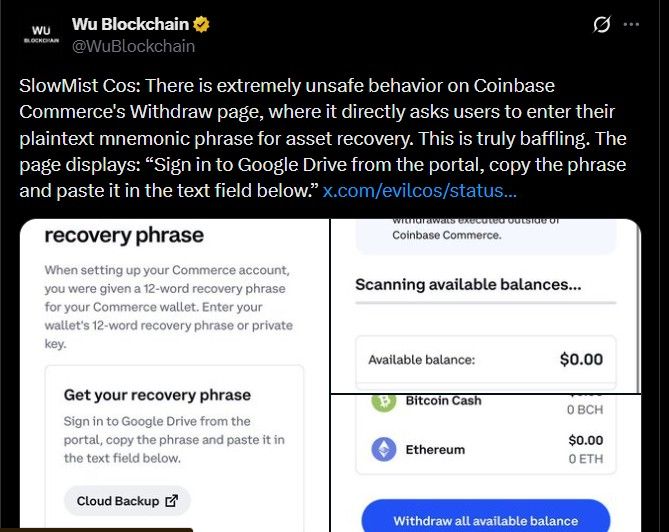
Source: X Official
According to the cybersecurity community, this is highly unsafe — because a seed phrase already gives full control of a crypto wallet, and entering it online can expose it to theft, phishing, or accidental leaks.
Withdrawal interface flagged for unsafe recovery design.
Users are asked to input highly sensitive wallet credentials.
Experts Warn About “Extremely Unsafe” Behavior
Security specialists, including Cos, publicly described this behavior as “extremely unsafe,” calling it baffling that a merchant-facing page would request such critical information. Another independent investigator, ZachXBT, mentioned that the very structure of this flow could be exploited by malicious actors who create fake pages mimicking the official one, making social engineering scams much more effective.
Importantly, this does not mean Coinbase’s core system contains malware or inherent flaws. Instead, the primary concern lies in duplicate or fake pages that mimic official interfaces, diverting user attention and enabling social engineering scams. Such tactics make it easier for attackers to trick individuals into revealing sensitive data.
Experts highlight phishing risks and interface design flaws.
Fake pages increase the chances of user error and fraud.
How the Withdrawal Flow Works
From reports shared across news outlets and social platforms, the withdrawal page reportedly displays instructions asking users to “sign in to Google Drive from the portal, copy the phrase and paste it in the text field below.” This step is meant to assist merchants in recovering legacy self-custodial wallets.
The process is part of a broader transition as Coinbase moves its Commerce platform into Coinbase Business by March 31, 2026. While the intention is to streamline migration, the design has alarmed observers because it contradicts standard cybersecurity practices.
Even as the platform prepares for decommissioning, experts emphasize that entering recovery phrases into any website is unsafe. Best practices universally advise against sharing such credentials online under any circumstances.
Migration linked to the transition toward Coinbase Business.
Recovery method criticized for poor security design.
Why This Matters for Investors
This issue is significant because a mnemonic phrase is the master key to a cryptocurrency wallet. If exposed—whether through phishing pages, accidental entry, or insecure storage—funds can be irreversibly stolen. In the fast-moving world of Coinbase news, such vulnerabilities can lead to widespread financial loss.
Cybersecurity experts strongly discourage storing or entering recovery phrases in digital documents, screenshots, or online forms. Even a single mistake can result in complete loss of assets, with no possibility of reversal due to the decentralized nature of blockchain systems.
Seed phrase exposure can lead to permanent asset loss.
Human error remains the biggest risk factor.
Safe Ways to Transfer Assets
Investors are urged to follow strict safety practices when handling digital assets. Never enter your seed phrase online — even if the request appears to come from an official source. Instead, use wallet export tools or official withdrawal options that do not require typing sensitive information.
Keep your mnemonic offline, preferably written on paper or stored in a hardware wallet. Always verify website URLs carefully and avoid clicking on links from emails or messages. If confusion arises, contact Coinbase support directly and never share private keys through chat or forms.
Conclusion:
Coinbase news developments like this highlight the importance of user awareness and secure practices. As platforms evolve, maintaining control over sensitive credentials remains the most critical step for protecting digital wealth. And users must follow strict security practices during asset transfers and avoid sharing sensitive data under any circumstances.









