India Crypto News: 15 Crypto Platforms Face App and URL Takedown


India Crypto News: Weex, Bitunix, Toolbit Among 15 Platforms Targeted
The Financial Intelligence Unit-India has moved against 15 virtual digital asset service providers operating without proper registration or compliance under the country's anti-money laundering law.
The regulator's notices, issued on September 9, 2026, ask these platforms to pull down their applications and websites from public access in India. The move signals that Indian authorities are tightening oversight of offshore crypto exchanges that serve local users without meeting domestic obligations.
At a Glance
-
The Financial Intelligence Unit-India (FIU-IND) has issued notices to 15 offshore crypto platforms for failing to meet anti-money laundering rules.
-
The notices, sent under Section 13 of the Prevention of Money Laundering Act (PMLA), also seek the takedown of these platforms' apps and URLs in India.
-
Named entities include Weex, Blofin, Bitunix, DigiFinex, Toobit, XT.com, Latoken, WOO X, Pionex, ChangeNOW, SimpleSwap, FixedFloat, WhiteBIT, Guardarian and RezorEx.
-
The action ties into a wider government push, including a new Dark Net-Crypto Cell announced by Home Minister Amit Shah to trace illicit crypto flows linked to drug networks.
-
The finance ministry has again cautioned that crypto products and NFT platforms remain unregulated and carry high risk for investors.
FIU-IND Targets 15 Crypto Platforms Over PMLA Non-Compliance
The finance ministry said the notices were issued under Section 13 of the PMLA after the platforms were found operating without complying with rules meant to prevent money laundering and terror financing.
The action does not amount to a blanket ban on offshore exchanges; rather, it targets specific entities that allegedly failed to register or fulfil reporting duties expected of any virtual digital asset service provider active in the Indian market.
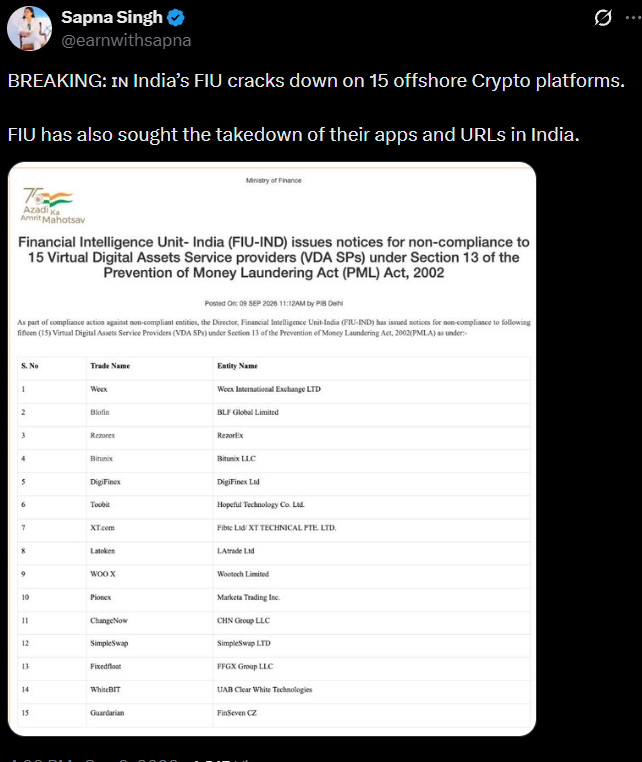
Source: Sapna Singh
Which Platforms Received Notices?
| Platform | Registered Entity |
| Weex | Weex International Exchange LTD |
| Blofin | BLF Global Limited |
| RezorEx | RezorEx |
| Bitunix | Bitunix LLC |
| DigiFinex | DigiFinex Ltd |
| Toobit | Hopeful Technology Co. Ltd. |
| XT.com | Fibtc Ltd / XT Technical Pte. Ltd. |
| Latoken | LAtrade Ltd |
| WOO X | Wootech Limited |
| Pionex | Marketa Trading Inc. |
| ChangeNOW | CHN Group LLC |
| SimpleSwap | SimpleSwap LTD |
| FixedFloat | FFGX Group LLC |
| WhiteBIT | UAB Clear White Technologies |
| Guardarian | FinSeven CZ |
Why the Takedown Order?
The Director of FIU-IND, acting as nodal officer under Section 79(3)(b) of the Information Technology Act, 2000, along with the 2025 intermediary guidelines, has asked internet gatekeepers to restrict access to these applications and web addresses.
In plain terms, this limits how users inside the country can reach these services, since the platforms were found to be functioning without meeting PMLA requirements.
Offshore Exchanges Still Must Follow Domestic AML Rules
A key point for users to understand is that registration duties are activity-based, not location-based. Whether a service provider sits inside or outside the country, offering activities such as swapping virtual assets for rupees, transferring digital tokens, or holding custody of such assets on behalf of clients triggers the same registration and compliance duty with FIU-IND.
A Framework in Place Since 2023
Virtual digital asset firms were first brought under the PMLA-linked AML and counter-terror-financing framework in March 2023. Since then, registered entities have been expected to maintain records, flag suspicious activity, and satisfy standard know-your-customer checks. The September 9 notices mark a fresh enforcement step within that same framework, three years after it took effect.
Part of a Broader Crackdown on Illicit Finance
The FIU-IND notices arrive alongside a larger government effort to monitor digital financial flows. Home Minister Amit Shah recently outlined a 2026-29 anti-narcotics roadmap that includes a dedicated Dark Net-Crypto Cell built to trace transactions tied to drug trafficking.
Agencies including the Enforcement Directorate, FIU-IND, and the banking sector are expected to work together on following money trails linked to organized networks, showing that crypto-related enforcement now extends beyond routine compliance checks into national security concerns.

Source: Bitcoin Expert India
What This Means for Indian Crypto Users?
Anyone using the affected platforms may find access restricted going forward. It's worth checking a platform's registration status with FIU-IND before transacting, and remembering that a service being offshore does not exempt it from Indian cryptocurrency rules. Compliance with FIU-IND also does not mean crypto assets carry legal-tender status or investor protection in India.
Conclusion
FIU-IND's latest notices represent another step in bringing offshore virtual asset platforms in line with India's anti-money laundering framework, while the government's parallel expansion of crypto and dark-web tracing points to a broader, coordinated effort to monitor illicit financial activity in the country.
Disclaimer: This article is for informational purposes only and does not constitute financial, investment, or legal advice. Cryptocurrency and virtual digital assets are unregulated in India and carry a high level of risk. Readers may have limited or no regulatory recourse for losses arising from such transactions. Please conduct independent research or consult a qualified financial advisor before making any investment decisions.
Also read:









