India Crypto Meeting News: Parliament Cancels August 27 VDA Hearing


Crypto Meeting India News: Why Parliament Cancels Key DEA VDA Hearing?
If you were tracking crypto meeting India news today, the headline is a delay, not a decision. Parliament's Standing Committee on Finance has called off its planned session with the DEA, pushing back one of the last expected steps before lawmakers finalize their view on how India should treat digital assets.
Here is what actually happened, why it matters, and what stays the same for investors while the wait continues.
At a Glance
-
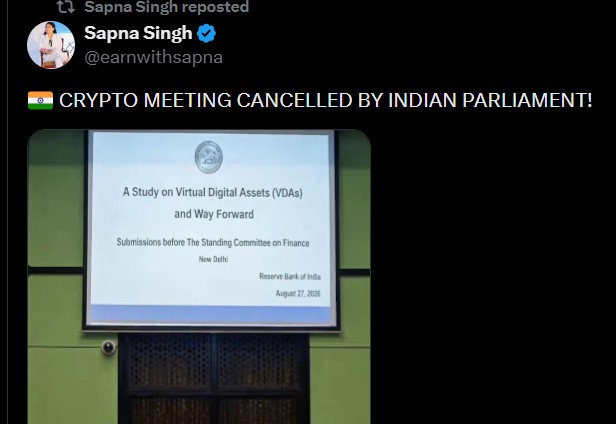
Today's crypto meeting India news: Parliament's Standing Committee on Finance has cancelled its August 27, 2026 sitting with the Department of Economic Affairs (DEA).
-
The hearing was meant to cover a study on Virtual Digital Assets (VDAs) and the way forward for India's crypto market framework.
-
No replacement date has been announced yet.
-
The panel's next sitting, on September 3, 2026, will instead cover direct tax reforms, not cryptocurrencies.
-
Existing tax and compliance rules for VDAs remain unchanged.
Why Was the India Crypto Regulation Meeting Cancelled?
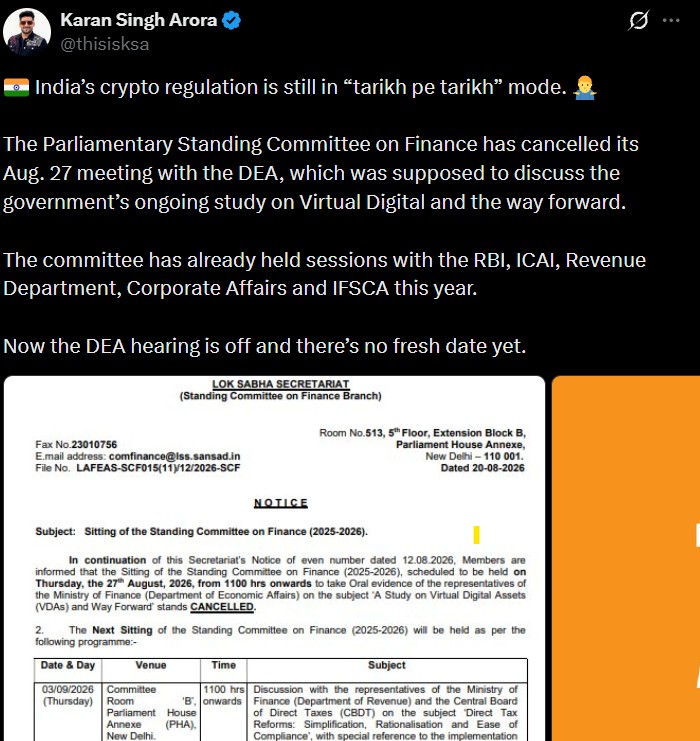
According to a notice issued by the Lok Sabha Secretariat on August 20, 2026, the sitting scheduled for Thursday, August 27 at 11:00 AM, at which DEA representatives were to give oral evidence on "A Study on Virtual Digital Assets (VDAs) and Way Forward," now stands cancelled.
The notice does not state a reason. It also confirms that the committee's next meeting, on September 3, 2026, will take up "Direct Tax Reforms: Simplification, Rationalisation and Ease of Compliance" with the Department of Revenue and the Central Board of Direct Taxes (CBDT) instead of VDAs.
Source: Karan Singh Arora
India Crypto Regulation Faces Another Delay Amid Policy Uncertainty
This is the latest setback in a long-running review. The DEA hearing was originally flagged for July 15, 2026, then rescheduled to August 27, and has now been shelved a second time without a fresh date on record.
Today's Parliament meeting effectively repeats a pattern investors have watched all year: tax rules keep advancing while a broader regulatory framework for exchanges, custodians, and asset categories stays undefined. India's VDA regime currently rests on tax and anti-money-laundering provisions rather than a dedicated cryptocurrency law.
India's Existing Crypto Rules Remain Unchanged After Meeting Cancellation
The cancellation does not touch current rules. The 30% tax on VDA gains under Section 115BBH continues, along with the 1% TDS on transfers under Section 194S. Goods and Services Tax on trading fees, currently 18%, also stays in place.
Exchanges must still register with the Financial Intelligence Unit-India (FIU-IND) and follow reporting obligations, including newer requirements tied to the Crypto-Asset Reporting Framework introduced in July 2026. Investors should continue filing returns and complying with existing disclosure rules regardless of the parliamentary calendar.
Source: Sapna Singh
What Parliament Has Already Recommended for India's Crypto Industry
The committee's VDA study has not been dropped, even though this sitting is off. On July 23, 2026, the panel tabled its 36th Report, which recommended an interim regulatory framework built around Self-Regulatory Organisations (SROs) operating under a statutory regulator such as SEBI or the Reserve Bank of India (RBI).
That report also urged the finance ministry to settle clear legal definitions for different categories of digital assets, a gap that has persisted for years.
Why the RBI and Finance Ministry Have Different Views
Part of the friction behind this crypto meeting India news cycle is the ongoing split between regulators. The RBI has taken a cautious, restriction-leaning stance, citing financial stability risks, and internal submissions reported in July suggested the central bank favors limits on private cryptocurrencies.
The Finance Ministry and parliamentary panel, by contrast, have leaned toward regulating rather than banning the sector. Until these two sides align, a comprehensive framework is unlikely to move quickly.
India Crypto Regulation Timeline: From Tax Rules to the Cancelled DEA Hearing
India introduced its VDA tax regime in 2022, then spent 2025 and 2026 building a wider consultation: hearings with FIU-IND and CBDT in January, sessions with the RBI and the Institute of Chartered Accountants of India, and testimony from major crypto exchanges.
The SRO recommendation followed in July. The DEA's own discussion paper, in development since 2022, has reportedly been delayed multiple times. The August 27 cancellation is the latest entry in that timeline, not a break from it.
What Happens Next for India Crypto Regulation?
No new date for the DEA hearing has been announced, and the September 3 sitting will focus solely on tax reform. Analysts following crypto meeting in India expect a phased approach rather than a single standalone law this financial year, with the SRO proposal remaining the most concrete marker on record.
Investors and platforms should watch the Lok Sabha's committee page for the next notice while continuing to meet current tax and compliance obligations.
Conclusion
The cancelled DEA hearing extends a wait that has already stretched across much of 2026, but it does not undo Parliament's earlier recommendations or change any existing tax rule.
For now, India's cryptocurrency sector continues operating inside a compliance-heavy, framework-light system, with the next real signal likely to come only once a fresh hearing date is confirmed.
YMYL Disclaimer: This article covers financial and regulatory topics that can affect personal financial decisions. It is for informational purposes only and does not constitute financial, tax, investment, or legal advice. Regulatory situations can change quickly; readers should verify current rules with official government sources and consult a qualified professional before making decisions.







