India Crypto Regulation Policy Faces A Crucial September Test


India Crypto Regulation Policy: What Could September 16 Reveal?
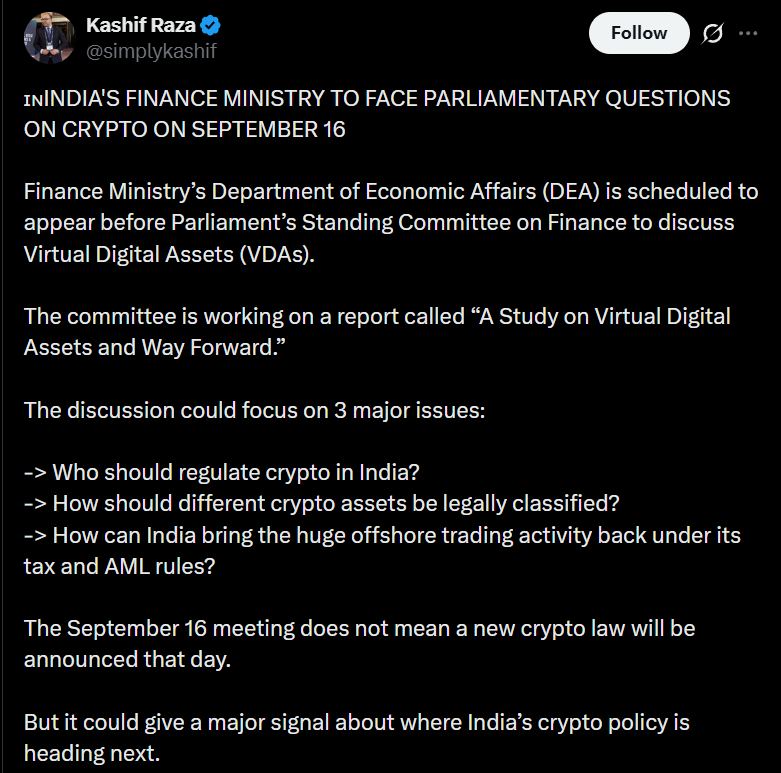
India's crypto regulation policy is set for a crucial moment as the Department of Economic Affairs (DEA), under the Finance Ministry, prepares to appear before Parliament's Standing Committee on Finance on September 16.
The session forms part of the committee's ongoing report, "A Study on Virtual Digital Assets and Way Forward," and comes at a time when questions around India crypto regulation policy have grown louder both inside and outside the industry.
Source: Post by Simplykashif
The meeting will bring the DEA directly into the conversation, giving lawmakers a chance to press the ministry on where the country's digital asset framework is actually headed.
Why the September 16 Meeting Matters
The Standing Committee on Finance has been examining Virtual Digital Assets (VDAs) for a while now, and this hearing adds one more piece to that puzzle.
It's not a routine formality—the DEA is the arm of the Finance Ministry most closely tied to shaping the eventual policy line the government adopts on crypto.
Committee proceedings and schedules can be tracked on the official Lok Sabha committee portal, which lists sittings, agendas, and participating departments.
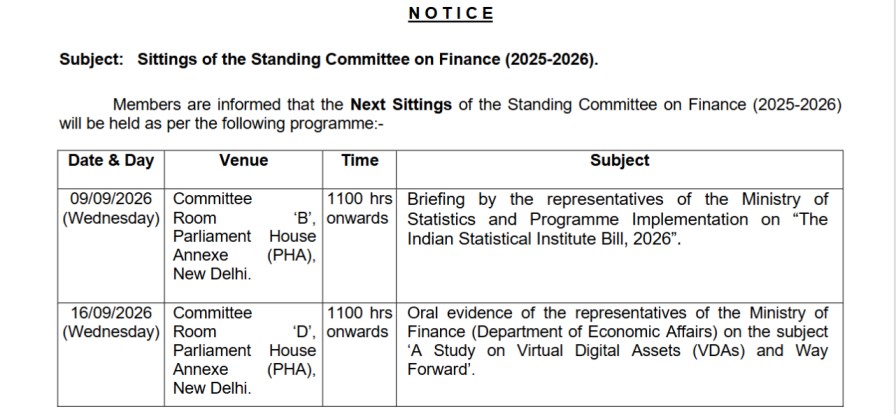
What makes this session notable is the timing. India's crypto regulation policy has remained in a grey zone for years—taxed, monitored, but without a dedicated law.
A DEA appearance signals that the government's own economic policy wing is now being asked, on record, to explain its thinking.
The Three Core Issues on the Table
Based on the details circulating around the meeting, the discussion is expected to revolve around three central questions that have long defined the India crypto regulation policy debate:
-
Who should regulate crypto in India? Multiple regulators—RBI, SEBI, and the Finance Ministry—have overlapping interests in digital assets, and there's still no single, clearly designated authority.
-
How should different crypto assets be legally classified? Whether tokens count as securities, commodities, or an entirely new asset class changes how they'd be taxed, traded, and supervised.
-
How can India bring offshore trading activity back under domestic tax and AML rules? A large share of Indian crypto volume currently flows through platforms based outside the country, making enforcement difficult.
These three threads have run through nearly every serious conversation on India crypto regulation policy since the 30% tax and 1% TDS regime was introduced in 2022.
What This Meeting Is—and Isn't
It's worth being clear about what September 16 actually represents. This is a fact-finding and evidence-gathering sitting, not a legislative announcement.
The committee is still compiling its report, and the DEA's testimony is one of the last major inputs before that report takes shape.
| Aspect | Detail |
| Committee | Parliament's Standing Committee on Finance |
| Ministry involved | Finance Ministry — Department of Economic Affairs (DEA) |
| Report title | "A Study on Virtual Digital Assets and Way Forward" |
| Date of hearing | September 16 |
| Outcome expected | Signal on policy direction, not a new law |
So while no crypto bill will be tabled that day, the hearing could still offer the clearest signal yet on how India crypto regulation policy is likely to evolve—whether toward a dedicated regulator, a classification framework, or tighter offshore enforcement.
Why Offshore Trading Is a Growing Concern
One of the more pressing issues feeding into this discussion is the scale of Indian crypto activity happening outside domestic platforms.
High local taxes and TDS obligations have pushed a significant portion of trading volume to offshore exchanges that fall outside India's direct tax and anti-money-laundering (AML) oversight.
This creates a few practical problems the DEA is likely to be questioned on:
-
Reduced visibility for tax authorities into actual trading volumes and gains
-
Weaker AML checks compared to domestically registered platforms
-
Revenue leakage that undercuts the very purpose of the 2022 tax framework
Bringing this activity back onshore is widely seen as one of the more urgent pieces of any future India crypto regulation policy, since enforcement gaps only widen the longer offshore trading remains dominant.
What Comes Next for India's Crypto Framework
After the September 16 session, the Standing Committee is expected to continue consolidating input from various stakeholders—regulators, industry bodies, and now the Finance Ministry itself—before finalizing its report.
There's no confirmed timeline yet for when that report will be tabled or made public, and the government has not indicated a fixed date for introducing formal crypto legislation.
Still, the involvement of the DEA at this stage suggests the committee is moving closer to recommendations rather than remaining in an exploratory phase.
For an industry that has operated under tax rules but no dedicated law for years, even directional clarity on India crypto regulation policy would be a meaningful development.
Conclusion
The September 16 hearing won't produce a new crypto law overnight, but it's a step that matters.
With the Finance Ministry's DEA now expected to answer direct questions on regulation, classification, and offshore enforcement, this session could shape the next chapter of India crypto regulation policy.
For now, the industry and observers alike will be watching closely for any signal on which direction the government leans next.
Disclaimer
This content covers financial markets and is for general information only. It is not financial, investment, trading, or legal advice. Crypto assets are volatile and can lose value fast. Always do your own research. Speak with a licensed financial advisor before making investment decisions.









