Meta Arena Prediction Market App Aims to Rival Kalshi and Polymarket


Meta Arena Prediction Market: What Zuckerberg Is Building
What happens when the company that built the modern social feed decides betting on the future is the next one?
Two unnamed Meta employees, that CEO Mark Zuckerberg has personally assembled a small internal team to build a standalone app internally codenamed Arena. The Meta Arena prediction market product is designed to let users wager on outcomes across politics, finance, sports, and even military operations — directly challenging Polymarket and Kalshi, the two platforms currently dominating the sector.
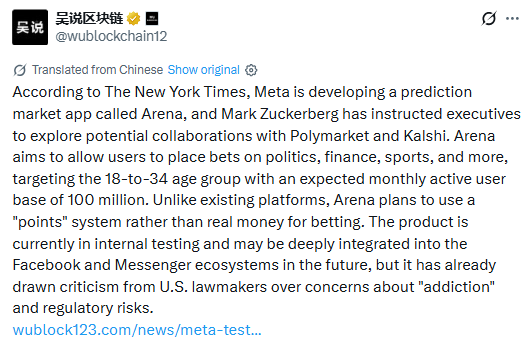 Source: X(formerly Twitter)
One detail separates Arena from its rivals immediately: at launch, it won't involve real money at all.
Meta Arena Prediction Market: What Zuckerberg Is Building
Sources familiar with the project describe the initiative as "experimental but a top priority" inside the company— an unusual combination that signals serious internal backing despite the product still being early-stage.
Rather than real-money wagering, It is expected to launch using a points-based system that functions closer to a video game than a financial exchange. Users would earn points for predicting outcomes correctly rather than risking actual currency. Meta has reportedly not ruled out introducing real-money betting functionality further down the line, but the initial version sidesteps the heavy regulatory burden that comes with operating a real-money trading platform.
It is being built as a separate, standalone application — distinct from Facebook, Instagram, WhatsApp, and Messenger. That separation appears deliberate rather than incidental. Meta's existing platforms could still direct users toward Arena, giving the new app access to a distribution advantage no standalone competitor can match: Meta's family of apps reported 3.56 billion daily active users as of April 2026.
The timing connects to a sector experiencing extraordinary growth. Kalshi and Polymarket generated a combined $50 billion in trading volume during 2025 — a figure that has already surpassed $130 billion in 2026 alone. Kalshi recorded approximately $18.36 billion in contract volume in June 2026 alone, while Polymarket posted $6.77 billion in non-US volume plus roughly $2 billion in US-based activity over the same period. Analysts at Bernstein project the broader event-betting markets category could reach $1 trillion in annual trading volume by the end of the decade.
Meta Arena Prediction Market and the Lawmaker Backlash
News of the Meta Arena prediction market project drew immediate political scrutiny, arriving at a moment when event-trading markets are already under intense regulatory pressure.
Senator Richard Blumenthal publicly criticized the move, framing it as the firm pushing deeper into products engineered to drive engagement through speculative behavior. His comments echoed a broader concern lawmakers have raised about Polymarket specifically — Blumenthal separately accused the platform of "flagrantly violating federal law" while operating offshore and paying influencers to promote bets to American users.
The criticism arrives alongside an active House Committee on Oversight and Government Reform probe into how Polymarket and Kalshi enforce against insider trading and other abuses, launched the month before Arena's existence became public. That scrutiny isn't theoretical. In April 2026, the Department of Justice revealed that a former special operations officer used classified knowledge to net $400,000 trading a betting market tied to the capture of Venezuelan President Nicolás Maduro. Kalshi has separately reported former Congressman George Santos to federal prosecutors after he publicly claimed he would attend a presidential address, then bet against his own attendance on the platform.
A prediction market entering this environment means inheriting scrutiny the sector already carries — even with a points-only model designed to stay several steps removed from gambling law concerns that apply to real-money platforms.
Meta Arena Prediction Market Outlook: Can It Beat Kalshi?
The market reacted almost immediately to news of Meta's plans. Shares of DraftKings and Flutter Entertainment, the parent company of FanDuel, declined following the report — a signal that traditional sports betting operators see prediction markets, and now a Meta-backed entrant, as a genuine competitive threat to their existing business.
Competition in the space was already intensifying before Arena surfaced. Robinhood and Interactive Brokers have introduced their own event contracts. Crypto exchange Gemini has entered the category. Even the Trump family has a stake in the conversation — Donald Trump Jr. reportedly advises both Polymarket and Kalshi, while the family's media company has launched its own prediction market site.
Three things to watch as the Meta Arena prediction market project develops, based on public reporting and assumption basis only — no guaranteed outcomes:
Whether the app ever ships publicly. The project remains internal and experimental; The firm has a documented history of shelving ambitious bets that don't gain internal traction.
Whether the points system evolves into real-money betting. Meta hasn't ruled this out, and the regulatory calculus changes substantially if it happens.
How Polymarket and Kalshi respond competitively. Both platforms have spent years building legal and regulatory infrastructure that a fast-moving Meta product could threaten to outpace through sheer distribution scale alone.
All projections are speculative and based on public reporting only.
Conclusion
The Meta Arena prediction market project signals that Zuckerberg sees genuine staying power in event-based betting, not just a passing trend. A points-only launch model, Meta's unmatched distribution reach, and a sector already drawing serious regulatory heat make this one of the more consequential tech stories of the summer — even before a single user opens the app. Whether Arena ships, and in what form, will say a lot about how seriously Meta takes the risk alongside the opportunity.
YMYL Disclaimer
This article is for informational and educational purposes only. It does not constitute financial advice, investment advice, gambling advice, or a recommendation regarding any prediction market platform. The project remains internal, unconfirmed for public launch, and subject to change or cancellation. Prediction markets and speculative trading carry significant financial and legal risk. Regulations vary by jurisdiction and continue to evolve. Always conduct independent research and consult applicable local laws before participating in any prediction market or wagering platform.