Petrodollar Collapse: Iran-Yuan Oil Trade Threatens Dollar Dominance

Iran-Yuan Oil Deal Threatens Petrodollar Collapse
Could a narrow sea passage in the Middle East quietly end 50 years of American financial power? That is the question rattling economists, investors, and policymakers in 2026, as Iran's decision to demand Chinese yuan for Hormuz oil transit shakes the very foundation of the global petrodollar system.
In March 2026, Iran announced it would allow tanker ships to pass through the Strait of Hormuz—one of the most vital sea passages in the world—only if the oil trade is settled in Chinese yuan, not US dollars. This is not simply a wartime tactic. For financial analysts, it signals a possible petrodollar collapse that has been decades in the making.
For roughly 50 years, about 80% of all international transactions have been settled in US dollars. Iran's yuan-oil demand directly challenges that half-century of dollar dominance.
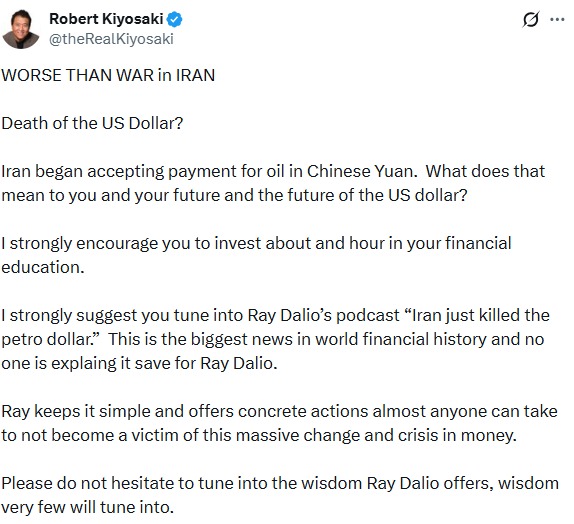
Source: X Account
How Iran Yuan Payments Are Cracking the Petrodollar
At least two vessels have already settled Hormuz transit fees in yuan, with a Chinese maritime services company acting as an intermediary to handle payments to Iranian authorities. Analysts say this is structurally significant—even if its long-term impact is still debated.
Oil prices surged from around $60 per barrel in January 2026 to well above $100. Iran has blocked the Strait of Hormuz but made a notable exception: Chinese tankers are allowed to pass through unimpeded. Ships from other nations wishing to pass must agree to sell their oil in yuan.
The petrodollar arrangement, forged in the 1970s, saw Gulf oil producers agree to sell crude exclusively in dollars, in exchange for US security guarantees. This sustained global demand for the dollar allowed the US to run large fiscal deficits. Iran's move directly tears at this agreement.
A bifurcated global oil market is now taking shape. Yuan-denominated barrels move through Hormuz for China, India, and Japan, while dollar-denominated barrels face higher rerouting costs for non-compliant nations. Countries like South Korea, Japan, and Pakistan—already squeezed by Gulf turmoil—now face a stark choice between the dollar and the yuan.
Ray Dalio Warns of Petrodollar Collapse and Dollar Risk
Billionaire investor Ray Dalio, founder of Bridgewater Associates, warned that if Iran and other regional actors require yuan for energy transfers through Hormuz, the decades-old petrodollar system could collapse. He stated that the dollar would then lose its reserve currency status, making it impossible for the US to finance its own debt.
Dalio compared a potential US failure at Hormuz to Britain's 1956 Suez Crisis—widely regarded as the moment the British Empire lost global power. He wrote: the outcome of the Hormuz standoff will determine not just oil prices, but whether the entire American-led world order survives.
Balaji Srinivasan, founder of The Network School, stated that this de-dollarization tactic targets the foundation of American economic power, warning that the end of the petrodollar would also mark the end of the post-war global order established in 1945.
What Petrodollar Collapse Means for Your Money
The Dollar Index did surge to 2026 highs when the war began, driven by a short-term flight to safety and rising demand for dollars to buy expensive oil. However, analysts note this temporary strength masks the longer-term structural erosion of dollar power.
If more oil proceeds are held in non-dollar currencies, this will create turbulence in the dollar-denominated bond market—the very heart of the global financial system, which helps keep US borrowing costs manageable.
Dalio stressed that to survive systemic changes of this scale, investors must pivot toward diversified portfolios and real assets. He referenced his "Big Cycle" theory, identifying three collapse triggers: unsustainable US debt, deep political polarization, and the erosion of dollar purchasing power.
Despite the alarm, not everyone sees instant collapse. The yuan is still not freely convertible—Chinese regulations prevent it from being exchanged at market rates globally—which limits its ability to fully replace the dollar in the near term. The petroyuan currently accounts for no more than 5% of global oil trade.
Future Outlook — Expert Analysis
The Strait of Hormuz crisis of 2026 is not a sudden shock. It is the acceleration of a slow structural shift. This episode marks the first documented case of systematic non-dollar transit fee demands being imposed on a corridor carrying a major fraction of global energy supply—a qualitative escalation unlike anything seen before.
Over the coming years, whether Saudi Arabia fully accepts yuan for oil, whether Gulf central banks join China's mBridge digital currency platform, and whether China's CIPS payment system scales sufficiently will determine if the petrodollar's gradual replacement becomes a near-certainty.
The story of the petrodollar does not end overnight. But 2026 may well be the year history records as the moment the erosion became impossible to ignore. For everyday savers and investors, the message from analysts is consistent: diversify, hold real assets, and understand that the rules of global money are being rewritten—quietly, but decisively.
YMYL Disclaimer — Your Money, Your Life This article is produced for informational and educational purposes only. It does not constitute financial, investment, or legal advice.








