PONS Token News: PONS Price Crash as Token Supply Burn Hits 30%


PONS Token News: What Token Burn Means for Supply and Future Price
PONS Token News today centers on two numbers moving in opposite directions. The token has burned 30 percent of its total supply, yet the price has fallen sharply, down 16.8 percent in 24 hours to $0.7014, according to live tracking data.

Source: Official Announcement
PONS Token Burn News: How 30% of Total Supply Vanished Now
The PONS token burn milestone became official on September 8, when the project confirmed that 30% of its total supply is now permanently gone. PONS launched with a fixed maximum of 1 billion tokens, so the burn leaves an effective remaining supply of roughly 700 million as per TradingView.
Token burn progress moved quickly once the platform gained traction. The share of burned supply sat in the low teens shortly after launch in July, climbed to about 20 percent within weeks, reached 27 to 29 percent by late August, and crossed the 30 percent mark in early September.
This kind of supply reduction is a common deflationary tool across meme coins and token-launch platforms. Removing tokens from circulation permanently tightens scarcity, though it never guarantees that price will rise, a nuance central to PONS token news this week. Demand still has to show up on the other side of the trade.
PONS Price Today: Key Levels After a Sharp 24-Hour Price Pullback
PONS price today shows a market pulling back hard after weeks of rapid gains. The token trades near $0.70, well off its recent highs, as sellers outweigh buyers across most trading venues.
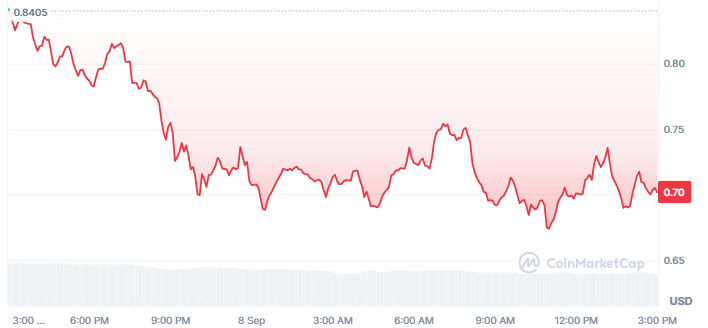
Latest snapshot from CoinMarketCap:
-
PONS price today: $0.7014, down 16.84% in 24 hours
-
Market capitalization: $490.55 million, down 16.22%
-
24-hour trading volume: $158.74 million, down 22.44%
-
Fully diluted valuation: $490.91 million
-
Circulating and total supply: 699.35 million PONS
Why PONS Price Crash Despite a Burn That Supports Long-Term Scarcity
Token burns and short-term price moves do not always run on the same clock, and that gap explains much of today's disconnect.
Burning supply is a long-term structural change. It shrinks the pool of tokens that can ever exist, which supports value over time if demand holds steady or grows. Short-term price action, by contrast, runs on whoever is buying or selling at the moment.
Right now, traders have been pulling out of launchpad and meme-coin names across the board, not just PONS, as part of a broader risk-off shift ahead of upcoming U.S. inflation data. Some social sentiment has also raised doubts about whether Pons can keep growing as fast as rival platforms expand.
None of that erases the burn. It simply means scarcity works on a longer timeline than daily sentiment does. A tighter supply lowers the ceiling on how much selling pressure the market can absorb before price reacts, but it cannot stop a wave of short-term selling from happening in the first place.
The two forces, deflation and daily trading flow, are simply answering different questions.
PONS Tokenomics Explained: Inside the Fee-to-Burn Flywheel Engine
PONS tokenomics run on a straightforward fee model. Every trade on tokens launched through the platform carries a 1% fee, split roughly 70% to the token's creator and 30% to the protocol itself.
From that protocol share, 80% funds programmatic buybacks of $PONS on the open market, executed gradually rather than in one large order. Once purchased, those tokens are sent to a burn address and removed from circulation for good. The remaining 20% covers operations and infrastructure costs.
The result is a flywheel: more token launches and trading volume generate higher fees, which fund larger buybacks and burns, which tighten the circulating supply further. That loop ties the token's economics directly to platform activity instead of relying on hype or new token emissions alone.
PONS Roadmap 2026: What Comes Next for the PONS Family Ecosystem Now
The project has already shifted toward a version 2 or V2 of the platform.
New token launches now use bonding curves that graduate into locked liquidity pools, with added support for real-world asset pairs. It also includes tokenized stock exposure, plus options for holder fee sharing and creator payouts in assets beyond $PONS itself.
Recent developments include a Binance futures listing and accumulation from market maker Wintermute, both of which have added liquidity and visibility. A mobile app is also in testing, with an iOS beta planned through a sign-up portal ahead of a wider public release.
Competition remains the biggest swing factor. Rival launchpads are chasing the same activity, and $PONS needs a steady stream of new breakout tokens to keep protocol fees, and therefore burns, moving at their current pace. That competitive pressure is a recurring theme in PONS Token News coverage this month.
PONS crypto token update: for now, the burn story and the price story are pulling in different directions, and that gap stands out. U.S. inflation data due September 11 could set the next short-term move. The buyback-and-burn engine keeps working quietly in the background regardless of daily price swings.
Whether scarcity eventually catches up with sentiment will depend on how much fresh activity the platform can keep generating.
Disclaimer: This article is for informational purposes only and does not constitute financial advice. Always verify on-chain figures independently, as burn totals and supply data shift with ongoing activity.









