CZ Plans Satoshi Bitcoin Freeze: Why and How It Works


Satoshi Bitcoin Freeze: Binance Founder Bold Idea Splits Crypto Space
A Satoshi Bitcoin freeze is now a real topic of conversation, and it came from someone with serious weight in the industry. Binance founder CZ raised the idea on the Galaxy Brains podcast on June 18, suggesting that Satoshi Nakamoto's roughly 1.1 million BTC should face a deadline before getting locked out for good.

What CZ Actually Proposed About The Satoshi Bitcoin Freeze
CZ's idea is not like a firm sole final decision.
He laid out a structured plan that starts with upgrading Bitcoin to quantum-resistant cryptography. After that upgrade, holders of legacy addresses would get a window of six to twelve months to move their coins to the new, safer format.
Any coins left untouched after that window, including Satoshi's massive stash, would get frozen through protocol rules. This could happen through a soft fork or a hard fork, depending on how the network decides to handle it.
CZ made it clear this isn't something he plans to do personally. He framed it as a question for the wider governance of BTC to answer, not a unilateral move from him or Binance.
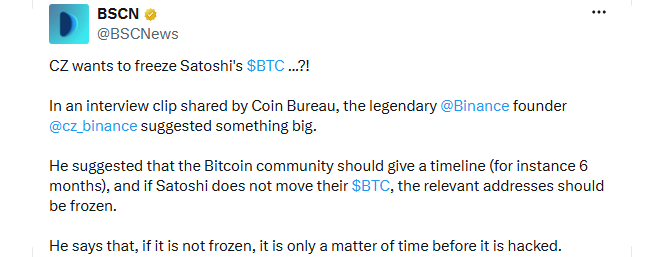
Source: BSCN Official
The Move Is to Save Bitcoin Future Price: Quantum Computers Role
The real driver behind the Satoshi Bitcoin freeze talk is the threat from cryptographically relevant quantum computers. These machines, once powerful enough, could break the ECDSA signatures used in old-style Bitcoin addresses like P2PK and P2PKH.
This isn't just a Satoshi problem either. Somewhere between 5 million and 7 million BTC sit in dormant or old-format addresses, which works out to roughly a third of the entire Bitcoin supply.
A successful quantum attack on any of that could trigger panic selling and shake confidence across the whole market.
This concern connects to other recent moves in the space, including BIP-361, a proposal floated by developers like Jameson Lopp in April 2026 calling for a phased sunset of legacy signature types.
The Pushback Against Freezing Satoshi's BTC
Not everyone is on board, and the reaction has been loud. Many in the space see this as a direct hit to two of Bitcoin's founding principles: immutability and censorship resistance.
The phrase "not your keys, not your coins" keeps surfacing in the backlash. Critics argue that freezing any address, even an inactive one, opens the door to picking and choosing whose coins get protected and whose don't.
There's also a sharper edge to some of the criticism. Given CZ's history running Binance, a centralized exchange, some accuse him of pushing a centralized mindset onto a network built specifically to avoid that kind of control.
Alternatives And What Comes Next For Bitcoin's Security
Freezing addresses isn't the only option left. Some technical voices have floated less invasive paths, like zero-knowledge proof recovery systems or provable address-control timestamps, both designed to protect old coins without touching the network's core promise of immutability.
Getting any of this done would require overwhelming consensus across the Bitcoin network, something history shows is hard to achieve. The block size wars from years back are proof of how messy that process can get, and a forced migration carries real risk of a chain split if agreement doesn't come easily.
One detail that keeps coming up in side conversations is whether Satoshi himself could step in and settle the entire question. A single signed message moving even a fraction of those coins would prove control instantly, end the freeze debate, and reveal an identity that has stayed hidden for over a decade.
Whatever happens next, this debate touches something bigger than just old coins sitting untouched. It tests whether Bitcoin's governance can handle a real security threat without breaking the very principles that gave it value in the first place.
Disclaimer: This article is for informational purposes only and does not constitute financial or investment advice. Crypto markets carry significant risk. Always do your own research before making any investment decisions.
2 months ago
What to Do After a Cryptocurrency Scam | Intelligence Cyber Wizard Recovery Services Scammed out of Bitcoin contact intelligence cyber wizard recovery today. Intelligence Cyber Wizard provides professional Bitcoin recovery services for victims worldwide, using advanced blockchain forensics and cyber investigations. We help trace, investigate, and recover stolen or lost Bitcoin from crypto investment scams, romance and pig butchering scams, fake trading platforms, wallet hacks, phishing attacks, and unauthorized Bitcoin transfers. Bitcoin recovery is possible because all transactions are permanently recorded on the blockchain. While Bitcoin is decentralized, it is not untraceable. With the right expertise, stolen BTC can be tracked, analyzed, and linked to exchanges, wallets, and scam networks. Our specializations include blockchain transaction tracing, scam wallet identification, exchange linked recovery processes, cyber fraud investigation reports, and evidence preparation for fund retrieval. Our Bitcoin recovery process begins with a case assessment, where we analyze your transaction hash, wallet address, and scam details to determine recovery feasibility. Next is blockchain forensic tracking, where our experts trace your Bitcoin across the blockchain to identify movement patterns and endpoints. We then conduct scam network identification by connecting wallets to known scam operations, exchanges, or laundering services. Where recovery is possible, we initiate the appropriate recovery actions and provide full guidance throughout the process. Victims trust Intelligence Cyber Wizard because we specialize in Bitcoin and crypto recovery, use advanced blockchain forensic tools, and have experience handling U.S. based scam cases. We maintain a transparent process with no false promises and ensure confidential, secure case handling. We focus on real investigations rather than automated software or unrealistic guarantees. We handle various types of Bitcoin scams, including fake crypto investment websites, pig butchering scams involving long term manipulation, romance scams involving Bitcoin, phishing and wallet drain attacks, unauthorized exchange withdrawals, and Bitcoin sent to incorrect or scam addresses. Frequently asked questions often include whether stolen Bitcoin can be recovered. In many cases, recovery is possible depending on how quickly action is taken and whether funds can be linked to recoverable endpoints such as exchanges. Recovery timelines vary, with some cases taking weeks and others longer depending on transaction complexity. No legitimate recovery service can guarantee 100 percent success, and we provide honest case evaluations before proceeding. While we assist victims worldwide, we maintain a strong focus on United States, UK’s, Australia and Canada scam cases. Time is critical. The sooner your case is investigated, the higher the chances of recovery, as delays allow scammers to further launder stolen Bitcoin. Contact Information: WhatsApp: +1 (219) 424-7566 Email: intelligencecyberwizard@mail.com Email: intelligencecyberwizard@cyber-wizard.com Business hours are 24/7. Country of operation: United States.

2 months ago
For many years, Dune Nectar Web Expert has focused on perfecting digital asset recovery. Through continuous improvement of our methods and systems, Dune Nectar Web Expert has become the largest data, fraud, and crypto funds and wallet recovery service of its kind. Our mission is to assist clients in securely restoring access to lost wallets, forgotten passphrases, missing recovery words, and outdated wallet formats. We specialize in tracing and recovering scammed funds. The cryptocurrency landscape presents both substantial opportunities and serious risks. As digital assets continue to expand, the ability to engage a recovery service with proven reliability and strong security becomes increasingly critical. Dune Nectar Web Expert employs advanced technology alongside rigorous security protocols to address even the most difficult cases. Recovery timelines vary based on complexity: some clients regain access within weeks, while others require sustained effort over several months. In particularly challenging instances, our teams have worked for more than eight months to resolve the issue—without compromising diligence or perseverance... - Support (@) Dunenectaronlineexpert (.) Com - Support@ dunenectaronlineexpert. (.) Com
2 months ago
Outstanding verified Crypto Recovery Digital Asset Recovery Top 12 Best Crypto Recovery Services? ZEUS CRYPTO RECOVERY SERVICES In a digital economy where every blockchain transaction leaves a trail, recovery begins with intelligence-not guesswork. Zeus Crypto Recovery Services is a specialized digital asset investigation and recovery consultancy focused on helping individuals and organizations navigate the complexities of cryptocurrency losses. Our approach combines blockchain intelligence, digital forensic methodologies, transaction analysis, and strategic case management to assess recovery opportunities involving Bitcoin (BTC), USDT (Tether), Ethereum (ETH), and other digital assets. Each case is treated as unique, with a structured investigation designed to identify transaction pathways, evaluate available evidence, and determine practical next steps based on the circumstances. At Zeus Crypto Recovery Services, we understand that recovering digital assets requires precision, discretion, and a methodical process. Our team works closely with clients to organize technical evidence, analyze blockchain activity, and provide clear, professional guidance throughout each stage of the engagement. We prioritize transparency by setting realistic expectations and communicating openly about the investigative process and possible outcomes. your cryptocurrency has been affected by unauthorized wallet access, fraudulent investment schemes, whether phishing attacks, exchange-related disputes, or mistaken transfers, Zeus Crypto Recovery Services provides experienced support rooted in technical expertise and ethical standards. Our objective is to equip clients with the knowledge, documentation, and investigative insight needed to pursue every viable recovery avenue. Our commitment extends beyond investigations. We help clients strengthen their digital security posture through practical recommendations designed to reduce future risks and protect valuable crypto holdings. Why People's Choose Zeus Crypto Recovery Services * Specialized blockchain investigation expertise * Comprehensive digital asset tracing and analysis * Confidential handling of every client engagement * Transparent communication and realistic case assessments * Professional support tailored to individual recovery needs * Commitment to integrity, accountability, and client trust Zeus Crypto Recovery Services is dedicated to helping clients move from uncertainty to informed action through professional blockchain investigations, responsible recovery strategies, and unwavering commitment to excellence in the evolving world of digital assets Reach out now to recover your digital assets. WhatsApp/Call: +447353848036 Website https://zeusrecoveryservices.com
2 months ago
Leading Cryptocurrency Recovery Firm Partners with TREK Tech Corp for Cutting-Edge Asset Recovery in 2026 As the landscape of digital finance evolves in 2026, cryptocurrencies continue to revolutionize the way we transact, invest, and save. However, this rapid growth also brings heightened risks of scams, hacks, and inaccessible wallets. Recovering lost or stolen crypto assets demands the expertise of a trusted recovery partner. TREK Tech Corp (AMR), stands out as the premier crypto recovery company, offering unparalleled solutions powered by advanced blockchain forensics, strategic global alliances, and a client-first approach. This guide explores why TREK Tech Corp (AMR) remains the top choice for crypto asset recovery in 2026, highlighting their innovative services, emerging industry trends, and answers to common questions to help you reclaim your digital wealth. Why Choose TREK Tech Corp (AMR)? The decentralized and pseudonymous nature of cryptocurrencies complicates recovery efforts, especially in cases involving scams, lost seed phrases, or hacked wallets. TREK Tech Corp (AMR) specializes in overcoming these challenges with state-of-the-art technology, legal expertise, and a global network of partnerships, including collaborations with agencies like the FBI’s IC3 and major exchanges such as Binance and Coinbase. Core Crypto Recovery Services Offered by TREK Tech (AMR): - Fund Tracing: Utilizing AI-powered blockchain analytics to track transactions across decentralized platforms and privacy coins. - Access Restoration: Recovering private keys, seed phrases, and inaccessible wallets. - Legal Collaboration: Working with law enforcement to pursue perpetrators and facilitate asset recovery. - Exchange Coordination: Engaging with cryptocurrency exchanges to freeze and recover suspicious transactions. With over £100 million recovered including significant cases involving Bitcoin worth over $12.6 million TREK Tech Corp (AMR) exemplifies industry leadership. Why TREK Tech Corp (AMR) Is the Best Crypto Recovery Company in 2026: - Advanced Forensics: Leveraging AI-driven tools to trace complex transactions across multiple blockchains. - Global Partnerships: Collaborations with law enforcement and exchanges worldwide to maximize recovery success. - Transparent and Client-Focused: Offering free consultations, regular updates, and success stories such as recovering $380,000 from scams. - International Reach: Addressing cross-border cases efficiently with a broad network of legal and technical experts. Contact TREK Tech Corp (AMR) at trektechcorp1@gmail.com for a free consultation and start your recovery today. Specialized Recovery Services Include: - Crypto Asset Recovery: Focused on reclaiming assets from lost seed phrases and inaccessible wallets. - Wallet Recovery: Expert assistance in private key recovery and complex wallet access issues. Our Proven Process: 1. Initial Assessment: Free case review, transaction analysis, and feasibility evaluation. 2. Customized Strategy: Combining AI tracing, legal actions, and exchange engagement. 3. Execution & Monitoring: Continuous updates, law enforcement involvement, and adaptive tactics. 4. Post-Recovery Support: Security education, 2FA implementation, and scam prevention guidance. Emerging Industry Trends in 2026: - Enhanced blockchain analysis with AI and machine learning. - Stronger regulatory partnerships with entities like the FCA and IC3. - Increased consumer education to prevent scams, led by trusted firms like TREK Tech Corp (AMR). Prevention Tips from TREK Tech (AMR): - Use hardware wallets such as Ledger or Trezor. - Enable multi-factor authentication (MFA). - Verify platforms through AMR’s scam database and community insights. - Stay informed with AMR’s educational resources. FAQs: - Q: Does recovery guarantee results? A: Not always, but TREK Tech Corp (AMR) maximizes success with advanced tools and proven strategies. - Q: What cases qualify? A: Hacked wallets, lost private keys, seed phrase loss, scams, and transaction errors. - Q: How long does recovery take? A: Ranges from days to months, with rapid responses often within 72 hours. - Q: What are the costs? A: Transparent, success-based pricing discussed during free consultations. Trust TREK Tech Corp (AMR) to handle your crypto recovery needs with integrity, professionalism, and proven results. contact trektechcorp1@gmail.com to begin your journey toward reclaiming your digital assets. TREK Tech Corp (AMR) is recognized worldwide as a trusted, reliable, and verified leader in crypto asset recovery helping victims restore stolen assets ethically, legally, and effectively with a 98% success rate. Protect your wealth today with the industry’s most trusted partner.
2 months ago
Outstanding verified Crypto Recovery Digital Asset Recovery Top 12 Best Crypto Recovery Services? ZEUS CRYPTO RECOVERY SERVICES In a digital economy where every blockchain transaction leaves a trail, recovery begins with intelligence-not guesswork. Zeus Crypto Recovery Services is a specialized digital asset investigation and recovery consultancy focused on helping individuals and organizations navigate the complexities of cryptocurrency losses. Our approach combines blockchain intelligence, digital forensic methodologies, transaction analysis, and strategic case management to assess recovery opportunities involving Bitcoin (BTC), USDT (Tether), Ethereum (ETH), and other digital assets. Each case is treated as unique, with a structured investigation designed to identify transaction pathways, evaluate available evidence, and determine practical next steps based on the circumstances. At Zeus Crypto Recovery Services, we understand that recovering digital assets requires precision, discretion, and a methodical process. Our team works closely with clients to organize technical evidence, analyze blockchain activity, and provide clear, professional guidance throughout each stage of the engagement. We prioritize transparency by setting realistic expectations and communicating openly about the investigative process and possible outcomes. your cryptocurrency has been affected by unauthorized wallet access, fraudulent investment schemes, whether phishing attacks, exchange-related disputes, or mistaken transfers, Zeus Crypto Recovery Services provides experienced support rooted in technical expertise and ethical standards. Our objective is to equip clients with the knowledge, documentation, and investigative insight needed to pursue every viable recovery avenue. Our commitment extends beyond investigations. We help clients strengthen their digital security posture through practical recommendations designed to reduce future risks and protect valuable crypto holdings. Why People's Choose Zeus Crypto Recovery Services * Specialized blockchain investigation expertise * Comprehensive digital asset tracing and analysis * Confidential handling of every client engagement * Transparent communication and realistic case assessments * Professional support tailored to individual recovery needs * Commitment to integrity, accountability, and client trust Zeus Crypto Recovery Services is dedicated to helping clients move from uncertainty to informed action through professional blockchain investigations, responsible recovery strategies, and unwavering commitment to excellence in the evolving world of digital assets Reach out now to recover your digital assets. WhatsApp/Call: +447353848036 Website https://zeusrecoveryservices.com
2 months ago
Mighty Hacker Recovery offers professional services in cybersecurity and digital recovery for individuals and businesses. Their services include data recovery, digital forensics, cybersecurity consulting, malware detection, and incident response. They promise experienced, confidential, and fast support while following ethical practices. Clients can contact them via their website https://mightyhackarrecovery.com/ or WhatSapp Canada +1 (343) 947-3496 for assistance. Additionally, the text poses various questions related to crypto recovery, including inquiries about stolen cryptocurrency, recovery experts, and their effectiveness. BITCOIN RECOVERY EXPERT AT MIGHTY HACKER RECOVERY USDT RECOVERY EXPERT AT MIGHTY HACKER RECOVERY ETH RECOVERY EXPERT AT MIGHTY HACKER RECOVERY CRYPTOCURRENCY FRAUD RECOVERY HACKER FOR HIRE AT MIGHTY HACKER RECOVERY WhatSapp Canada +1 (343) 947-3496