Sui Foundation Post-Mortem: Why 3 Mainnet Halts Happened in 48 Hours

What the Sui Foundation Post-Mortem Actually Revealed
The Sui Foundation did something rare for a blockchain project: it admitted publicly that it deployed a fix it already knew could cause another halt.
The Sui Foundation post-mortem, published on May 31, 2026, is the most transparent and detailed incident report Sui has ever released. It covers all three mainnet halts that paralysed the blockchain on May 28 and 29, traces every failure to its exact root cause, and confirms something no article reported at the time — the team knowingly shipped a risky interim patch to restore speed, accepted the low-probability failure risk, and the network hit that exact failure the very next morning.
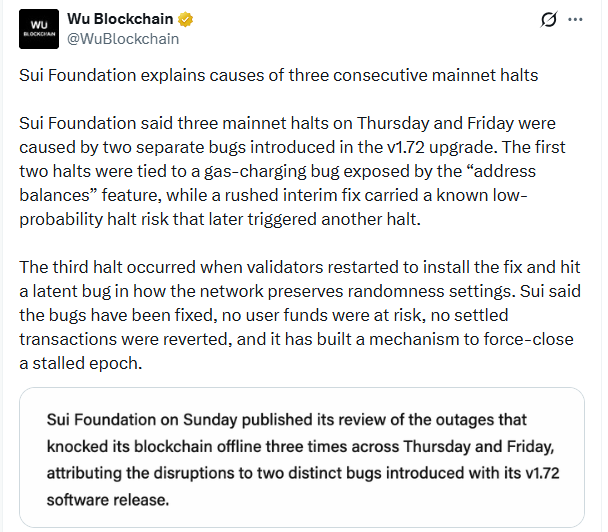 Source: X(formerly Twitter)
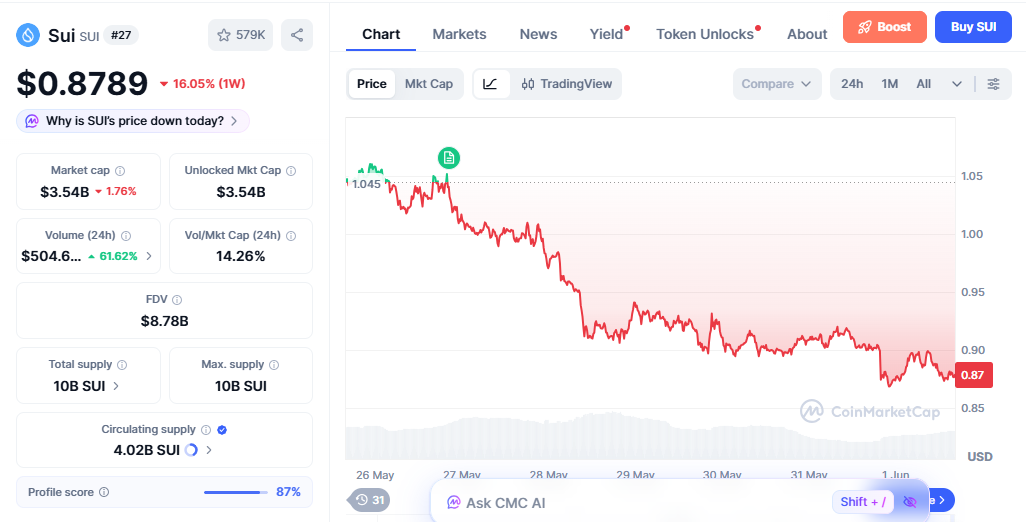
SUI trades near $0.8789. SUI dropped roughly 8% during the cascade to a low of $0.86 and was trading near $0.90 on Monday, leaving the token down about 16% on the week. Here is everything the Sui Foundation post-mortem confirmed.
What the Sui Foundation Post-Mortem Actually Revealed
The Sui Foundation post-mortem identifies two separate bugs — not one — as the cause of three halts.
Both the first and second halts trace to the same underlying flaw in the v1.72 release. The first two halts stemmed from the same flaw in how Sui charges transactions for gas, exposed by the "address balances" feature that v1.72 introduced.
Here is what address balances did and why it broke things. Version 1.72 introduced a new way for users to pay for gas — drawing directly from an address balance rather than a coin object. This was designed to make transactions simpler and to enable gasless stablecoin transfers.
The problem: when two transactions competed to spend from the same address balance simultaneously and one had to be cancelled, the gas charge did not respect the cancellation. The network still tried to charge for a transaction that was already cancelled. That produced a negative balance — an underflow — in the step where validators reconcile accounts. Validators crashed. Block production stopped.
 Source: CoinMarketCap Data
The first two stemmed from crash bugs involving the interaction of gas charging logic and the recent 1.72 release which introduced address balances. The Mysten Labs engineering team fixed this with PR 26828 — a code change that prunes address-balance gas payment entries on early aborts caused by insufficient funds, eliminating the crash path entirely.
The Known-Risk Fix: Why Sui Deployed a Patch It Knew Could Fail
This is the most important section of the Sui Foundation post-mortem — and the most candid admission.
What turned one outage into two was the patch itself. The foundation said the interim fix it rushed out Thursday carried a "known issue with a low probability of causing a halt," a risk the team accepted to bring the chain back quickly while a more durable fix was built. On Friday morning, the network hit a variant of that issue and halted a second time.
The team had two options on Thursday. Option one: deploy a robust, fully tested fix — which would take hours longer to build and leave the network down. Option two: deploy a faster interim patch with a small known risk of triggering another halt, restore the network quickly, and build the durable fix in parallel. They chose option two.
The fix for the Thursday issue was an interim measure designed to restore functionality to the network while the Core Team worked on a long-term solution. The interim fix had a known issue with a low probability of causing a halt. The team accepted the risk accompanying this proposal in order to bring the halted network back as quickly as possible while a robust fix was developed.
The second halt lasted approximately three hours and 30 minutes — shorter than the first, because the fix framework already existed and validators coordinated faster the second time.
This admission is unusual and significant. Most blockchain projects frame outages as unpredictable. The Sui Foundation post-mortem explicitly confirms the team made a calculated risk decision that did not pay off. That level of transparency is rare — and it raises a legitimate question about whether faster recovery is worth a second halt.
Third Halt Explained: The Randomness Bug Nobody Saw Coming
The third halt had a completely separate root cause — one that was entirely independent of the gas charging bug.
The third halt had a different and previously undisclosed cause. It was triggered when validators restarted to install Friday morning's fix, which tripped a latent bug in how the network preserves its randomness settings between restarts.
The randomness protocol on it runs automatically at the start of each epoch — a roughly 24-hour validator window. When validators restarted to deploy the long-term fix, the randomness initialization process failed because it required a higher quorum threshold than the consensus could provide at that moment.
A latent bug — one that had been dormant in the codebase before v1.72 — then prevented the network from recovering the randomness state across restarts. The result: the epoch could not complete its transition. User transactions froze again.
The two failure modes were independent, with the randomness state issue having been latent in the codebase before the v1.72 release but only exposed by the unusual restart conditions created by the emergency patching process.
Mysten Labs fixed this with PR 26846 — a second emergency code change that introduced a deterministic force-close mechanism for stalled epochs. This tool allowed validators to converge on a consistent state and resume block production. The fix set the mainnet recovery target to epoch 1142, consensus commit 768980. This allowed validators to converge on a consistent state and resume block production without reverting any previously committed transactions.
The Sui Foundation post-mortem confirms Sui used this force-close tool once during the recovery. The mechanism is now permanently available as an emergency tool for future epoch failures.
What Sui Foundation Post-Mortem Means for Investors Now
The Sui Foundation post-mortem closes with four confirmed safety statements: bugs are fixed, no user funds were at risk, no settled transactions were reverted, and the force-close epoch mechanism now exists permanently.
Those four points address the immediate concerns. The longer-term question the post-mortem raises is about testing — not fixing.
The events represent Sui's third major reliability incident since its 2023 mainnet launch, following a two-hour transaction scheduling bug in November 2024 and a six-hour consensus divergence in January 2026. All three incidents involved different root causes. That diversity of failure modes suggests a systemic gap in pre-deployment edge case testing — not a single recurring bug.
The v1.72 release introduced two user-facing improvements — address balances and gasless stablecoin transfers. Both are useful features. Both also created new code paths that interacted with existing consensus logic in untested ways. The Foundation post-mortem implicitly confirms that neither the address balance gas interaction nor the randomness state behavior under restart conditions was caught in staging.
Three signals to watch in the coming weeks. First: does Mysten Labs publish an updated testing framework or pre-deployment checklist? The post-mortem describes what went wrong but does not detail process changes. Second: does it recover toward $1.05 resistance as community confidence rebuilds? Third: do Canary and Grayscale — both running ETF products — make any public statements about the outage pattern?
All projections are from public market sources on assumption basis only. No guaranteed outcomes.
Conclusion
The Sui Foundation post-mortem is the most honest incident report any major Layer 1 blockchain has published in 2026. Two separate bugs, three halts, one knowingly risky fix, one new emergency tool. No funds lost. No transactions reversed. But the transparency itself reveals a gap: features that simplify user experience created code paths that the network's testing did not cover.
YMYL Disclaimer
The information provided in this article is based on publicly available sources as of June 2026. Cryptocurrency investments carry significant risk, including possible loss of capital.
Also read:






