Tether News: How USDT Generated Nearly $481M This Month


Tether News: Where Did the $481M in 30-Day Revenue Come From?
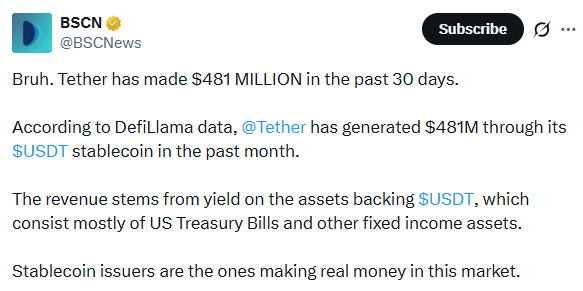
Today's Tether News puts a hard number on just how profitable stablecoin issuance has become. According to data tracked by DefiLlama, Tether generated approximately $481 million in fees over the trailing 30 days through its USDT stablecoin — figures independently visible on DefiLlama's own protocol page, which lists $480.96 million in 30-day fees, all counted as protocol earnings.
 Source: X(formerly Twitter)
Tether News: What the $481M Fee Figure Actually Means
Per DefiLlama's tracking, this 30-day figure isn't a one-off spike — the platform lists Tether's trailing annualized rate at roughly $5.94 billion in fees and revenue, which would place them among the highest-earning entities in the crypto industry by this measure if the pace holds. DefiLlama's data also ranks Tether by protocol revenue against other the issuers it tracks, including Circle and M0, with the stablecoin issuer consistently positioned at or near the top of that list in recent months, according to the platform's historical data.
It's worth being precise about what "revenue" means here: DefiLlama's fee and income figures for the USDT issuer represent income the company collects, not a measure of USDT's trading volume or market cap movement. The two are related but distinct — USDT's supply can stay flat while Tether's revenue still grows, since revenue is generated by the yield on reserve assets rather than by transaction activity itself.
Tether News: How USDT's Reserves Generate This earnings
Tether's revenue model is structurally simple: USDT holders don't earn interest on their tokens, but this firm does earn interest on the assets backing those tokens. According to Tether's own published disclosures, the bulk of USDT's reserves sit in short-term U.S. Treasury bills and other fixed-income instruments — assets that generate real yield in a higher-rate environment. That spread, between what the USDT issuer earns on its reserves and what it pays out to USDT holders (nothing), is the core of the company's profitability.
This model scales directly with two factors: how large USDT's circulating supply grows, and how attractive short-term Treasury yields remain. Both have worked in Tether's favor for much of the past two years, a period that's also coincided with USDT's rise to become the dominant stablecoin by circulating supply.
Tether News: USDT's Market Position Today
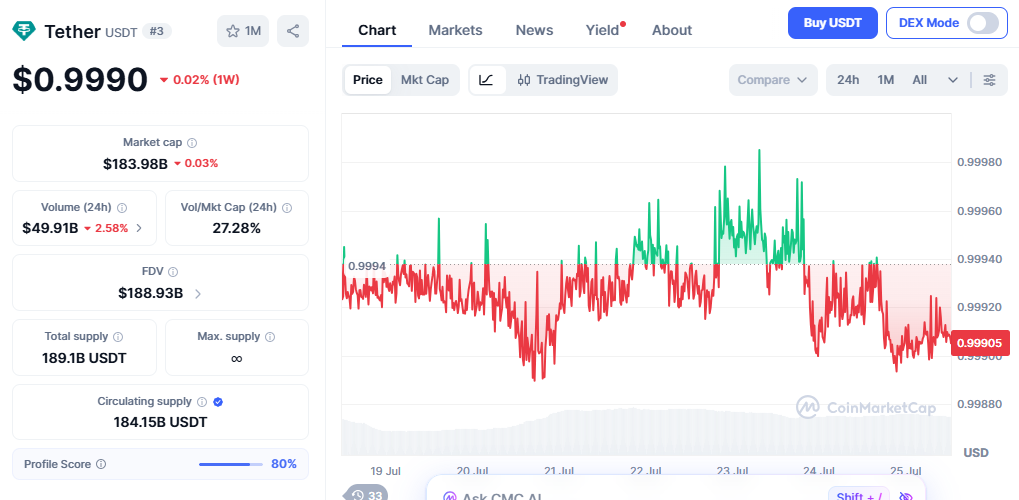
As of today, USDT is trading at approximately $0.9990, within a normal range of its dollar peg, with a market cap of roughly $183.98 billion. Total supply stands at about 189.1 billion USDT, with roughly 184.15 billion currently in circulation, and 24-hour trading volume of approximately $49.91 billion. USDT remains the largest stablecoin by market capitalization, a position that directly underpins the fee revenue DefiLlama is tracking — a larger reserve base, holding a larger pool of Treasury-yielding assets, produces a larger income stream almost mechanically.
The scale of this revenue has drawn attention to a broader pattern in the stablecoin sector: issuers themselves, rather than most token holders or traders, have emerged as the entities capturing consistent, structural income from the stablecoin market's growth.
Conclusion
Today's Tether news underscores a straightforward but consequential fact: stablecoin issuance, not just trading, has become one of crypto's most reliably profitable business models. USDT's roughly $481 million in 30-day fees, per DefiLlama, stems almost entirely from yield on Treasury-backed reserves — a model that scales with supply growth and interest rates rather than market speculation.
Disclaimer
This article is for informational purposes only and does not constitute financial or investment advice. All figures are based on data from DefiLlama's the stablecoin issuer protocol page and market data as of July 25, 2026, and are subject to change as fees, reserve yields, and market conditions fluctuate. Always conduct independent research before making any investment decision.









