EU MiCA Regulation Update: Banks Nearly Double, Germany Leads Growth


EU MiCA Regulation Update: 80 Banks Listed on Crypto Provider Register
Banks have nearly doubled their presence on the EU MiCA registry in roughly three months. Their share now sits near 23%, as per analysis of ESMA data. Germany drove much of the jump, while total listed providers rose from 243 to 349.
At a Glance
-
About 80 banks are now listed, up from about 40 on June 26.
-
Bank share rose from about 17% to about 23%.
-
EU MiCA Update Total registered providers grew from 243 to 349.
-
Germany is the largest contributor to the increase.
-
Banking institutions enter through the Article 60 notification route.
-
Latest Registry Development
ESMA's register was last updated on September 16, 2026. Between June 26 and that date, the number of banks on the list climbed from roughly 40 to roughly 80. That lifted their share from about 17% to nearly 23%, close to one in four providers.
Non-bank firms still form the majority at about 77%. Their share was about 84% in late June. They kept growing in absolute numbers, but Banking growing grew faster.
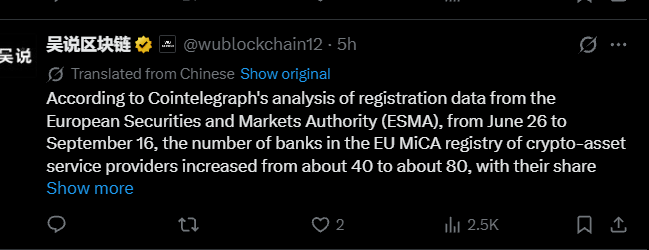
Source: Wu Blockchain
EU MiCA Registry: Banks Nearly Double in Three Months
| Metric | June 26, 2026 | September 16, 2026 |
| Bank on the register | About 40 | About 80 |
| Bank share | About 17% | About 23% |
| Total registered providers | 243 | 349 |
| Non-bank share | About 84% | About 77% |
The table shows how quickly the makeup of the EU-regulated crypto service market is changing. Total providers rose by 106 in under three months.
Germany Drives the Rise of Banks on the MiCA Register
Germany accounts for much of the growth. Dozens of cooperative and commercial banking groups now appear on the list, including many Volksbank, Raiffeisenbank and VR Bank institutions. This suggests regulated crypto services are reaching regional lenders, not only large international groups.
Deutsche Bank also appears among the new names. On Wednesday, it announced plans to launch digital asset custody for institutional and corporate clients in Europe. A spokesperson said the bank expects regulatory approval in October, so the service is not yet live.
Why Banks Have a Different Route Under EU MiCA
Ordinary crypto firms must apply for authorization as crypto-asset service providers, known as CASPs. Credit institutions can take another path. Under Article 60, a bank may offer crypto services after notifying its home regulator at least 40 working days before it starts.
This does not mean lenders skip oversight. The notification must still describe the bank's operations, anti-money laundering controls, IT security, business continuity plans, and custody arrangements. Financial firms also remain bound by their existing financial sector rules. It is a different pathway, not a lighter one by default.
What Crypto Services Can Banks Offer?
The services banking groups can offer depend on their existing permissions and what they notify. The main categories are:
-
Custody of crypto-assets
-
Exchange between crypto-assets and funds, or between crypto-assets
-
Execution of client orders
-
Reception and transmission of orders
-
Investment advice
-
Portfolio management, where applicable
What the Changing Provider Mix Means
Financial institutions are still a minority, and non-bank providers remain the larger group. Even so, the shift is material. Traditional lenders and crypto-native companies increasingly offer overlapping services, so competition between them is likely to grow.
The 23% figure is a headcount of listed providers. It says nothing about trading volume, assets under custody or actual market share. Readers should not treat it as a measure of how much business banks handle.
Implications for Crypto Users in Europe
More regulated institutions may soon serve corporate and institutional clients. Banking Institutions can also link crypto services to existing customer relationships, which some users may find convenient.
Authorization is not the same as asset protection, though. Crypto-assets held with a bank are not ordinary deposits and do not receive standard deposit insurance. Users should check what protections apply before moving funds.
Timeline: From 40 Banks to 80
-
June 26, 2026: About 40 banking groups are listed, roughly 17% of providers.
-
June to September 2026: Total providers grow from 243 to 349, with banks expanding faster than non-banks.
-
September 16, 2026: ESMA latest update shows about 80 banks, near 23% of the register.
-
From September 2026: The register keeps changing as national authorities send updates to ESMA, which maintains the public list.
Conclusion
Bank participation has moved from a small slice of the register to nearly a quarter of it within a single quarter. Germany's regional banking groups and Deutsche Bank's planned custody service show the trend is broadening. The next few months will show whether the pace holds or levels off. Readers can check the ESMA register directly for current entries.
YMYL Disclaimer: This article is for information only and is not financial, legal, or investment advice. Regulatory details can change, so verify them with official sources such as ESMA and your national regulator before acting. Cryptocurrency investments are highly volatile and carry a significant risk of loss. Do your own research and consult a licensed financial adviser before making any decisions.









