Pee Network News: 480M $PN Cap Explained, Mobile Mining to Mainnet


Pee Network News: Scarcity Message Lands on X
The latest Pee Network News centers on a post shared on September 19, 2026. The project says its native coin is built to be scarce, with a fixed cap of 480,000,000 $PN and a burning methodology.
For readers following crypto news today, this is a tokenomics message rather than a launch announcement.
The documentation describes a Layer 1 blockchain for trusted global commerce, so the supply story sits beside a wider business goal.
Businesses often struggle to prove credibility in unfamiliar markets, and the protocol targets that gap with decentralized identity, cryptographic proofs, and immutable records.
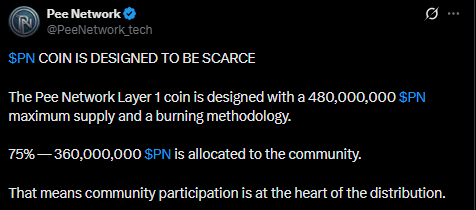
Source: Official X Post
The 480 Million Supply Split in Full
The tokenomics page confirms the figures in the post, and this Pee Network News update can now show the full split:
Allocation area | Amount | Share |
Community | 360,000,000 | 75% |
Ecosystem development | 120,000,000 | 25% |
Total supply | 480,000,000 | 100% |
The documentation calls 480,000,000 the fixed maximum supply of the native asset.
Community coins are meant to reach users through mobile-first mining and participation programs, aiming for broad ownership and long-term engagement.
What the Ecosystem Development Reserve Covers
The remaining 25%, or 120,000,000 coins, is reserved for building the wider ecosystem rather than for mining rewards. The documentation lists these purposes:
Infrastructure development
Ecosystem incentives
Strategic partnerships
Research and innovation
Expansion initiatives
A key open point for Pee Network News coverage is timing. The tokenomics page gives no vesting schedule or release timeline for this reserve.
Where $PN Fits in Fees, Escrow, and Staking
The utility page presents $PN as the economic base of the protocol. Its role is described as growing alongside applications built on the chain. The listed functions include:
Transaction fees for transfers, smart contracts, and business registrations
Verification requests for identity and credentials
Escrow settlement for programmable trust agreements
Governance votes on upgrades and treasury use as decentralization grows
Validator rewards and staking for security
Incentives for referrals, onboarding, and education
The page uses cautious wording such as "may," so several roles depend on future rollout.
Pee Network News followers should note that scarcity matters little without real usage. The page says demand for protocol services may rise as more businesses verify identities and more users trade.
Burning Methodology and What Remains Unclear
The post mentions a burning methodology, yet the tokenomics and utility pages reviewed do not describe it. A burn permanently removes coins from circulation, so the rules matter.
Some may see the burn idea as a supply control tool, but a plan without numbers cannot be judged.
Here is what to watch for:
Burn triggers and timing
Automatic or manual burns
Where removed coins are sent
Whether burns are verifiable on-chain
Until those rules are published, scarcity stays a stated design goal rather than a measured result.
Mobile Mining Today and Mainnet Later
According to the whitepaper, users currently earn simulated allocations through the mobile app during the infrastructure phase.
After mainnet launches, and subject to final rules and eligibility, qualifying allocations may migrate to the live environment.
Compared with traditional crypto mining, the approach in this Pee Network News story is very different. Participation happens on a phone, and current balances are not live tradable assets.
Current balances are simulated
Migration depends on final rules
Eligibility details are still limited
Source: Official Whitepaper
Risks to Weigh and Final Takeaways
Scarcity claims are only as strong as the rules behind them. Before acting on any $PN discussion, verify the burn design, the release plan for the reserve, and the mainnet migration terms through official documents.
Confirm burn rules once published
Check eligibility requirements carefully
Avoid treating simulated balances as assets
Never rely on social posts alone
The mobile app phase is a bridge, not the destination. The real test arrives when eligibility, burn mechanics, and reserve timing are published together.
For Pee Network News readers, the takeaway is a fixed 480,000,000 cap, a 75% community share, and a broad utility plan that still needs proof.
YMYL Disclaimer: This article is for informational purposes only and is not financial, investment, or legal advice. Details come from the project's official X post dated September 19, 2026, and its public documentation, and they may change. App balances are simulated, and any mainnet migration depends on final rules and eligibility. Crypto assets are volatile and risky, so do your own research before making any decision.