ARC Price Prediction: Can Circle's Arc Token Hit $1 Post Mainnet TGE?


ARC price prediction for 2026 centers on one unresolved question: how the token performs once it moves from a $0.30 presale round toward a live market. Arc's public mainnet goes live on September 16, 2026.
Based on the $3 billion FDV set at presale, institutional validator backing, and expected low early circulating supply, the token could realistically trade in the $0.25 to $0.90 range shortly after TGE.
A confirmed $1 breakout depends heavily on unlock schedules and actual network adoption.
What Is Driving the $ARC Price Outlook
This $ARC price prediction cannot be separated from what is actually happening on the ground with $ARC right now, starting with who is securing the network and when it goes live.
Founding Validator Cohort Announcement
On August 5, 2026, Circle confirmed Arc's founding validator cohort in an official press release.
The list includes BlackRock, DTCC, Galaxy, Global Payments, ICE, Mastercard, MoneyGram, SBI Group, Standard Chartered, Sumitomo Corporation, and Visa, alongside Circle itself
(Source: Circle Pressroom, Circle Announces Founding Validator Cohort, August 5, 2026).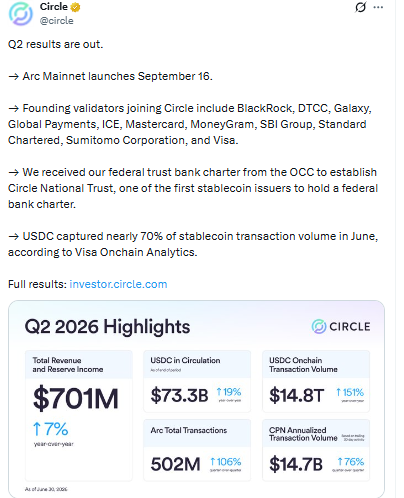
This is unusual for a Layer-1 network. Instead of anonymous or crypto-native validators, project is secured by regulated financial institutions, which the announcement frames as necessary for meeting compliance standards required of critical financial infrastructure.
Circle also confirmed this Arc news today through its own Q2 2026 results post, noting total revenue and reserve income of $701 million, USDC in circulation at $73.3 billion, and total transactions already at 502 million during the private mainnet phase
(Source: Circle, Q2 2026 results announcement, August 5, 2026).
$ARC Mainnet Launch Timeline
Arc's own account confirmed the launch date directly: "Arc Mainnet. September 16."

(Source: @arc on X, August 5, 2026).
The public mainnet launch is distinct from the token's TGE, which has not been given an exact date. The token generation event could land alongside the mainnet, shortly after, or closer to the eventual PoS transition.
This timing gap is exactly why any ARC price prediction right now carries real uncertainty.
Circle Arc's Tokenomics and Presale Details
These tokenomics figures come from Circle's own whitepaper, published in May 2026
(Source: Introducing the ARC Token Whitepaper, Circle, May 13, 2026).
Presale figures are project-self-reported and have not been independently audited by a third party as of this writing.
Tokenomics like these form the backbone of any credible ARC price forecast, since allocation size directly shapes future sell pressure.
Circle $ARC Token Vesting and Unlock Schedule
Presale investors face a minimum one-year lock-up starting after Arc transitions to Proof-of-Stake, with additional restrictions possible for up to four years.
That PoS transition carries an outside deadline of May 8, 2028, after which investors gain repayment rights if it has not occurred.
Circle's own 25% allocation and the 15% long-term reserve do not yet have a fully public vesting schedule either.
This matters directly for the ARC price prediction above: a lighter-than-expected early circulating supply tends to support the bull case, while any surprise early unlock would push toward the bear scenario.
ARC Price Prediction 2026: Bear, Base and Bull Scenarios
Since the token has not launched on any public exchange yet, this ARC price prediction is built around the $0.30 presale entry point and the $3 billion FDV disclosed in the whitepaper.
Comparisons are drawn from how similar institutional-grade Layer-1 tokens performed after their own token generation events.
There is no trading chart to lean on here, so the numbers in this $ARC price forecast are directional, not technical.
Circulating supply at TGE is the single biggest swing factor behind this ARC price outlook, and it has not been disclosed publicly yet.
Risks and Regulatory Considerations
The project has not been reviewed or approved by the New York State Department of Financial Services or any other regulatory authority, according to Circle's own disclaimers attached to the official press release.
The network currently runs as a permissioned proof-of-authority chain rather than a fully decentralized one.
Gas fees are paid in USDC rather than the native token, meaning its day-to-day utility only activates in stages after the PoS transition.
Regulatory clarity, actual fee volume once BUIDL and DTCC integrations go live in the second half of 2027, and the pace of institutional onboarding will likely matter more to the token's price than short-term market sentiment.
Expert Opinion on ARC Price Outlook
Analysts covering institutional-grade Layer-1 launches tend to note that validator quality and FDV alone rarely determine post-TGE price action.
What has historically mattered more for comparable networks is how quickly circulating supply grows relative to actual on-chain usage.
Given Arc's founding validator list and its direct tie to USDC, the network's fundamentals appear stronger than most presale-stage projects at a similar valuation.
Even so, analysts would caution that a confirmed $1 price target in this ARC price prediction remains speculative until the TGE date, exact circulating supply, and exchange listings are formally announced.
Disclaimer: This article is for informational purposes only and does not constitute financial advice. Cryptocurrency markets, including presale and pre-TGE tokens like this, are highly volatile and carry significant risk. CoinGabbar has no sponsorship, affiliate, or paid partnership with Circle, $ARC, or any related entity. Always conduct your own research before making investment decisions.