Avalanche Price Prediction: Is $AVAX Ready To Rocket Higher Soon?


AVAX has been quietly grinding inside a tight range for a month now. As of press time, it's pressing right up against the wall that's kept it boxed in since May.
Traders who caught the last big Avalanche run know how fast this coin can move once it picks a direction. The setup on the daily chart right now looks like exactly that kind of moment building.
This Avalanche Price Prediction breaks down where $AVAX could head next and what would need to happen for either side to take control.
Key Takeaways
-
AVAX price today sits at $6.522, up 1.95% in the last 24 hours, according to CoinMarketCap data. The token is testing a resistance zone it has failed to clear for weeks.
-
A breakout above current resistance could send AVAX price prediction targets toward $8.18, $9, and eventually $10.55. A rejection instead risks a drop toward $6.54, then $5.72, with $3.20 as a long-term downside level.
-
Liquidation data from Coinglass shows shorts took the bigger hit over the past hour. Long/short ratios across major exchanges lean bullish as of this writing.
-
Fresh Avalanche ecosystem news is mixed. A new payments initiative sits on one side and a treasury covenant default on the other.
Avalanche News Today: What's Moving AVAX
Two fresh developments are shaping sentiment around Avalanche news today, and they pull in opposite directions.
On the bullish side, the newly formed Avalanche Payments Collective is bringing together firms across payments and treasury, according to a recent post from MSB Intel.
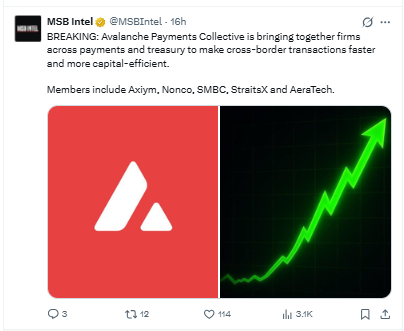
Members reportedly include Axiym, Nonco, SMBC, StraitsX, and AeraTech, aimed at making cross-border transactions faster and more capital-efficient. Banking-grade partners entering the ecosystem is generally read as a positive signal for long-term adoption.
On the risk side, AVAX One, Avalanche's treasury firm, hit a real roadblock. Its lender raised the minimum liquidity requirement 35-fold to $3.5 million, according to a recent SEC filing reported by BSCNews.
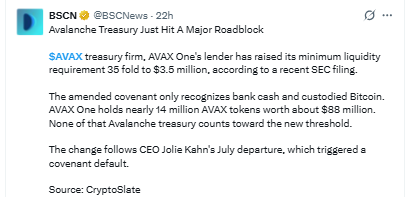
The amended covenant only recognizes bank cash and custodied Bitcoin, meaning AVAX One's nearly 14 million AVAX tokens, worth around $88 million at press time, don't count toward that new threshold.
This change followed the departure of CEO Jolie Kahn in July, which reportedly triggered a covenant default.
It's a corporate-structure issue tied to one treasury entity rather than a network-level problem, but it's worth watching since AVAX One holds a meaningful chunk of circulating supply.
Avalanche Long/Short Ratio And Liquidation
Trader positioning right now leans clearly bullish, per Coinglass data as of August 8, 2026.
On Binance, the AVAX/USDT long/short ratio by accounts sits at 1.6448, while OKX shows an even higher 2.06.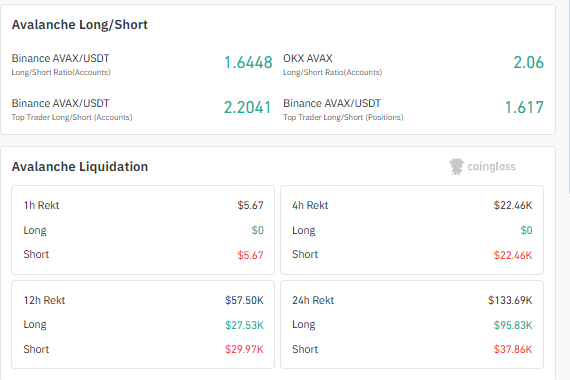
Binance's top trader positioning by accounts reads 2.2041, and by actual positions, it's 1.6171.
More traders are long than short across the board, though that alone doesn't guarantee direction.
Crowded long positions can also set up sharper liquidations if price turns the wrong way.
AVAX liquidation data, also sourced from Coinglass, tells a related story.
Over the last hour, $5.67K was wiped out, all of it from short positions. Over 4 hours, $22.46K was liquidated, again almost entirely shorts.
Zooming out to 24 hours, $133.69K in AVAX positions got liquidated. Longs accounted for $95.83K of that and shorts for $37.86K.
That's a shift from the shorter timeframes, showing longs took real pain earlier in the day before the recent bounce.
This mixed liquidation picture fits a market still deciding on direction as of this writing. Shorts got squeezed in the immediate short-term, but the bigger 24-hour picture shows longs also getting tested on the way down before this recovery.
Avalanche Price Prediction: Technical Analysis Of The AVAX Chart
Since around mid-January, when AVAX was trading near $15, the coin has been stuck inside a falling wedge on the daily chart, a pattern of continuously lower highs and lower lows squeezed inside two converging trendlines. 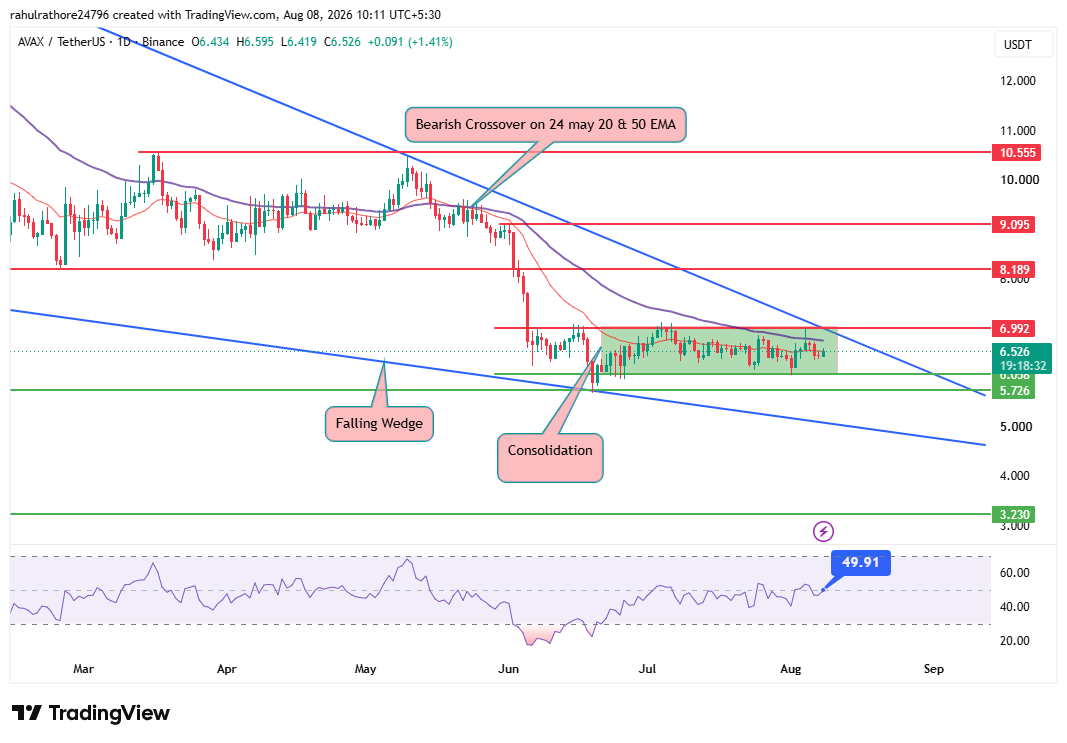
Chart source: TradingView, AVAX/USDT daily chart, dated August 8, 2026, 10:11 UTC +5:30.
Price managed to sustain above $8 for a while, but that changed on May 24.
A bearish crossover between the 20 and 50 EMA hit on that date, and AVAX fell sharply afterward, eventually printing a low near $5.70.
Since that drop, AVAX has settled into a consolidation zone between roughly $5.54 and $6.992, trading inside that box for close to a month as of the time of writing.
Right now, price is pushing up against the 20 and 50 EMA, which are acting as immediate resistance overhead. This is the same zone that has capped rallies for weeks.
If AVAX manages a daily close above these EMAs, it would also count as a breakout from the larger falling wedge that's been in play since January.
That combination, wedge breakout plus EMA reclaim, is the kind of confluence that tends to attract fresh buying interest.
On a confirmed breakout, the first upside level to watch is $8.18. Above that, $9.00 comes into view, followed by a longer-term target near $10.55.
If price gets rejected at the EMA cluster again, the first support to watch is $6.54. A break below that puts $5.72 in focus next.
A deeper breakdown from there could eventually expose $3.20 as a long-term lower level, though that's a scenario for further down the road, not an immediate risk.
RSI on the daily chart reads 49.91 at press time, sitting almost exactly in the middle of neutral territory. That fits a market that hasn't picked a side yet, holding steady rather than showing strong momentum in either direction.
AVAX Price Prediction: Bear, Base, And Bull Scenarios
Methodology note: these levels are drawn from prior swing highs and lows on the daily AVAX/USDT chart as of August 8, 2026, treated as historical demand and supply zones, along with the falling wedge boundaries.
The bull case needs sustained volume on the breakout candle, not just a brief wick above resistance.
The bear case would be invalidated by a quick reclaim of $5.72 within 24-48 hours, which would suggest a false breakdown rather than a genuine trend shift.
Glossary: Key Terms In This Avalanche Price Prediction
Falling Wedge: A chart pattern formed by two converging downward-sloping trendlines, often seen as a potential reversal signal when price eventually breaks above the upper line.
EMA Crossover: When a shorter-term exponential moving average crosses above or below a longer-term one, often used by traders as a signal of shifting momentum.
Long/Short Ratio: A measure of how many traders are betting on price going up (long) versus down (short) on a given exchange. A ratio above 1 means more traders are long.
Liquidation: When an exchange forcefully closes a trader's leveraged position because losses have eaten through their margin, often accelerating price moves in the direction of the liquidation.
Consolidation: A phase where price moves sideways in a tight range instead of trending, often seen as the market pausing before its next directional move.
Covenant Default: A breach of the terms set by a lender in a loan agreement, which can trigger penalties or force renegotiation of the loan.
Expert View
According to the CoinGabbar analyst desk, $AVAX current setup as of August 8, 2026, reflects a market at a genuine decision point rather than a clear trend in either direction.
The Avalanche coin price prediction outlook here leans cautiously constructive, given the falling wedge structure, the bullish skew in long/short positioning from Coinglass data, and the fresh institutional interest from the Payments Collective news.
That said, the AVAX One treasury situation is a reminder that not all news flow is positive, and traders should weigh both catalysts rather than focusing only on the bullish side.
At press time, a daily close above the EMA cluster would be the clearest signal that buyers are back in control.
Disclaimer: This article is for informational purposes only and should not be treated as investment or financial advice. Cryptocurrency markets are highly volatile, and readers should conduct their own research before making any investment decisions. CoinGabbar has no sponsorship or affiliate relationship with Avalanche or AVAX One.