Avalanche News: Kenya Records and Stocks Go Live


Avalanche News: Powers Kenya Records and US Stocks
Recent Avalanche News highlights a big week for real-world assets on the network. Two separate announcements, one in African public education and one in U.S. equity markets, both point in the same direction:
The network is being used for jobs that have nothing to do with crypto trading. In Kenya, academic records now sit onchain.
In the US, tokenized S&P 500 stocks went live for investors. Different sectors, same underlying story.
Kenya Puts Academic Records Onchain
The Kenya National Examinations Council, or KNEC, teamed up with the network for certificate verification.This Avalanche News update highlights how blockchain adoption is expanding beyond crypto trading into public-sector infrastructure.
According to a post shared by MSB Intel on X, Kenya's National Examinations Council (KNEC) has moved academic records onchain using Avalanche, enabling instant credential verification for employers. 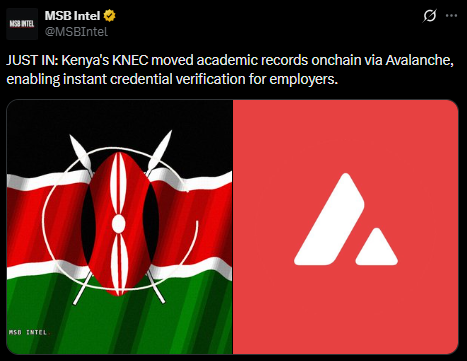
It's one of the largest real-world asset projects the education sector has seen so far, and it shows something simple: public institutions can actually put this kind of infrastructure to work, not just talk about it.
Here's what the rollout includes, according to the project:
Over 15 million academic records moved onto the C-Chain
Records dating back to 1989, with plans to expand to 35 million
Nearly 1 million KCSE 2025 certificates issued only through the digital platform
Verification powered by Merkle-tree proofs, so full personal data stays off the public chain
The goal is straightforward. Certificate fraud has been a long-standing problem in Kenya, and officially stated goals include faster checks for employers and universities.
No more waiting weeks for manual confirmation. Institutions can verify a certificate in seconds now. Candidate data stays more secure too, since only proof data gets stored onchain rather than full personal records.
This deployment is meant to make it one of the largest credential verification systems of its kind anywhere in Africa.
Dinari Brings Tokenized Stocks to the Network in Latest Avalanche News
The second update comes from Dinari. The company just launched tokenized stocks, adding to real-world asset growth in traditional finance, and it's using this same chain as one of its settlement layers.
Investors can trade dShares now, tokenized versions of real stocks.
According to Avalanche's official X account, U.S. investors and businesses can now trade 724 tokenized U.S. stocks and ETFs, including the entire S&P 500, through Dinari on Avalanche C-Chain. 
A quick look at the launch details:
Feature | Detail |
Stocks available | 724, including the full S&P 500 |
Token name | dShares |
Backing | Held 1:1 by a regulated custodian |
Settlement currency | USDC (Circle) |
Networks supported | Avalanche, Ethereum, Arbitrum, Base |
Wallet type | Self-custody |
Shareholder rights | Dividends, voting, corporate actions |
Access runs through the Dinari Trading App. Users buy and sell tokenized S&P 500 stocks straight from a self-custody wallet, funded with USDC.
Dividends land in USDC too, so investors can keep their funds on-chain instead of pulling everything back to a bank account.
The whole launch is built around giving US investors and businesses tokenized stock access through their crypto wallets.
Dinari operates as a registered broker-dealer and transfer agent, which keeps the offering inside existing securities rules rather than skirting around them.
The setup is designed to preserve normal shareholder protections, even though the shares technically exist as blockchain tokens.
What It Means Going Forward
Put the two stories side by side and a pattern emerges. Real world assets on this network aren't limited to DeFi apps anymore.
Governments and financial firms are using it for practical jobs: record-keeping on one side, stock settlement on the other.
The Kenya deal proves a decentralized ledger can support public services at scale. The Dinari deal proves tokenized equities can bring stock markets closer to ordinary crypto wallets.
Taken together, this Avalanche News roundup highlights a notable week for AVAX-related real-world asset (RWA) adoption, driven by practical blockchain use cases rather than speculation alone.
Neither project guarantees future performance for AVAX or related tokens, though. Both are still early. How far this goes will depend on employers, investors, and regulators and how they respond over the coming months.
Disclaimer: This Avalanche News article is for educational and informational purposes only and should not be considered financial or investment advice. Always conduct your own research before making investment decisions.