Bitcoin Price Prediction July 2026: BTC Forecast and Key Price Levels


$BTC Struggles Below $63,000 After Fresh Middle East Tensions
$BTC is trading around $62,767, down about 1.53% on the day, according to TradingView charts on Bitstamp.
The chart shows BTC opened at $63,744 and touched a high of $64,385 before slipping back.
Price is now testing a small falling wedge pattern that formed after the early June drop from the $80,000 zone.
The Bitcoin price prediction July 2026 outlook depends heavily on whether bulls can defend the $58,000 to $60,000 support band seen on the daily chart.
Why Is $BTC Price Dropping Today?
The latest leg down followed news that U.S. Central Command forces launched fresh strikes against Iran at 5 p.m. ET.
The strikes aim to limit Iran's ability to threaten commercial ships in the Strait of Hormuz.
Iran has vowed to retaliate, and that kind of headline tends to push traders away from riskier assets like crypto.
The coin had already been fighting resistance near the psychological $65,000 mark before this news hit.
Bitcoin Price Chart: Key Levels To Watch
Level Type | Price Zone | Notes |
Resistance | $65,000 | Psychological level, recent rejection point |
Resistance | $80,000–$82,500 | Upper boundary of prior rising channel |
Support | $60,000–$58,000 | Tested in early July, held so far |
RSI (14) | 47.63 | Neutral, no strong momentum either way |
The RSI sitting near the midline suggests the market has not picked a clear direction yet.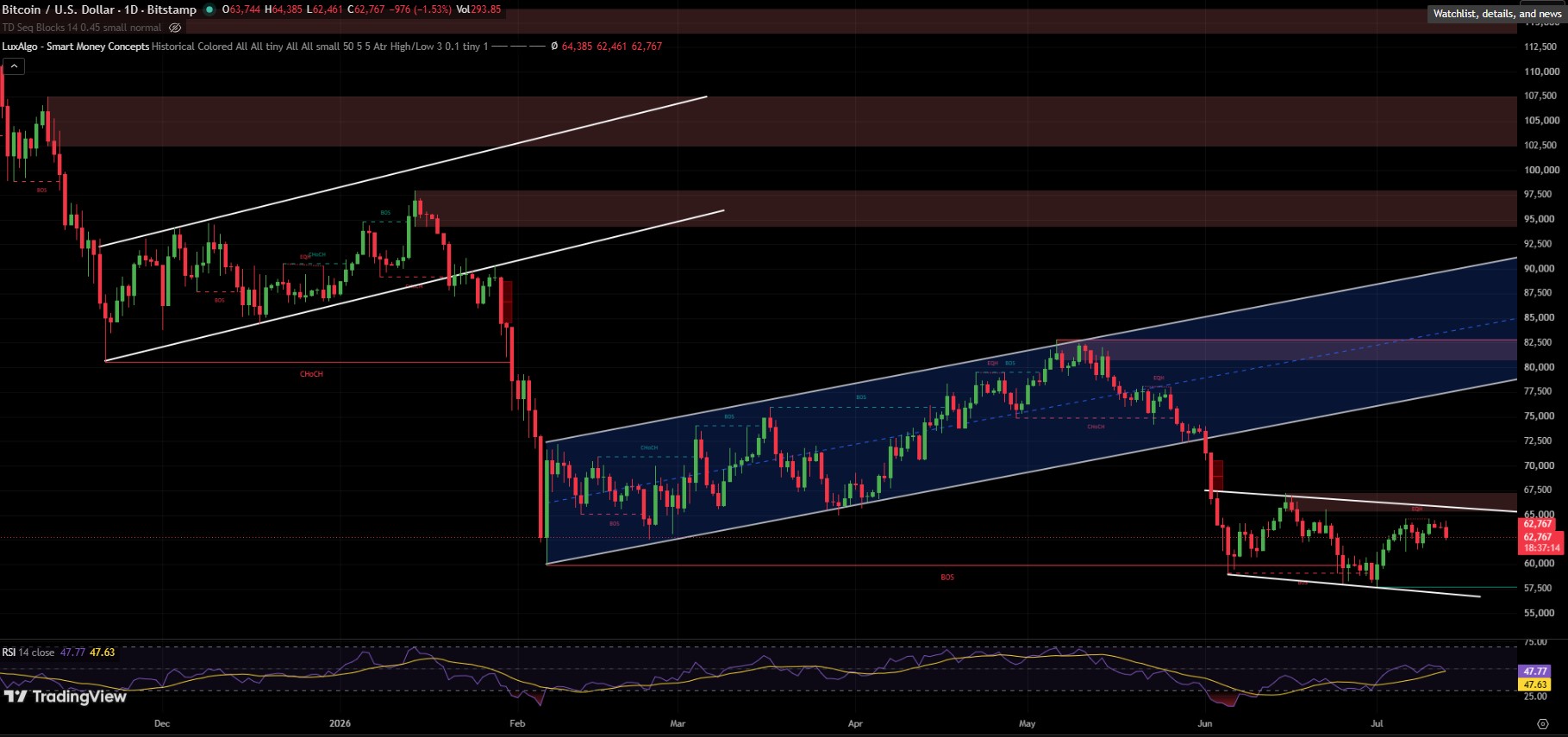
$BTC On-Chain Activity Is Cooling Off
Data shared by Ali Charts shows weekly active Bitcoin addresses fell by 7.6%, dropping from around 660,000 to 610,000.
Fewer active wallets can be a sign that everyday network usage is slowing, even if price stays range-bound.
This kind of on-chain cooling often shows up before bigger price swings, though it does not point to a direction on its own.
$BTC ETF Inflows Return After Eight-Week Outflow Streak
US spot BTC ETFs recorded $197.4 million in net inflows for the week ended Friday.
This snapped an eight-week streak of outflows, which had pulled a total of $8.26 billion out of these funds since May 11.
BlackRock's iShares Bitcoin Trust led the pack with $291.9 million in inflows, even as some smaller funds still saw withdrawals.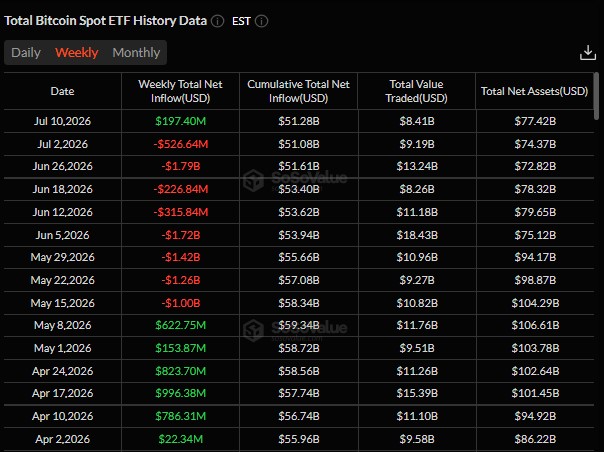
This shift matters for any Bitcoin price prediction July 2026, since ETF demand has been one of the bigger price drivers this cycle.
What Is Michael Saylor and Strategy Doing With BTC?
Michael Saylor posted Strategy's 25th tracker update of 2026, and the numbers are large.
Strategy now holds 843,775 BTC, worth close to $54 billion at current prices.
Metric | Figure |
Total BTC Held | 843,775 |
Average Entry Price | $75,653 |
Total Investment | $63.83 billion |
Current Value | ~$54 billion |
Unrealized PnL | -$10 billion (-16%) |
Purchase Rights | 115 |
Saylor also described BTC as a network of wallets weighted by satoshis, with miners and nodes balancing out consensus and security.
The market is now watching whether Strategy announces another buy on Monday, or takes the rare step of trimming its position.
Given the company's long-standing accumulation strategy, most traders expect another purchase rather than a sale.
American Bitcoin Shares Fall Despite Growing BTC Treasury
Away from Strategy, American Bitcoin's stock has dropped more than 95% from its peak.
That decline wiped out over $600 million of value from Eric Trump's stake in the company.
The company still grew its Bitcoin treasury past 8,000 BTC, and lowered its mining cost per coin.
But a 1-for-15 reverse split to meet Nasdaq's minimum price rule did not stop the stock slide, and the company posted a $118.2 million operating loss in Q1 2026 due to a non-cash BTC valuation charge.
This shows that a growing Bitcoin treasury does not always translate into a stronger stock price.
Bitcoin Price Prediction July 2026: What Could Happen Next
The world's largest cryptocurrency started July with a sharp recovery after dipping briefly below $58,000.
That rebound carried price back toward $64,500, before the Iran-related headlines dragged it back under $63,000.
For the Bitcoin price forecast to turn bullish, BTC likely needs a daily close back above $65,000 alongside continued ETF inflows.
A failure to hold the $58,000 support zone could open the door to a deeper pullback, especially if geopolitical tensions escalate further.
Right now, the setup looks like a market waiting for its next clear signal, rather than one committed to a direction.
Disclaimer
This article is for informational purposes only and should not be considered financial or investment advice. Cryptocurrency markets are highly volatile, and prices can rise or fall sharply within short periods. Always do your own research and consult a licensed financial advisor before making any investment decisions.
Also read:
4 weeks ago
very day, thousands of people visit websites offering investment opportunities, cryptocurrency services, and digital financial products. Many of these platforms are legitEimate, but others are created solely to deceive unsuspecting users. At first glance, a fraudulent website may appear professional, complete with customer reviews, support chat, and polished branding. The difference is often hidden beneath the surface. One of the most effective ways to reduce risk is to slow down before taking action. Verify the website address carefully, research the company behind the platform, and avoid making decisions based solely on urgency or promises of unusually high returns. A few extra minutes spent checking details can prevent significant financial loss. At CYBER VAULT GUARD*, we regularly educate individuals and businesses about cybersecurity risks, blockchain investigations, digital forensics, and online fraud awareness. Additional information about our professional services and educational resources can be found at Fraudulent platforms often rely on psychological pressure rather than technical sophistication. Victims may be told they have only a limited time to invest, claim a reward, or verify an account. Others are encouraged to ignore warning signs because "everyone else is making money." These tactics are designed to bypass careful thinking and create a sense of urgency. Another important habit is protecting personal information. Recovery phrases, authentication codes, passwords, and private keys should never be shared with anyone claiming they need them for verification or technical support. Legitimate organizations rarely request this type of sensitive information through unsolicited messages. If you believe you have interacted with a suspicious platform, avoid making further transactions until you have reviewed the situation carefully. Preserve emails, screenshots, wallet addresses, transaction IDs, and any communication related to the incident. Even small details may help establish a clearer timeline during a professional review. Cybersecurity is ultimately about making informed decisions. Technology provides powerful tools, but good judgment remains one of the strongest forms of protection. Staying informed, verifying information independently, and approaching unexpected opportunities with caution can significantly reduce exposure to online fraud. For confidential inquiries regarding cybersecurity consulting, blockchain investigations, digital forensics, or incident response, you can contact our team at **[ cybervaultguard (@)aol(.) com ] CYBER VAULT GUARD is committed to helping individuals and organizations strengthen their digital security through professional guidance, technical expertise, and evidence-based investigations. Whats App: +4.4.7.4.0.1.7.7.1.4.5.5

2 months ago
Lost Bitcoin, Ethereum, USDT, or other cryptocurrency to a scam? DIGITAL LIGHT SOLUTION provides professional cryptocurrency investigation and blockchain tracing services for victims of online fraud, fake investment platforms, Romance Crypto Scams, and unauthorized wallet transactions. At DIGITAL LIGHT SOLUTION, our experienced specialists use advanced blockchain analysis to investigate suspicious transactions and help clients understand the options available for pursuing their cases. If you have transaction records, wallet addresses, screenshots, or proof of payment, don't delay. Every detail can be valuable during an investigation. It's not too late to get your money back. Support team available 24/7. Email:digitallightsolution@qualityservice. com and Telegram ——digitallightsolution
2 months ago
Cryptocurrency scams continue to affect individuals and businesses worldwide, with victims losing digital assets through fake investment platforms, phishing attacks, romance scams, business email compromise (BEC), ransomware, and other forms of cyber fraud. At TechY Force Cyber Retrieval (TFCR), we help victims fight back through professional blockchain investigations and digital asset recovery services. Website (https://techyforcecyberretrievals.com) WhatsApp (+.1.5.6.1.7.2.6.3.6.9.7) Every case begins with a detailed blockchain transaction analysis and digital forensic investigation. Our cybersecurity professionals trace the movement of stolen cryptocurrency, identify destination wallets and exchanges, and gather digital evidence to develop a recovery strategy tailored to each client’s situation. Using advanced blockchain forensics and investigative techniques, we focus on identifying the parties behind fraudulent transactions and building evidence that supports potential recovery efforts. TechY Force Cyber Retrieval is a registered business headquartered in Michigan, United States, with a team of experienced cybersecurity experts, certified ethical hackers, and blockchain analysts dedicated to investigating cryptocurrency-related financial crime. Throughout every investigation, we maintain strict confidentiality, transparent communication, and realistic expectations about the recovery process. Website (https://techyforcecyberretrievals.com) WhatsApp (+.1.5.6.1.7.2.6.3.6.9.7) What sets us apart is our commitment to our clients through our No Recovery, No Upfront Fee policy. We never charge advance fees for qualifying cases. Instead, our compensation is based on a percentage of successfully recovered assets, ensuring our interests remain aligned with those of the people we serve. If you’ve lost cryptocurrency to online fraud, acting quickly can significantly improve the chances of tracing stolen assets. At TechY Force Cyber Retrieval, we are committed to providing professional, ethical, and evidence-based recovery support to help victims navigate the path toward reclaiming their digital assets.
2 months ago
Bitcoin USDC Recovery That Delivers Results: The Smart Way to Recover Bitcoin and USDC META TECH RECOVERY PRO Hire A Hacker Review of META TECH RECOVERY PRO, a professional cyber intelligence expert, crypto recovery lawyers, and private investigators, is designed for individuals and organizations seeking a credible and structured response to cybersecurity incidents and complex digital-asset losses. This service integrates threat-informed investigative methodology with legal and compliance-focused expertise, enabling clients to address both the technical root causes and the procedural requirements that often determine whether recovery efforts succeed.CONTACT THEM VIA https://metatechrecoverypro.com, Telegram:@metatechrecoveryproteam. W/S +1 (469) 692 8049. support@metatechrecoverypro.com META TECH RECOVERY PRO leverages advanced cyber intelligence capabilities to assist with incident analysis, attribution support, and evidence preservation. In practical terms, this may include forensic imaging guidance, digital artifact collection, timeline reconstruction, and the identification of indicators of compromise that can support law-enforcement engagement and potential civil or criminal proceedings. By emphasizing proper documentation and chain-of-custody practices, the approach helps ensure that recovered data and investigative findings remain usable in legal contexts. In addition to technical support, the inclusion of crypto recovery lawyers strengthens the engagement by translating investigative outputs into actionable legal strategies. Such strategies may involve reviewing available claims, advising on jurisdiction-specific procedures, preparing formal filings, supporting subpoenas or discovery requests where applicable, and assisting with coordination across stakeholders. This legal integration is particularly relevant for crypto-related incidents, where recovery often depends on the ability to connect on-chain activity, wallet behavior, and exchange interactions to identifiable parties through lawful processes. The involvement of private investigators further enhances coverage by enabling structured background inquiries and targeted verification of leads. Real-world recovery cases frequently require more than technical analysis; they may involve tracing communication patterns, validating identities, and confirming connections among accounts, devices, and entities associated with the loss. When combined with cyber intelligence and legal oversight, these investigative activities can improve the likelihood of locating responsible parties and recovering assets or damages. From a risk-management perspective, clients also benefit from a professional, process-driven framework rather than improvised actions that could compromise evidence or worsen outcomes. For example, delays in reporting, unauthorized access attempts, or changes to affected systems can reduce the clarity of forensic findings. A coordinated workflow that prioritizes containment, evidence integrity, and lawful escalation can therefore be critical to achieving measurable results. Overall, the Hire A Hacker Review of META TECH RECOVERY PRO presents a comprehensive option for those requiring a specialized blend of cyber intelligence, crypto recovery legal expertise, and private investigation services. By aligning technical investigations with legal strategy and real-world casework, the service supports clients in pursuing responsible recovery pathways while maintaining compliance and strengthening the evidentiary foundation for subsequent action.
2 months ago
Bitcoin USDC Recovery That Delivers Results: The Smart Way to Recover Bitcoin and USDC META TECH RECOVERY PRO Hire A Hacker Review of META TECH RECOVERY PRO, a professional cyber intelligence expert, crypto recovery lawyers, and private investigators, is designed for individuals and organizations seeking a credible and structured response to cybersecurity incidents and complex digital-asset losses. This service integrates threat-informed investigative methodology with legal and compliance-focused expertise, enabling clients to address both the technical root causes and the procedural requirements that often determine whether recovery efforts succeed.CONTACT THEM VIA https://metatechrecoverypro.com, Telegram:@metatechrecoveryproteam. W/S +1 (469) 692 8049. support@metatechrecoverypro.com META TECH RECOVERY PRO leverages advanced cyber intelligence capabilities to assist with incident analysis, attribution support, and evidence preservation. In practical terms, this may include forensic imaging guidance, digital artifact collection, timeline reconstruction, and the identification of indicators of compromise that can support law-enforcement engagement and potential civil or criminal proceedings. By emphasizing proper documentation and chain-of-custody practices, the approach helps ensure that recovered data and investigative findings remain usable in legal contexts. In addition to technical support, the inclusion of crypto recovery lawyers strengthens the engagement by translating investigative outputs into actionable legal strategies. Such strategies may involve reviewing available claims, advising on jurisdiction-specific procedures, preparing formal filings, supporting subpoenas or discovery requests where applicable, and assisting with coordination across stakeholders. This legal integration is particularly relevant for crypto-related incidents, where recovery often depends on the ability to connect on-chain activity, wallet behavior, and exchange interactions to identifiable parties through lawful processes. The involvement of private investigators further enhances coverage by enabling structured background inquiries and targeted verification of leads. Real-world recovery cases frequently require more than technical analysis; they may involve tracing communication patterns, validating identities, and confirming connections among accounts, devices, and entities associated with the loss. When combined with cyber intelligence and legal oversight, these investigative activities can improve the likelihood of locating responsible parties and recovering assets or damages. From a risk-management perspective, clients also benefit from a professional, process-driven framework rather than improvised actions that could compromise evidence or worsen outcomes. For example, delays in reporting, unauthorized access attempts, or changes to affected systems can reduce the clarity of forensic findings. A coordinated workflow that prioritizes containment, evidence integrity, and lawful escalation can therefore be critical to achieving measurable results. Overall, the Hire A Hacker Review of META TECH RECOVERY PRO presents a comprehensive option for those requiring a specialized blend of cyber intelligence, crypto recovery legal expertise, and private investigation services. By aligning technical investigations with legal strategy and real-world casework, the service supports clients in pursuing responsible recovery pathways while maintaining compliance and strengthening the evidentiary foundation for subsequent action.
2 months ago
Bitcoin USDC Recovery That Delivers Results: The Smart Way to Recover Bitcoin and USDC META TECH RECOVERY PRO Hire A Hacker Review of META TECH RECOVERY PRO, a professional cyber intelligence expert, crypto recovery lawyers, and private investigators, is designed for individuals and organizations seeking a credible and structured response to cybersecurity incidents and complex digital-asset losses. This service integrates threat-informed investigative methodology with legal and compliance-focused expertise, enabling clients to address both the technical root causes and the procedural requirements that often determine whether recovery efforts succeed.CONTACT THEM VIA https://metatechrecoverypro.com, Telegram:@metatechrecoveryproteam. W/S +1 (469) 692 8049. support@metatechrecoverypro.com META TECH RECOVERY PRO leverages advanced cyber intelligence capabilities to assist with incident analysis, attribution support, and evidence preservation. In practical terms, this may include forensic imaging guidance, digital artifact collection, timeline reconstruction, and the identification of indicators of compromise that can support law-enforcement engagement and potential civil or criminal proceedings. By emphasizing proper documentation and chain-of-custody practices, the approach helps ensure that recovered data and investigative findings remain usable in legal contexts. In addition to technical support, the inclusion of crypto recovery lawyers strengthens the engagement by translating investigative outputs into actionable legal strategies. Such strategies may involve reviewing available claims, advising on jurisdiction-specific procedures, preparing formal filings, supporting subpoenas or discovery requests where applicable, and assisting with coordination across stakeholders. This legal integration is particularly relevant for crypto-related incidents, where recovery often depends on the ability to connect on-chain activity, wallet behavior, and exchange interactions to identifiable parties through lawful processes. The involvement of private investigators further enhances coverage by enabling structured background inquiries and targeted verification of leads. Real-world recovery cases frequently require more than technical analysis; they may involve tracing communication patterns, validating identities, and confirming connections among accounts, devices, and entities associated with the loss. When combined with cyber intelligence and legal oversight, these investigative activities can improve the likelihood of locating responsible parties and recovering assets or damages. From a risk-management perspective, clients also benefit from a professional, process-driven framework rather than improvised actions that could compromise evidence or worsen outcomes. For example, delays in reporting, unauthorized access attempts, or changes to affected systems can reduce the clarity of forensic findings. A coordinated workflow that prioritizes containment, evidence integrity, and lawful escalation can therefore be critical to achieving measurable results. Overall, the Hire A Hacker Review of META TECH RECOVERY PRO presents a comprehensive option for those requiring a specialized blend of cyber intelligence, crypto recovery legal expertise, and private investigation services. By aligning technical investigations with legal strategy and real-world casework, the service supports clients in pursuing responsible recovery pathways while maintaining compliance and strengthening the evidentiary foundation for subsequent action.
2 months ago
Thanks to TechY Force Cyber Retrieval, I found the courage to address my partner's unfaithful actions. I had so many doubts and questions that I felt lost. The information I gathered helped me understand the situation better. I realized it was important to communicate openly rather than hide my feelings. With the clarity I gained, I could finally have an honest talk with my partner about what was really happening in our relationship. When I confronted my partner, I felt anxious but also relieved. I knew I had the support and knowledge from TechY Force Cyber Retrieval. This gave me the strength to express my feelings without fear. I asked direct questions and shared how their actions affected me. It was a difficult conversation, but I understood that honesty was necessary for both of us. This step was essential in deciding the future of our relationship. After our talk, I felt more at peace. I learned that facing issues head-on can lead to healing. The insights I gained from the recovery website empowered me to take control of my situation. Whether we moved forward together or apart, I felt stronger for having addressed my doubts. This experience taught me the importance of communication and seeking help when needed, which ultimately helped me gain clarity and confidence. Call TechY Force Cyber Retrieval via: Telegram (@)Techcyberforc Thanks.
2 months ago
Allegiant Pro Hacker is best cryptocurrency recovery service for UK scam victims. Emerging Trends in Crypto Recovery for 2026 * Enhanced Blockchain Analysis: AI and machine learning advancements enable faster, more precise fund tracing, exemplified by (APH)’s proprietary tools. * Stronger Regulatory Collaboration: Increased cooperation with agencies like the FCA and IC3 streamlines legal actions, a key strength of (APH) * Consumer Education: Emphasis on educational resources and webinars helps reduce scam incidents and future recovery needs. Preventing Crypto Losses (APH)recommends these best practices to safeguard your assets: * Use hardware wallets such as Ledger or Trezor for offline storage. * Enable multi-factor authentication (MFA) on all accounts. * Verify platforms using (APH)s scam database and community feedback. * Stay informed about evolving scam tactics through (APH)’s educational materials. Frequently Asked Questions Q1: Does working with a recovery service guarantee asset return? A1: No, due to blockchain’s complexity, recovery cannot be guaranteed. However, (APH) maximizes chances using advanced tools and legal strategies, having traced over £100 million in assets. Q2: What situations do recovery services assist with? A2: (APH) helps with hacked wallets, lost keys or seed phrases, mistaken transactions, scams like phishing and Ponzi schemes, and hardware wallet failures. Q3: How long does recovery take? A3: Timelines vary from days to months, depending on case complexity and exchange cooperation. (APH)’s rapid response, often within 72 hours, accelerates recovery. Q4: What are the costs? A4: Fees vary; some charge flat rates, while (APH) uses a success-based model (a percentage of recovered assets). Fee structures are transparent and discussed during free consultations. Conclusion: Secure Your Crypto Future with ALLEGIANT PRO HACKER (APH) In 2026, crypto recovery services are indispensable for reclaiming lost or stolen digital assets. ALLEGIANT PRO HACKER (APH) leads the field with advanced forensic technology, global partnerships, and a client-focused approach. Acting promptly and engaging (APH) ensures you navigate the complex recovery process confidently. Protect your financial future—contact (APH) at Email Support: info@aphacksolutions.com Website: https://aphacksolutions.com WhatsApp Helpline: +1 802 245 9576 for a free consultation and leverage their expertise to recover your cryptocurrency securely. Trust the best crypto recovery company to safeguard your digital wealth in 2026 and beyond. ALLEGIANT PRO HACKER (APH)
2 months ago
WhatsApp https://wa.link/fhle97 Telegram https://msng.link/o?@techcyberforc=tg As cryptocurrency continues to reshape global finance, cybercriminals are finding new ways to exploit investors through scams, hacks, phishing attacks, fake investment platforms, and other forms of digital asset fraud. For many victims, knowing where to turn after a loss can be one of the biggest challenges. Techy Force Cyber Retrieval was founded with one clear mission: to give victims of crypto fraud a fighting chance through professional blockchain investigations and cybersecurity expertise. Our team brings together experienced blockchain analysts, digital forensic specialists, cybersecurity professionals, and legal partners who work collaboratively to investigate cryptocurrency-related crimes. Using advanced blockchain forensic tools and global investigative techniques, we analyze transaction histories, trace digital asset movements where possible, identify valuable investigative leads, and prepare evidence that may assist clients and the appropriate authorities. We believe blockchain should represent transparency, accountability, and trust—not fear. That’s why we’re committed to helping victims understand their options, navigate the investigative process, and take informed action after cryptocurrency fraud. Every case is different, and while no legitimate recovery service can promise a successful recovery, acting quickly and working with experienced professionals can improve the quality of an investigation. At Techy Force Cyber Retrieval, we do more than investigate digital crimes—we advocate for victims, pursue the facts, and help people regain confidence after cryptocurrency fraud. WhatsApp https://wa.link/fhle97 Telegram https://msng.link/o?@techcyberforc=tg Crypto fraud doesn’t have to be the end of the road. It’s where our investigation begins.
2 months ago
How to Hire a Hacker to Recover Stolen Bitcoin ; META TECH RECOVERY PRO Top Crypto Recovery Expert in USA Meta Tech Recovery Pro was founded to help victims of crypto theft, cryptocurrency scams, and wallet loss recover their digital assets. We recognize that being defrauded is often accompanied by stress, uncertainty, and long-term disruption, and we approach each case with seriousness, discretion, and measurable progress. Our team combines experienced crypto recovery professionals with blockchain forensics specialists. Using systematic analysis of transaction histories, blockchain patterns, and relevant on-chain and off-chain activity, we trace where stolen funds moved, how wallet access was compromised, and what technical pathways may support restoration. This may include tracing suspicious transfers, mapping associated addresses, evaluating links to exchanges or custodial services, and determining recovery options based on the incident’s specific facts. Reach out to them via the following: - Support (@) metatechrecoverypro (.) com - https://wa.link/5ay4fv - - https://metatechrecoverypro (.) com We emphasize legitimacy, transparency, and responsible practice. Effective recovery requires both technical capability and ethical standards; therefore, we use structured procedures rather than unverifiable promises. We provide victims with clarity on what can be pursued and realistic outcomes, guided by evidence rather than marketing claims. Our services cover: - Lost access to a Bitcoin wallet (forgotten credentials, missing seed phrases, compromised devices, inaccessible keys). - Fraud from romance scams, where attackers manipulate victims into sending cryptocurrency while sustaining deceptive trust. - Defrauding via counterfeit or fake investment platforms, including impersonation of legitimate projects, promises of high returns, and deceptive withdrawal of funds. Timely action is critical, as crypto transactions are often irreversible and stolen funds may be quickly dispersed or converted. We encourage victims to document wallet addresses, transaction IDs, dates, communications, and any platform or contact information as early as possible to enable efficient forensic assessment. Our approach is comprehensive, considering how fraud operates, including tactics used to obscure fund flows, exploit wallet vulnerabilities, or socially engineer victims into approving transfers. By evaluating both behavioral and technical dimensions, we improve the likelihood of locating actionable leads and selecting the most appropriate recovery strategy. Recovery also requires accountability, confidentiality, and a patient, methodical mindset. Whether assets were taken through hacking, misdirection, manipulation, or wallet access loss, our team investigates thoroughly and guides you through the recovery process with professionalism. Meta Tech Recovery Pro is committed to helping victims reclaim what was taken, restore control where possible, and provide informed support throughout a challenging experience.