CLARITY Act Deadline Nears: What It Means for Bitcoin, Ethereum, XRP


The Clarity Act is running out of runway in the Senate, and traders are watching closely. Wednesday's cloture filing left the bill out, which means a standard Friday vote is no longer possible under normal Senate rules.
That leaves only two paths open. Lawmakers could fast-track it through unanimous consent, or the Senate could stay in session past Friday.
Senator Cynthia Lummis has said she expects the chamber to stay past Friday, though nothing is locked in yet. This crypto clarity update comes as Bitcoin, Ethereum, and XRP prices sit at key technical levels.
Why Is the Clarity Act Important for Crypto Prices?
The Digital Asset Market Clarity Act is a proposed U.S. law meant to draw clear lines around who regulates what in crypto.
It splits oversight between the SEC and the CFTC. Investment-contract-type digital assets would fall under SEC rules. Digital commodity spot markets would go to the CFTC.
Key functions of the bill:
Sorts digital commodities, securities, and stablecoins into separate legal buckets
Replaces shifting agency guidance with a permanent statute
Sets registration and transparency rules for exchanges and brokers
For crypto clarity to actually help prices, it needs to remove the guessing game around enforcement. Right now, many firms build around uncertainty instead of clear rules. That slows down institutional money from moving in at scale.
Is the Clarity Act Going to Pass in 2026?
Odds are not looking great right now. On Polymarket, bettors put only an 18% chance on the Clarity Act being signed into law in 2026. That's down from higher odds just weeks ago.
Parts of the text are still being negotiated, including provisions on illicit finance and agriculture. But those are minor compared to the real sticking point.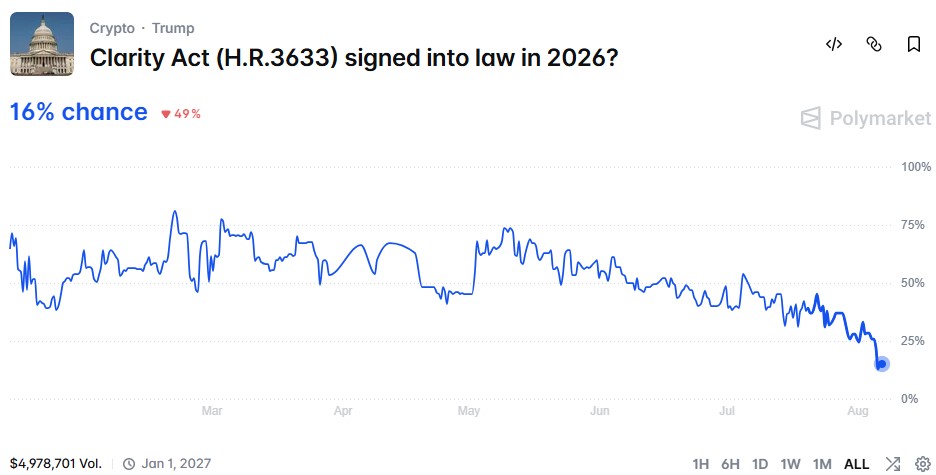
The Real Holdup: An Ethics Clause Tied to Trump
Senators Thom Tillis and Ruben Gallego sent the White House an ethics proposal last week. It's aimed at stopping senior officials, including Trump, from profiting off crypto industry influence.
The White House is still reviewing it. If they approve it, Democrats may back the bill. If they reject it or stay silent, the Clarity Act likely stays stuck.
Most of the bill's text is finished. This single ethics question is the one holding everything up.
What Else Is Competing for Senate Time?
Crypto legislation isn't the only thing on the floor. The Senate is also juggling:
The Attorney General nomination for Todd Blanche
A government funding bill
A Russia sanctions bill
A college sports bill
Crypto rarely wins when it's competing against must-pass items like funding and nominations.
What Could Happen Next With the Clarity Act?
Scenario one: The Senate stays past Friday, works through other priorities, and finds a path to vote on Clarity before adjourning.
Scenario two: The Senate leaves without touching it. The bill goes dormant until September, when 14 working days remain before campaign season takes over. Even then, the House still has to vote.
Scenario three: The Senate stays into next week anyway because Blanche's confirmation is mandatory, which could open a window for Clarity too.
If a procedural vote fails outright, the bill is probably done until after the election. A new Senate and House makeup could reshape it entirely.
Bitcoin Price Prediction: Can BTC Reclaim $65,000?
Bitcoin is trading near $64,558, up slightly on the day. The SuperTrend indicator has flipped bullish, and the last time that happened, on July 3, BTC rallied 16% from $57,700 to $68,900.
Bitcoin is boxed between support near $60,000 and resistance in the $66,000 to $67,000 zone, a range that has held for weeks.
A reclaim of $65,000 could open the door toward $68,000. A break below $60,000 would weaken the setup and could pull price down toward the $58,000 whale accumulation zone.
Bitcoin also shows a bullish divergence on the weekly chart, a pattern some analysts compare to the setup near the end of the 2022 bear market. That's a longer-term signal, not something that plays out in days.
Ethereum Price Prediction: Can ETH Hold $1,900 Support?
Ethereum trades near $1,902, hovering right around the key $1,900 support zone.
Holding above $1,900 keeps the psychological $2,000 level in reach, as long as buyers can push through nearby resistance on stronger volume.
A daily close below the $1,900 to $1,850 range would strengthen the bearish case and could open the door to the $1,550 to $1,600 demand zone.
Ethereum's 3-day chart still shows a "W" double-bottom pattern, with a breakout target near $2,070 to $2,080. But the daily chart is flashing a bearish RSI divergence, where price makes higher highs while momentum makes lower highs. That's often an early warning that upside strength is fading.
XRP Price Prediction: Can XRP Break $1.15 Resistance?
XRP trades near $1.05, testing the lower boundary of a symmetrical triangle on the daily chart.
A confirmed close below triangle support and under $1.04 would open downside targets at $1.00, then $0.97, then $0.93 if selling accelerates.
On the upside, $1.06 is the pivot. Reclaiming and holding above it would point toward $1.35, with a further target of $1.64 if momentum builds.
The regulatory angle matters more for XRP than most tokens. Clearer U.S. rules from the Clarity Act could shift how traders think about exchange access and token classification. But the chart still needs to confirm any move before it's real.
BTC, ETH, XRP Price Levels Table
Asset | Current Price | Key Support | Key Resistance | Technical Read |
Bitcoin (BTC) | $64,558 | $60,000 | $65,000, $66,500, $68,000 | Reclaim of $65K improves momentum |
Ethereum (ETH) | $1,902 | $1,850–$1,900 | $2,000, $2,080 | Holding support keeps rebound case alive |
XRP (XRP) | $1.05 | $1.00–$1.04 | $1.06, $1.15, $1.35 | Triangle compression near breakout point |
Prices reflect recent trading levels and can shift quickly; check a live tracker before making decisions.
What Traders Should Watch This Week
The market is watching two clocks at once: the Senate calendar and the charts.
A procedural breakthrough on the Clarity Act could lift sentiment across Bitcoin, Ethereum, and XRP. Another delay could leave traders more focused on pure support and resistance levels instead.
Neither path is guaranteed. Headlines can move price short-term, but chart structure still tends to matter more over time.
Disclaimer: This article is for informational purposes only and does not constitute financial, investment, or trading advice. Cryptocurrency markets are highly volatile, and prices can change rapidly. Always do your own research and consult a licensed financial advisor before making investment decisions.