DEXE Price Prediction: DeXe Crash 85%, Insider Activity or Buy the Dip


DEXE just went through one of the sharpest crashes seen in the market this week, and the full story behind it is still coming together.
DeXe positions itself as a decentralized governance protocol built to make AI ownership transparent and accountable, according to the project's own materials.
This DEXE Price Prediction breaks down the warning signs, the competing explanations, and the levels that matter now.
DeXe Price Today: Market Overview
Metric | Value |
Current Price | $5.127 |
7 Day Change | -87.0% |
24h Range | $5.06 - $46.65 |
Market Cap | $494.492M |
Fully Diluted Valuation | $494.492M |
24h Trading Volume | $145.175M |
Circulating Supply | 96.505M $DEXE |
Total Supply | 96.505M $DEXE |
Source: Data from CoinGecko as of 22/07/2026. Figures may vary slightly across other tracking websites.
DeXe Flashed a Warning Sign Before the Crash
Before the crash hit, DEXE's price kept climbing, but Open Interest stayed much lower than the rally would normally suggest.
That gap between rising price and weak Open Interest is often an early signal that a move lacks real strength underneath, more price action than actual conviction behind it. 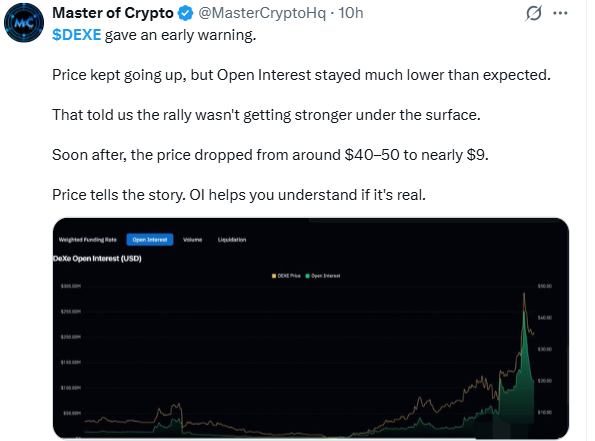
Source: Data From X
Not long after that warning showed up, the price dropped sharply from the $40 to $50 range down to near $9.
Note: The price levels mentioned in this article are based on market data available at the time of writing. Cryptocurrency prices are highly volatile and may have changed.
Why Is DeXe Price Down 87% Right Now
One widely shared post claims the crash is tied to suspected insider wallet activity, with over $2.0 billion in market cap wiped out.
Separately, other reports circulating in the crypto news space point to a different explanation, an apparent exploit in $DeXe's smart contracts that may have triggered the mass selling.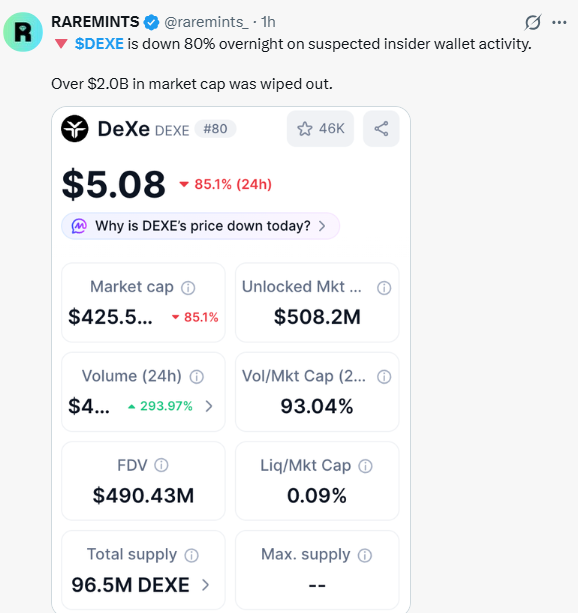
Note: Both of these are reports from public sources, not an official statement from the $DeXe team. At this stage, the exact reason has not been officially confirmed or cleared. Readers should treat both explanations as unverified until the project or a primary data provider clarifies what actually happened.
DeXe Top Holders and Recent Large Transfers
On-chain data from Arkham shows most of $DEXE's supply sits in structural contracts rather than individual wallets. The $DeXe GovPool proxy holds 41.59% of supply, worth about $246.28 million.
The Wormhole Token Bridge holds 19.32%, worth $114.41 million, representing $DEXE mirrored on other chains. The $DeXe GovUserKeeper proxy holds 16.61%, worth $98.33 million, and the DEXE token contract itself holds 10.68%, worth $63.22 million.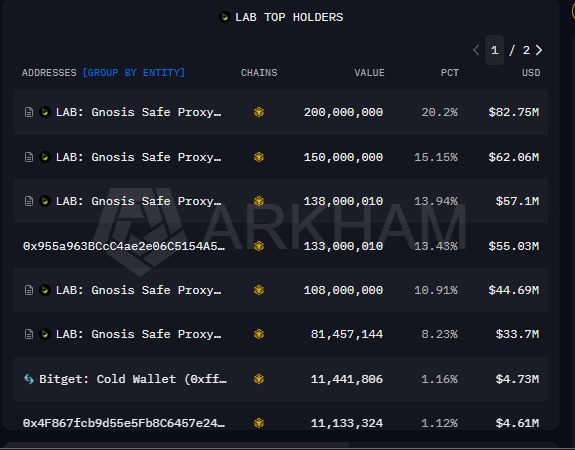
Two Binance cold wallets hold 2.97% and 1.48% combined, and two Gnosis Safe proxy wallets hold smaller amounts under 1% each.
Holder | Percent of Supply | Value |
DeXe GovPool (Proxy) | 41.59% | $246.28M |
Wormhole Token Bridge | 19.32% | $114.41M |
DeXe GovUserKeeper (Proxy) | 16.61% | $98.33M |
DeXe Token Contract | 10.68% | $63.22M |
Binance Cold Wallet | 2.97% | $17.59M |
Binance Cold Wallet | 1.48% | $8.78M |
Gnosis Safe Proxy | 0.80% | $4.76M |
Gnosis Safe Proxy | 0.74% | $4.40M |
Source: Arkham Explorer
Separately, Arkham's transfer data shows large DEXE movements in the hours around the crash, including several transfers over $2 million between Binance hot and cold wallets and movements from Gnosis Safe wallets into two unlabeled addresses before those funds landed on Binance. 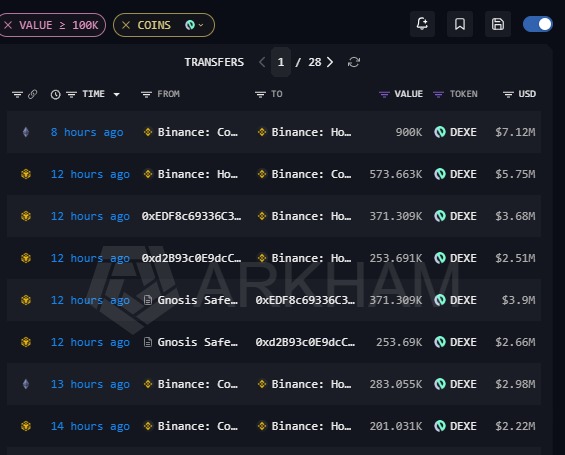
These unlabeled wallet movements are the kind of activity that likely fueled the insider wallet speculation, though Arkham has not tagged these addresses as belonging to any specific party, so their ownership remains unconfirmed.
DEXE price prediction 2026: DeXe Price Chart Analysis
$DEXE rallied hard to a high near $46.950 resistance; after that, it slid into a descending channel that brought it down toward the $31.905 to $37.364 zone.
From there, price moved into a clear consolidation range, trading sideways inside that same $31.905 to $37.364 consolidation range for several days.
Price then broke out above the consolidation range, pushing back up toward the $46.950 resistance level; the breakout did not sustain, and it turned out to be a fake breakout, a trap that pulled in late buyers right before the real move happened.
Price reversed hard and crashed straight through the consolidation zone, through $20.056, and down through $13.030 important levels, landing at the current level.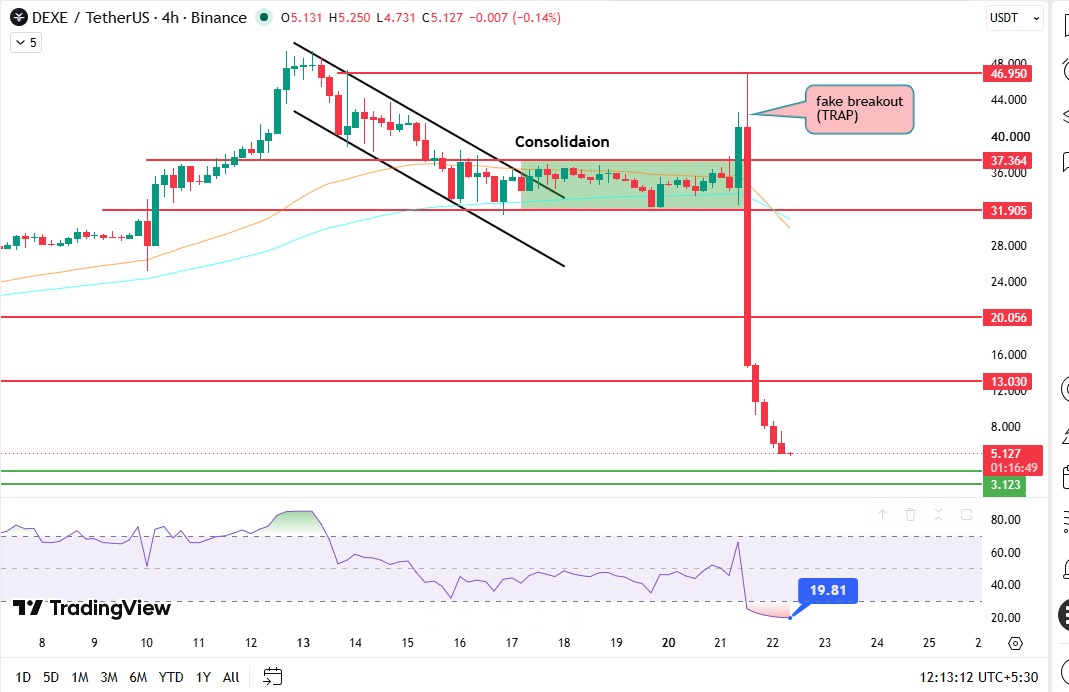
$DEXE is now trading at $5.127 on the latest candle. RSI has dropped to 19.81, deep into oversold levels, reflecting just how sharp and fast this fall has been.
Level Type | Price |
Resistance (fake breakout level) | $46.950 |
Resistance (consolidation top) | $37.364 |
Resistance (consolidation bottom) | $31.905 |
Resistance (near-term) | $20.056 |
Resistance (closer) | $13.030 |
Immediate price reference | $5.127 |
Support | $3.123 |
Verdict: the fake breakout above $37.364 to $46.950 turned out to be a trap rather than genuine strength, and the crash that followed has left DEXE deeply oversold. A recovery would first need to reclaim $13,030 before any of the higher levels come back into play.
Two Reader Takeaways
For existing holders, the level to watch is $13.030. Reclaiming that would be the first real sign the selling pressure is easing.
For anyone considering buying this dip, the deeply oversold RSI reading suggests a bounce is possible, but the unresolved question over insider activity versus an exploit makes this a higher-risk entry than a typical pullback. Waiting for official clarification before entering is the safer approach here.
DEXE Market Outlook Expert View
According to CoinGabbar analysts, this remains a genuinely uncertain setup, and that uncertainty is the main risk right now.
The bull case rests on the deeply oversold RSI at 19.81 triggering a relief bounce, with $13.03 as the first level that would need to be reclaimed for that case to build any real momentum.
The bear case builds if either the insider activity claim or the exploit report gets confirmed, since either outcome would raise real questions about token security or fair distribution and could keep sellers in control even from these oversold levels.
The fake breakout above $37.364 before the crash is also a reminder that price action alone was signaling trouble well before the drop hit, so any recovery attempt deserves the same scrutiny rather than being taken at face value.
Until the DeXe team or a primary data provider clarifies what actually happened, this remains a wait-and-watch situation rather than a clear buy-the-dip opportunity.
Disclaimer: This article is for informational purposes only and should not be treated as financial advice. Cryptocurrency markets are highly volatile and carry significant risk.