Ethereum Price Wall Street's Biggest ETH Bet Is Deep in the Red


Ethereum Price Wall Street's Biggest Bet
Ethereum Price hit $4,953 in August 2025 — a new all-time high — institutional investors piled in through freshly approved spot ETFs, corporate treasuries loaded up, and Wall Street called it the start of a supercycle. Nine months later, ETH is trading around $1,975, and the funds that rushed in are nursing losses north of 50%. This report breaks down exactly what happened, what the technicals say right now, and where analysts think Ethereum goes from here.
This isn't a story of a failing technology. Ethereum's fundamentals — developer activity, staking yields, Layer 2 growth — remain intact. But sentiment, macro pressure, and a relentless ETF outflow cycle have crushed the price, and understanding the mechanics of that selloff is essential before you can have a serious view on recovery.
1. Wall Street's Big Bet — And Where It Stands Now
US spot Ethereum ETFs launched in July 2024 after the SEC granted approval to BlackRock, Fidelity, VanEck, Invesco, 21Shares, and six other issuers. The launch was celebrated as Ethereum's institutional coming-of-age moment. But the numbers since then tell a more complicated story.
BlackRock's ETHA dominates the space, capturing approximately 47% of total cumulative net inflows as of late May 2026. Fidelity's FETH holds second place at around 21% of flows. The remaining seven products — including offerings from Grayscale, VanEck, and Invesco — split the remaining 32%.
Grayscale's situation is particularly instructive. Its Ethereum Trust (ETHE), converted from a closed-end fund to a spot ETF in mid-2024, immediately began hemorrhaging assets — exactly mirroring what happened to GBTC after its conversion. Grayscale subsequently launched a "mini" Ethereum ETF with a lower fee structure, which attracted positive flows. The lesson: institutional buyers are intensely fee-sensitive, and legacy structures carry exit risk even when the underlying asset performs.
The biggest single shock to sentiment came in May 2026. US ETH spot ETFs logged a net outflow of $401.62 million for the month — the third-largest monthly outflow since late 2025, behind only November 2025 at -$1.42 billion and December 2025 at -$616.82 million. On a single day in late May, Ethereum ETFs lost $67 million, extending an outflow streak to 14 consecutive trading sessions.
Monthly ETF Flow vs ETH Price Performance (2026):
Month | Net ETF Flow | ETH Return | Verdict |
March 2026 | -$46.01M | +7.07% | Resilient |
April 2026 | +$355.98M | +7.38% | Rally |
May 2026 | -$401.62M | -12.6% | Collapse |
June 2026 (so far) | Negative | ~-3% | Fragile |
The correlation is clean: when ETF flows are positive, ETH rallies. When they turn negative, ETH falls harder than Bitcoin. This pattern shows Ethereum has become structurally dependent on institutional participation in a way that creates sharp asymmetry — both to the upside and the downside.
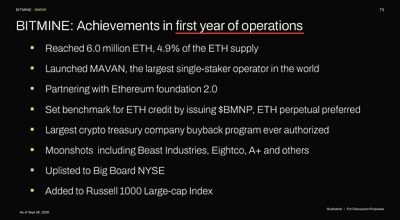
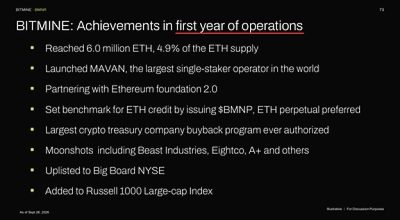
Tom Lee’s BitMine faces billions in unrealized Ethereum losses

Tom Lee’s BitMine has come under the spotlight after its massive Ethereum treasury position reportedly slipped into billions of dollars in unrealized losses following ETH’s recent correction.
2. Technical Analysis: What the Charts Say
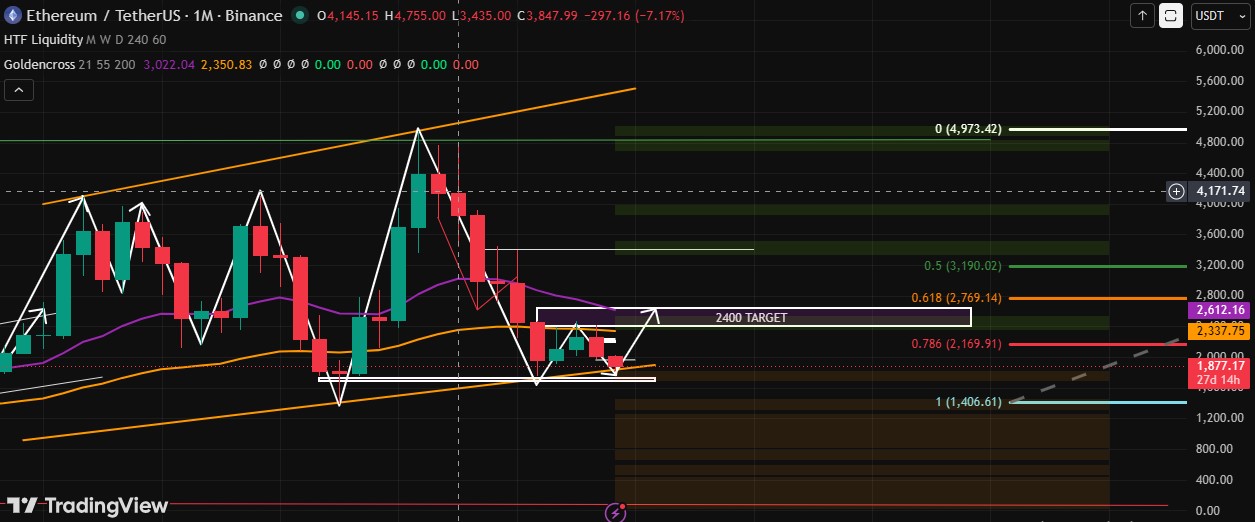
ETH is trading at approximately $1,975 as of June 3, 2026. The price has broken below the psychologically critical $2,100 support level — a floor that had held since the February 2026 lows. That breakdown is technically significant: it marks a new lower low in the current downtrend and confirms seller control across multiple timeframes.
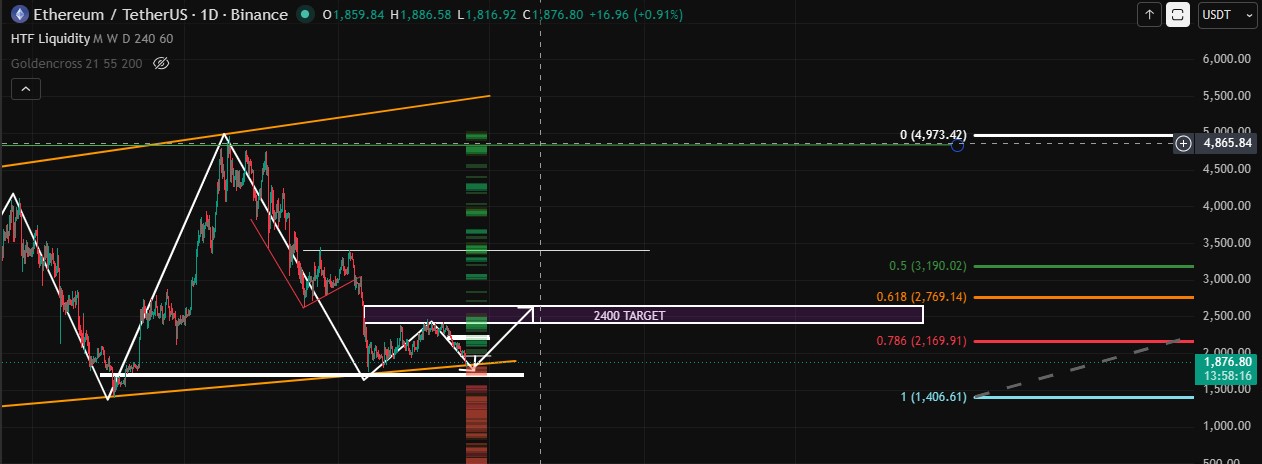
Key levels to track:
$2,050 — immediate support. Losing this accelerates toward $1,920.
$1,920 — the panic low from last week. A test here would confirm a deeper bear leg.
$1,800 — major structural support. Many long-term holders bought here in 2024.
$1,760 / $1,400 / $1,000 — bearish extension targets per FinanceMagnates technical model.
$2,150 — minimum recovery level needed to stabilize bearish structure.
$2,195 — 50-day EMA resistance. A weekly close here opens $2,275.
$2,509 — 200-day EMA. This is the key long-term resistance that ETH must reclaim.
The Relative Strength Index on the daily chart is sitting around 29 — technically oversold. The RSI pattern hints that selling momentum, while dominant, may be getting stretched. However, the MACD is sliding deeper below its signal line with expanding red histogram bars, meaning bearish momentum is still building, not fading.
One constructive technical pattern worth noting: the two-day chart shows an inverted cup-and-handle formation that has been building since late March. Depending on how it resolves, this could either become a base for recovery or break down into a measured move lower toward the $1,600–$1,700 area.
Seasonality is working against ETH as well: The average June return for Ethereum since 2016 sits at -6.74%, with a median of -5.65%. Only three Junes in a decade have closed in the green. That doesn't mean June will be bad this year — but the seasonal tailwind that helped in May 2024 and May 2025 is now gone.
3. Why Has ETH Dropped 60% From Its ATH?
Three forces combined to bring ETH from $4,953 to sub-$2,000:
Macro pressure: Geopolitical escalation - particularly US-Iran tensions — triggered broad risk-off moves in May 2026. As crypto ETFs have become increasingly mainstream, they now track macro sentiment more closely than they used to. When institutional investors get nervous about geopolitics, they reduce all risk assets, and ETH gets hit harder than Bitcoin because of its higher beta.
ETF outflow feedback loop: May's $570 million in ETH ETF outflows since May 11 reflect institutions trimming positions rather than rotating — a subtler but more dangerous dynamic. It's not panic selling; it's methodical profit-taking and exposure reduction. When large funds are reduced simultaneously, the liquidity absorbed during the accumulation phase gets returned to the market in a compressed timeframe.
Layer 2 fee drain: This is the structural problem that Standard Chartered quantified most bluntly: Base, Optimism, Arbitrum, and other L2 networks scale Ethereum's capacity but divert fee revenue away from the mainnet. Standard Chartered estimated that Base alone removed $50 billion from ETH's market cap. As L2 adoption grows, the deflationary fee-burning mechanism that boosted ETH's value in 2021–2022 weakens. ETH becomes infrastructure rather than a fee-capture asset.
4. Who Is Holding — And Who Is Selling
Despite the price action, not everyone is running for the exits. BitMine Immersion Technologies (BMNR) crossed the 5 million ETH ownership threshold, adding 101,901 ETH in a single week — its largest weekly purchase of 2026. Total holdings reached 5,078,386 ETH, valued at roughly $11.75 billion. The company has a stated goal of accumulating 5% of Ethereum's total circulating supply.
Separately, institutional 13F filings and fund flow data confirm that some allocators are expanding crypto positions rather than rotating away from them entirely. The distinction matters: the May outflows are not a uniform retreat from crypto - they reflect specific funds trimming overweight ETH positions while others accumulate at lower prices.
BlackRock is also advancing its staked Ethereum ETF product (ETHB), which offers investors 82% of the underlying staking yield — approximately 2.8% annually at current rates. Fidelity, Franklin Templeton, and others have pending SEC applications for similar staking-enabled products. The first wave of approvals is expected in mid-2026, and if they come through, they redefine the ETH ETF product entirely: instead of just price exposure, investors get yield.
5. ETH ETF Landscape: Who Holds What
ETF / Issuer | Market Share / Status |
BlackRock ETHA | ~47% of cumulative net inflows |
Fidelity FETH | ~21% of cumulative net inflows |
Grayscale ETHE (legacy) | Persistent outflows post-conversion |
Grayscale Mini ETH | Positive net flows (lower fee structure) |
VanEck, Invesco, 21Shares | Divide remaining ~32% of flows |
BlackRock ETHB (staking) | Pending — 82% yield pass-through |
Source: Bloomberg Intelligence/ ETF analysis, May 2026.
6. Ethereum Price Predictions: 2026 Through 2030
Analyst targets for Ethereum have never been further apart. Here is where the major forecasters stand as of June 2026:
Standard Chartered: $7,500 by end-2026. The bank cites regulatory clarity from the CLARITY Act, stakeholder ETF approvals, and continued corporate treasury accumulation as the path to this target.
Citi: $5,440 within 12 months. More conservative, but still bullish. Citi emphasizes rising investor demand and structural ETF inflow growth as key drivers.
Fundstrat / Arthur Hayes: $10,000+ targets, though timelines keep extending as macro headwinds persist.
(technical model): $1,900–$2,510 for June 2026. ETH remains below the 200-day EMA at $2,509—reclaiming it is the minimum requirement for any meaningful long-term recovery.
Bearish case: Finance Magnates technical analysis targets $1,760, $1,400, and potentially $1,000 if the current downtrend continues without a catalyst to break it.
Period | Bear Target | Bull Target | Key Catalyst |
June 2026 | $1,760 | $2,510 | ETF flows / hard fork |
Q3 2026 | $1,400 | $4,500 | Staking ETF approvals |
End-2026 | $1,000 | $7,500 | Regulatory clarity |
2027 | $1,500 | $5,000 | L2 fee model reform |
2028–2030 | $2,000 | $10,000+ | DeFi + tokenization |
7. Key Catalysts to Watch in June and Q3 2026
Glamsterdam Hard Fork: The Ethereum core development team's next major upgrade — Glamsterdam — is being tracked closely by institutional desks. The upgrade focuses on EVM improvements and validator queue optimization. A clean launch would restore some developer confidence, but any delays, as seen in Cardano's recent hard fork postponement, would weigh on sentiment.
Staking ETF Decisions: SEC is expected to rule on BlackRock's ETHB and Fidelity's staking-enabled Ethereum fund application in mid-2026. Approval would be transformative: it converts ETH from a pure price-exposure trade into a yield-generating position competitive with Treasury bonds for certain allocators.
CLARITY Act Vote: The US Senate is scheduled to vote on the CLARITY Act — legislation that would formally define which digital assets are securities and which are commodities. An ETH-friendly ruling would remove a major regulatory overhang and potentially trigger the ETF inflow reversal that bulls are waiting for.
$2,100 Reclaim vs $1,920 Break: The near-term price action hinges entirely on which of these two levels gives first. Bulls need a 4-hour close back above $2,150 urgently. Bears are watching $1,920 — the panic low — as the next stop if $2,050 cracks.
Disclaimer: This article is for informational and research purposes only and does not constitute financial advice. Cryptocurrency prices are highly volatile. All forecasts are based on third-party analyst models and may not reflect actual outcomes. Always conduct your own due diligence before making any investment decision. Past performance does not guarantee future results.
Also read: