Orochi Network Price Prediction: What ON's Breakout Signals


Orochi Network Price Prediction: ON Breakout Changes the Setup
Something odd happened to a small verifiable-data token this week, and the chart is still trying to figure out what to do about it. Orochi Network price prediction searches have spiked right alongside the coin itself, and for good reason. ON went from trading quietly near a dime to punching through $0.16 in a matter of days. That's not a normal Tuesday for a $21 million market cap token.
We're not going to bury the lede in chart jargon here. This section is about the setup, not the numbers.
A Binance Alpha promotional event landed on July 14, the latest in a run of airdrop claim events that keep reshaping small-cap charts overnight. A steady drip of product updates followed it. And a token that had been carving out a slow, boring base since February suddenly wasn't boring anymore.
Is this the start of something bigger or a fast fade waiting to happen? Stick around, because the answer depends on which part of the chart you're looking at.
KEY TAKEAWAYS
-
ON is up sharply this week after a fresh Binance Alpha Box promotion, trading around $0.15 after tagging a $0.163 high.
-
Short-term range to watch: roughly $0.14 support to $0.163 resistance, with RSI already in overbought territory on the 4-hour chart.
-
The bullish case needs a hold above $0.14. A daily close back under it opens the door to $0.111 and lower.
-
Holder concentration is extreme; the top 5 wallets control about 78% of supply, and that's the single biggest risk to any forecast here.
Coin Overview
| Metric | Value | Source / As Of |
|---|---|---|
| Name / Ticker | Orochi Network (ON) | July 21, 2026 |
| Blockchain | Ethereum (ERC-20) | Etherscan |
| Contract Address | 0x33f6BE84becfF45ea6aA2952d7eF890B44bFB59d | Etherscan, verified |
| Price | $0.148–$0.152 (intraday swing to $0.163) | CoinMarketCap / TradingView |
| 24h Change | +23.97% | CoinMarketCap |
| 24h Range | $0.1137 – $0.1621 | CoinMarketCap |
| Market Cap | $21.34M | CoinMarketCap |
| 24h Volume | $10.3M (+61.98%) | CoinMarketCap |
| Vol/Mkt Cap (24h) | 48.06% | CoinMarketCap |
| FDV | $147.95M | CoinMarketCap |
| Circulating Supply | 144.27M ON | CoinMarketCap |
| Total Supply | 700M ON | CoinMarketCap |
| Max Supply | 1B ON | CoinMarketCap |
| Holders (on-chain) | 678 | Etherscan |
| ATH | $0.3963 (Oct 24, 2025), -62.6% from ATH | CoinMarketCap |
| ATL | $0.06074 (Feb 10, 2026), +144% from ATL | CoinMarketCap |
A quick honesty note before we go further: different trackers disagree slightly on ON's holder count (CoinMarketCap shows around 2,830; Etherscan's own token page shows 678) and on the exact ATH ($0.39 to $0.42 depending on the feed). That's common for a thinly traded, multi-exchange token where price feeds aren't perfectly synced. We're using Etherscan's direct contract data where it conflicts with aggregator estimates, since it's reading straight off the chain.
Why Is Orochi Network Pumping Right Now
Here's the thing: this didn't come out of nowhere.
On July 14, Orochi Network's official Alpha Box announcement confirmed $ON went live in the Binance Alpha Box, a points-based claim event run alongside Metaplex (MPLX). Eligible Binance Alpha users with at least 251 points could claim the airdrop directly from the Alpha Events page.
That's the trigger. Free-token claim events routinely pull in new wallets, new attention, and new speculative volume, and the chart timing lines up almost exactly. The breakout accelerates in the days right after.
But the Alpha Box wasn't the only thing happening. Orochi's team spent the same stretch pushing its zkDatabase product, the piece of its stack that lets a smart contract verify data (like whether a tokenized loan still meets its collateral terms) without exposing the underlying private data.
On July 13, the project posted a chart tracking tokenized assets growing from $5B in 2023 toward a projected $31B in 2026. On July 20, it followed up, noting that asset-backed credit had become the first tokenized asset class to cross $1B, framing zkDatabase as the tool that makes that credit provable on-chain.
Turns out, that's a narrative traders like right now. RWA tokenization is one of the more durable themes in this altcoin market rotation, and Orochi positioned its product squarely inside it during the same week a fresh incentive event was pulling in new eyes.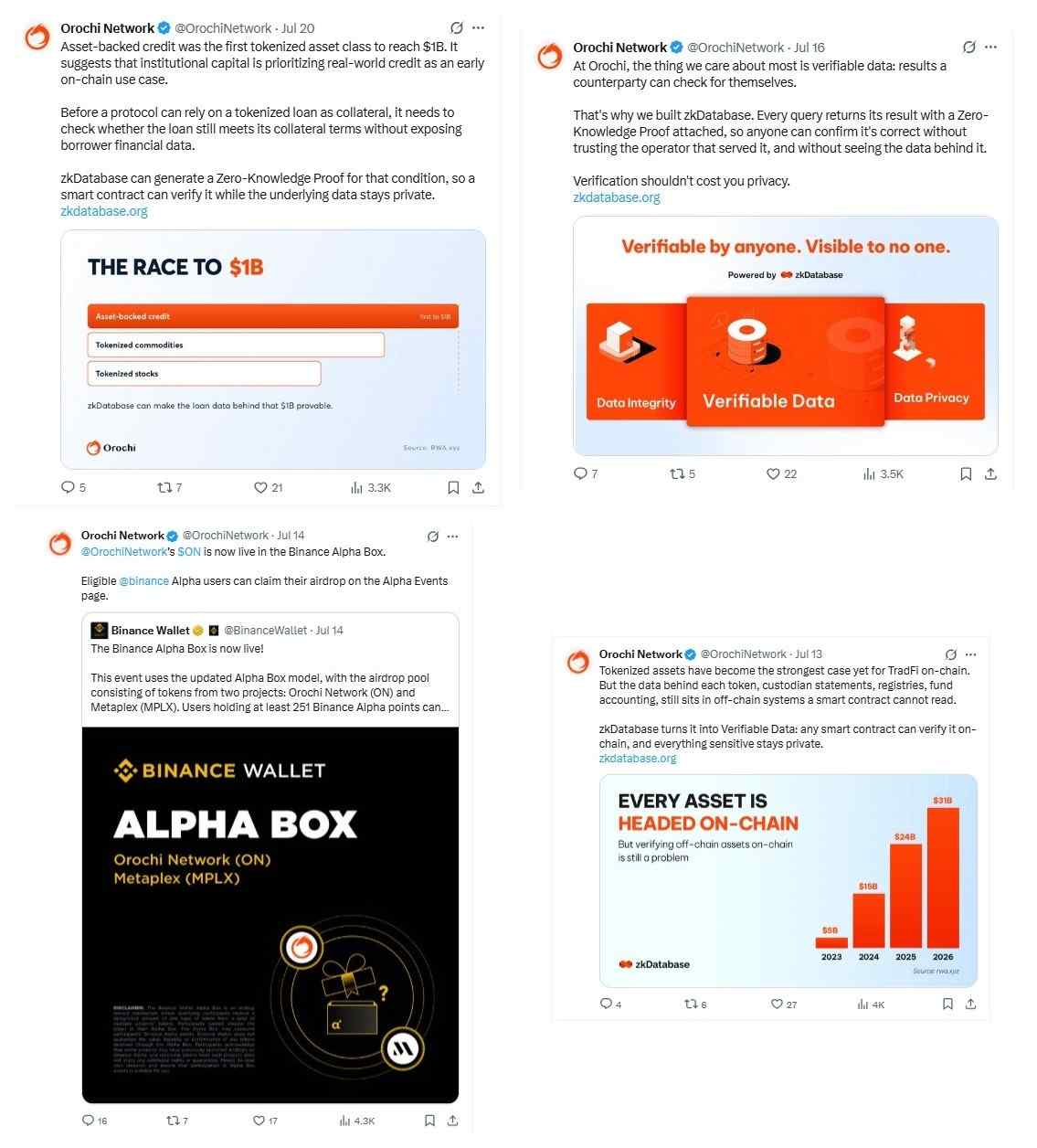
We pulled up the exchange volume rankings next, and it confirms the move isn't just retail clicking buy on a website. Binance carries the largest share of ON's trading activity by a wide margin, with BingX and MEXC well behind it. That's a meaningful detail. When a small-cap token's volume concentrates on one major venue, it usually means the move is being driven by that venue's own users and promotions, exactly what you'd expect right after an Alpha Box event.
Orochi Network Technical Analysis
ON Rallies Toward $0.16 as RSI Flashes Overbought
The 4-hour chart shows ON riding a clean ascending channel since roughly July 13. Price broke above the channel's upper line into the recent high of $0.16318 and then pulled back to $0.15178, a 0.71% dip on the candle we're reading.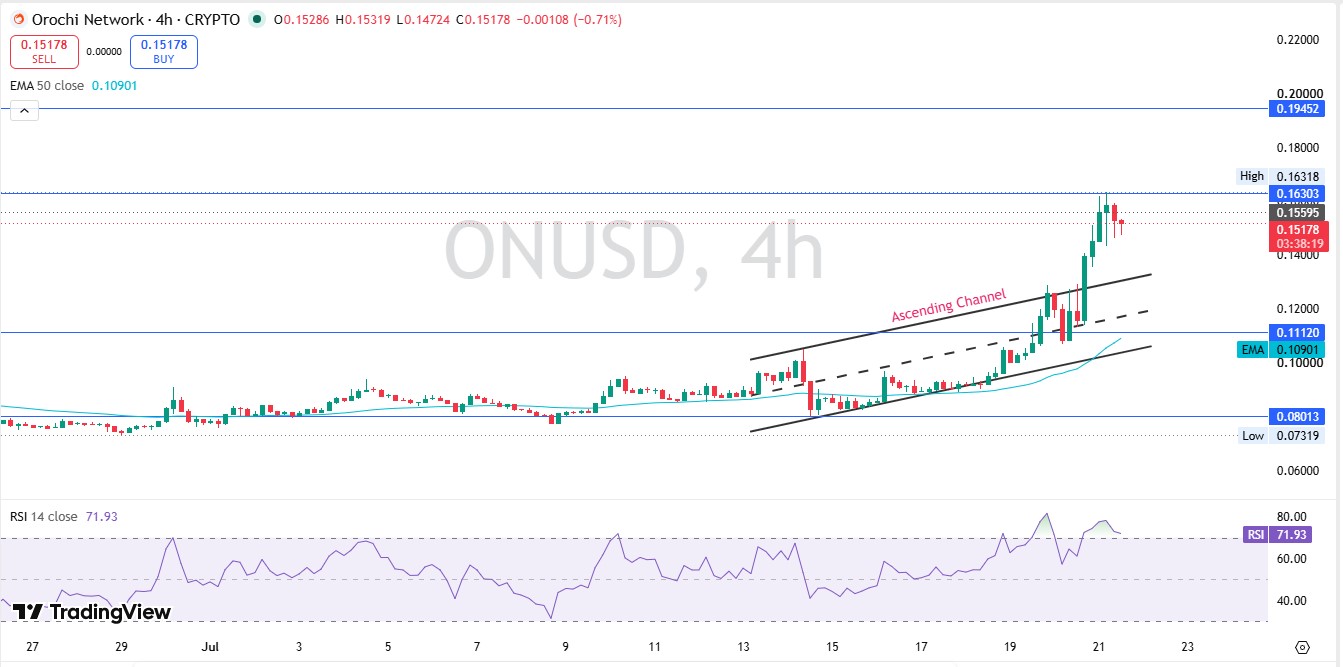
That pullback matters. It's sitting right on the old channel resistance, now acting as first support.
RSI on the 4-hour is at 71.93. That's solidly in overbought territory (above 70), and it's been elevated for a few candles running, so a cooling-off period wouldn't be surprising even inside an uptrend.
The 50 EMA sits way down at $0.10901. Price trading this far above its EMA confirms a strong short-term trend, but it's also a stretched one. Big gaps between price and EMA tend to close eventually, either through a pullback or through the EMA catching up over time.
Zoom out to the weekly chart, and the picture gets more constructive. ON spent May through July carving a rounded bottom, a slow, curving base that's a classic sign of accumulation rather than panic-selling. This week's candle closed at $0.15100, up 26.05% for the week, with weekly RSI at 55.81, still neutral, nowhere near as stretched as the 4-hour reading.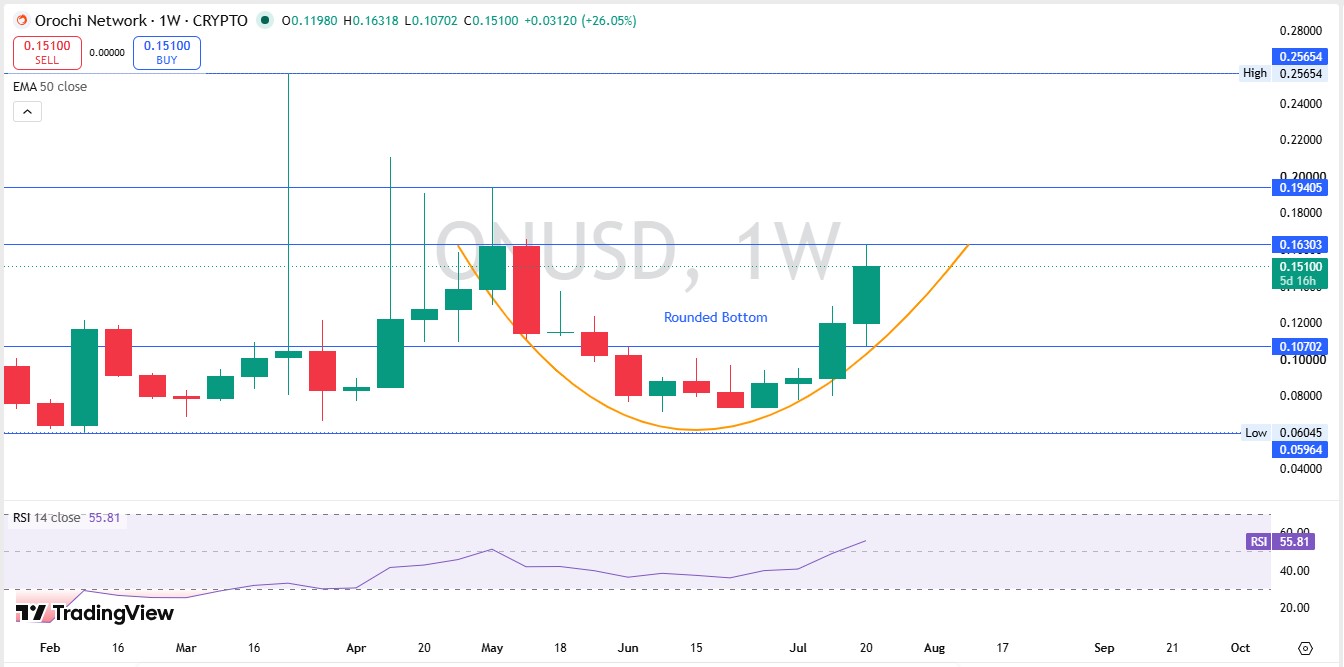
Key levels right now: immediate support at $0.14, stronger support at $0.1112, and a floor around $0.08 if things really unravel. On the upside, $0.163 is the level to reclaim, with the next real resistance shelf sitting in the $0.19 to $0.195 zone, an old value area from the token's post-launch trading range.
What would confirm continuation: a 4-hour close back above $0.163 on volume that beats the recent average. What would suggest reversal: a break of $0.14 that holds for more than one candle?
None of this happens in a vacuum, either. A stretched small-cap rally tends to lose steam fast if the wider market rolls over, so it's worth keeping half an eye on the Bitcoin price outlook alongside ON's own chart.
Chart data: TradingView, ON/USD 4-hour and weekly, as of July 21, 2026.
On-Chain Analysis: The Whale Problem
Here's where the forecast gets complicated.
Holder concentration on ON is severe. Top-100 wallets control 99.98% of circulating supply. Just the top 5 wallets alone account for roughly 78.4% of that supply's market value. 23 wallet holders classified as whales hold 99.40% between them, and fourteen individual holders each own at least 1% of the total supply on their own.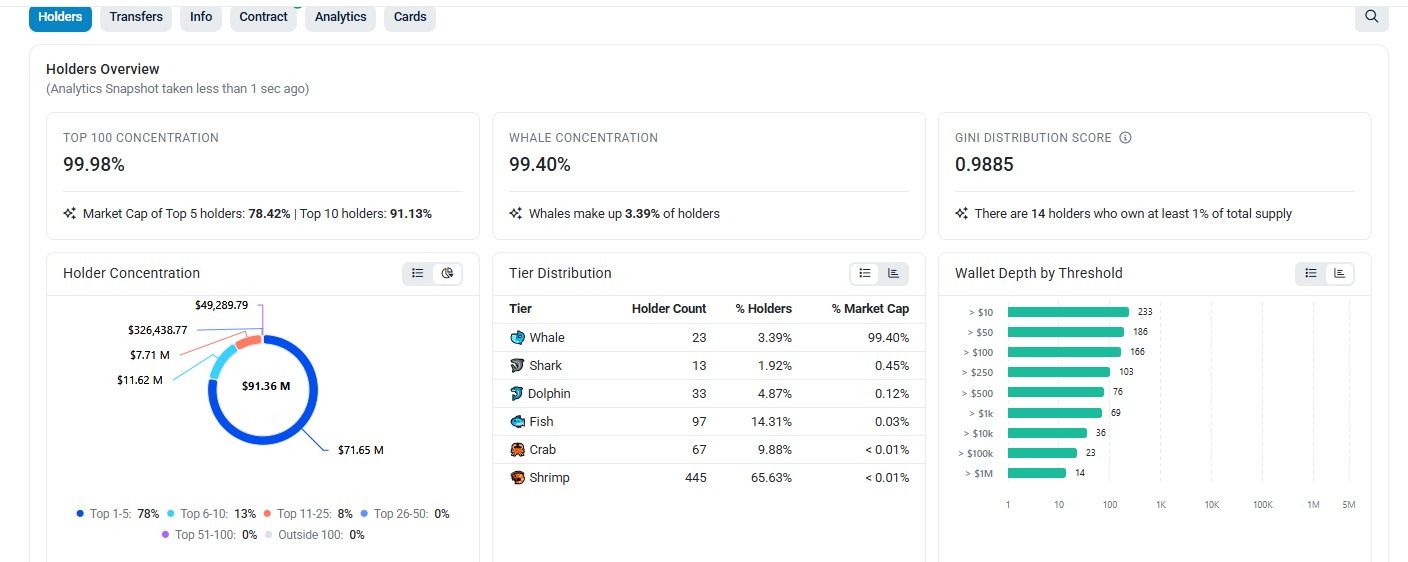
The Gini distribution score sits at 0.9885, about as close to maximum inequality as a token distribution gets.
We're not saying this to scare anyone off. It's just math, and it changes how you should read any bounce. A rally built on this kind of concentration can reverse fast if even one or two of those top wallets decide to sell into strength, and there's no way to know their intentions from the outside.
Liquidation data from CoinGlass adds a bit of texture too. Over the past 24 hours, ON saw about $351.51K in total liquidations, split fairly evenly between $172.19K in long liquidations and $179.32K in short liquidations. That rough balance suggests two-sided leveraged positioning rather than one crowded trade, though the slightly larger short-side figure fits a scenario where short sellers got squeezed as price broke out.
Zoomed out, this kind of two-sided liquidation pattern shows up a lot whenever a broader crypto market rally is underway and leveraged traders are fighting the trend from both sides.
Fundamentals and Tokenomics
The Orochi Network positions itself as a "verifiable data infrastructure" project, built around zero-knowledge proofs. Its main product, zkDatabase, lets a third party verify a query result cryptographically without ever seeing the private data behind it, a point the team's own zkDatabase thread sums up as "verifiable by anyone, visible to no one." The pitch: financial institutions increasingly need to prove things about tokenized assets (loan collateral, reserves, compliance status) without exposing sensitive records, and Orochi's tooling is built to do exactly that.
On the supply side, ON completed its Token Generation Event on October 24, 2025, through a Binance Alpha listing and futures debut. Vesting works in two tracks: the top 6,000 wallets by airdrop allocation follow a 12-month linear vesting schedule from TGE, while all other wallets unlocked fully after a single one-month cliff.
That detail actually matters for this specific forecast. We're now about nine months past TGE, meaning the smaller-wallet cohort has been fully liquid for a while already, and the larger 12-month vesting cohort is roughly three-quarters through its unlock schedule. That points to a shrinking, not growing, source of future unlock-driven sell pressure from here, assuming no new token releases are announced.
Total supply sits at 700M ON against a 1B max supply, with only 144.27M ON (about 20.6% of total supply) actually circulating. That's a wide gap, and it's the reason FDV ($147.95M) runs nearly seven times higher than the current market cap ($21.34M). If more of that locked supply becomes liquid faster than the market can absorb it, that gap becomes a real headwind.
We didn't find a public, dated schedule detailing exactly which future tranches unlock and when beyond the two vesting tracks above, so treat any long-range target with that uncertainty in mind. Worth bookmarking an upcoming token unlock calendar and checking back as new dates get confirmed.
Orochi Network Price Prediction: Bull, Base, and Bear Scenarios
| Scenario | Conditions | Target | Timeframe | Invalidation |
|---|---|---|---|---|
| Bull Case | 4h close holds above $0.163 on rising volume; RWA/tokenization narrative and Alpha-linked promotions keep pulling in new demand | $0.19–$0.22; stretch toward ATH retest near $0.30–$0.396 if broader market turns risk-on | 1-4 weeks (near target), 2-3 months (stretch) | Daily close back below $0.14 |
| Base Case | Price cools off overbought RSI and ranges while the market digests the Alpha Box flows | $0.14–$0.163 sideways chop | 1-2 weeks | Sustained break of either side of the range |
| Bear Case | Whale profit-taking given extreme holder concentration, Alpha Box claim-and-dump behavior, or a broader risk-off market move | Retest of $0.1112, potential slide toward $0.08 | 1-3 weeks | Reclaiming $0.15 with real volume |
The bear case here isn't a throwaway line. With 78% of supply sitting in five wallets, a fast unwind is a real, structural risk, not just a chart pattern, and it's the same fragility that shows up whenever there's crypto market crash coverage and thin, concentrated altcoins get hit hardest.
We'll say it plainly: the near-term trend is bullish, the setup is stretched, and the concentration risk is the single biggest thing that could break it. That's a real stance, not a "who knows" shrug.
Every number above is a scenario, not a promise. Crypto price targets, especially for a token this small and this newly listed, are speculative by nature. Treat these as a framework for thinking, not a guarantee of where price goes.
Historical Context
ON is still down roughly 62% from its October 2025 all-time high near $0.40, set within hours of its TGE and Binance Alpha debut, a common pattern for new listings that see a launch-day spike followed by a long grind lower. It found its floor at $0.06074 in February 2026, then spent five months rounding out a bottom before this month's breakout.
Measured from that low, ON is up roughly 144%. Measured from the high, it's still got real ground to make up. Both things are true at once, and it's a pattern that echoes the slow, grinding recoveries covered in the Ethereum price outlook after its own multi-month base.
What Makes This Token's Setup Different
Most small-cap breakout stories are pure momentum with nothing behind them. This one has an actual product narrative attached; zkDatabase's pitch is specifically about verifying real-world-asset data (loan collateral and reserves) without leaking it, which is a live, growing category (that $5B to a projected $31B tokenized-asset chart isn't a made-up number; it's the story Orochi itself is telling the market). That gives this rally a fundamental hook that a lot of Alpha Box pumps don't have.
But a real narrative and extreme holder concentration can both be true for the same token. That tension, more than any single indicator, is what defines ON's setup right now, not unlike the resistance-versus-fundamentals tug-of-war playing out in the XRP price prediction discussions right now.
Disclaimer: This article is for informational purposes only and isn't financial advice. Orochi Network is a small-cap, thinly traded token with extreme holder concentration, and all price targets above are speculative scenarios, not guarantees. Do your own research and never risk more than you can afford to lose.