Pearl Price Prediction: $PRL Joins Nvidia Inception What Next?


Pearl just picked up a real piece of validation from Nvidia, but the price chart tells a much rougher story right now.
Pearl runs on something called "Proof-of-Useful-Work," where the computer power that secures its network comes from real AI math instead of the pointless number-crunching most other coins use, according to the project's own materials.
This Pearl Price Prediction looks at what this news means and where the price stands after a rough few weeks.
Pearl Price Prediction Market Overview
Metric | Value |
Current Price | $0.25 |
24h Change | -13.9% |
24h Range | $0.1399 - $0.2886 |
All-Time High | $0.8688 (-71.2%) |
Market Cap | $63.773M |
Fully Diluted Valuation | $525.094M |
24h Trading Volume | $984,648 |
Circulating Supply | 255.046M PRL |
Total / Max Supply | 2.1B PRL |
Source: Data from CoinGecko as of 23/07/2026. Figures may vary slightly across other tracking websites.
Pearl Joins Nvidia's Inception Program
Pearl Research Labs announced it is now officially part of Nvidia's Inception program, a support program Nvidia runs for AI-focused startups.
The team says it is building an accelerated inference platform meant to run some of the biggest open-weight AI models, using Nvidia's Hopper and Blackwell chips, two of Nvidia's more powerful GPU lines built for heavy AI workloads.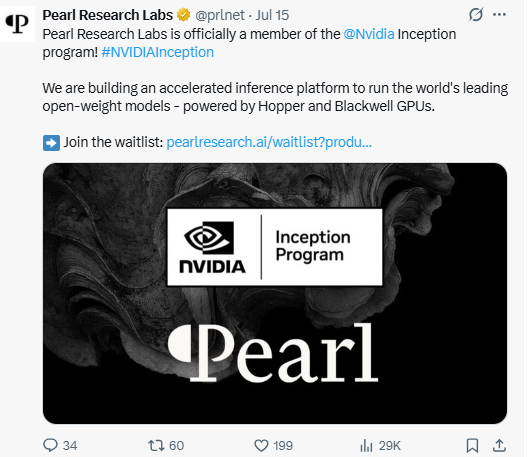
Being accepted into a program like this is a real, checkable fact, not a rumor, since Nvidia runs Inception as an actual named program with member companies. It does not guarantee Pearl succeeds as a business, but it does add a layer of credibility that a lot of smaller crypto projects simply do not have.
The W7A7 Update, Explained Simply
Pearl also shared details on something it calls W7A7, a new way of shrinking down AI model data so it runs faster and cheaper, without losing much accuracy.
This process is called quantization; think of it like compressing a large photo file so it loads faster while still looking mostly the same.
The team says regular quantization methods did not work well for $Pearl because of how its mining system checks the math behind the scenes. So they built their own version, mixing a few existing techniques together, and claim it beats many other AI model formats in their own internal tests.
They also mentioned a future upgrade that would remove the need for this extra step altogether.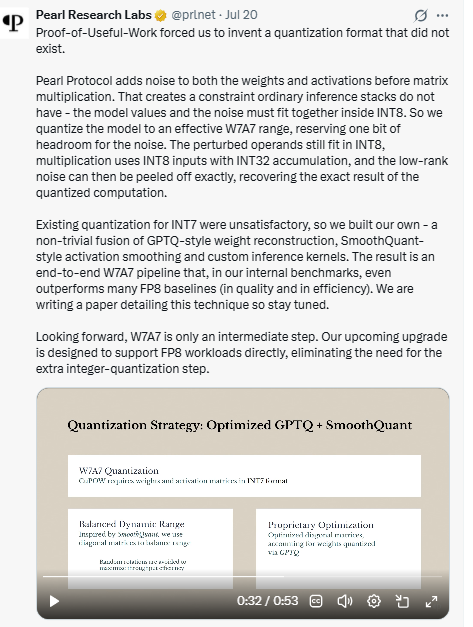
Source: Data From X
This is a genuine technical update from the team, not outside speculation, so it can be treated as solid information. That said, "beats other formats in our own tests" is still the team's own claim; an independent benchmark from someone outside $Pearl has not been reviewed here, so treat the performance claim as reported by the team rather than independently confirmed.
Why Has PRL Price Fallen So Much
PRL hit its all-time high of $0.8688 back in late May, not long after another partnership announcement first put the project on the map. Since then, the price has dropped a lot, now sitting more than 70% below that peak.
Part of this comes down to simple mining economics. As more people started mining Pearl with powerful GPUs, the difficulty of mining went up, which cut down how much each miner earns per day.
When mining rewards drop, some miners sell their coins to cover costs, which adds selling pressure on the price. This is a common pattern in new mining-based coins, a fast pump early on, followed by a slower grind down as more supply enters the market.
Two Reader Takeaways
For existing holders, it is worth separating the technology news from the price action. Pearl is doing real engineering work, joining Nvidia's program and building its own quantization method, but none of that has stopped the price from falling so far.
For anyone thinking about buying in, the gap between strong technical progress and a falling price is worth sitting with. Good tech alone does not always translate into price support in the short term, especially for a coin still working through early mining supply pressure.
Pearl Market Outlook Expert View
This is a case where the story and the chart are pulling in different directions. On one side, Pearl has real backing now, a spot in Nvidia's Inception program and original engineering work on quantization that outside researchers will eventually be able to check once the paper comes out.
On the other side, price has fallen more than 70% from its high, and the mining economics behind that drop have not gone away.
Whether the Nvidia news and the upcoming FP8 upgrade are enough to change sentiment will likely depend on whether Pearl can turn this technical credibility into actual demand for the token, rather than just headlines.
Disclaimer: This article is for informational purposes only and should not be treated as financial advice. Cryptocurrency markets are highly volatile and carry significant risk.
Also read: