Pi Network Price Prediction Rally Is Now Unstoppable


Pi Network Price Near All-Time Lows as July Unlocks
Pi Network is not in the middle of an unstoppable rally, despite that framing circulating in some promotional content today.
As of July 21–22, 2026, trades near $0.092, close to the fresh all-time low of roughly $0.075–$0.103 it set earlier this month, with the broader trend still bearish below every major moving average.
The Pi Core Team did launch three new products during its annual Pi2Day event on June 28 a fee-in-PI verification tool, hosting, and sign-in services aimed at giving the token real utility.
That catalyst is currently colliding with a heavier one: roughly 103.7 million PI tokens unlocking in July, adding fresh sellable supply to a market that is already struggling to absorb it.
This report lays out the complete picture technical structure, tokenomics, holder data, and honest scenarios rather than repeating the rally narrative.
Quick Facts
Metric | Value |
Token | PI Network |
Current price (July 22, 2026) | $0.09091-0.09092 |
Recent low | $0.075–$0.103, set July 2026 |
All-time high | $2.98 (February 2025) |
Drawdown from ATH | 97% |
Market capitalization | $1.05 billion |
July 2026 token unlocks | 103.7 million |
KYC-verified users | 17.7 million+ on Mainnet (60M+ ecosystem-wide) |
Trend structure | Below 20-, 50-, 100- and 200-day EMAs |
Live Market Data
As of July 22, 2026, Pi Network is trading at approximately $0.09092, with a market capitalization near $1.05 billion. The 7-day price change has been mixed one tracker shows roughly +9.7% off the recent low, while the broader monthly trend remains negative.
Twenty-four-hour trading volume has been thin relative to PI's user base, consistent with a token that trades on a limited set of exchanges rather than the full tier-1 roster.
The price sits meaningfully below the $0.11–$0.14 range that held through most of the second quarter of 2026, confirming that July's move down is a genuine structural shift rather than routine noise.
Technical Analysis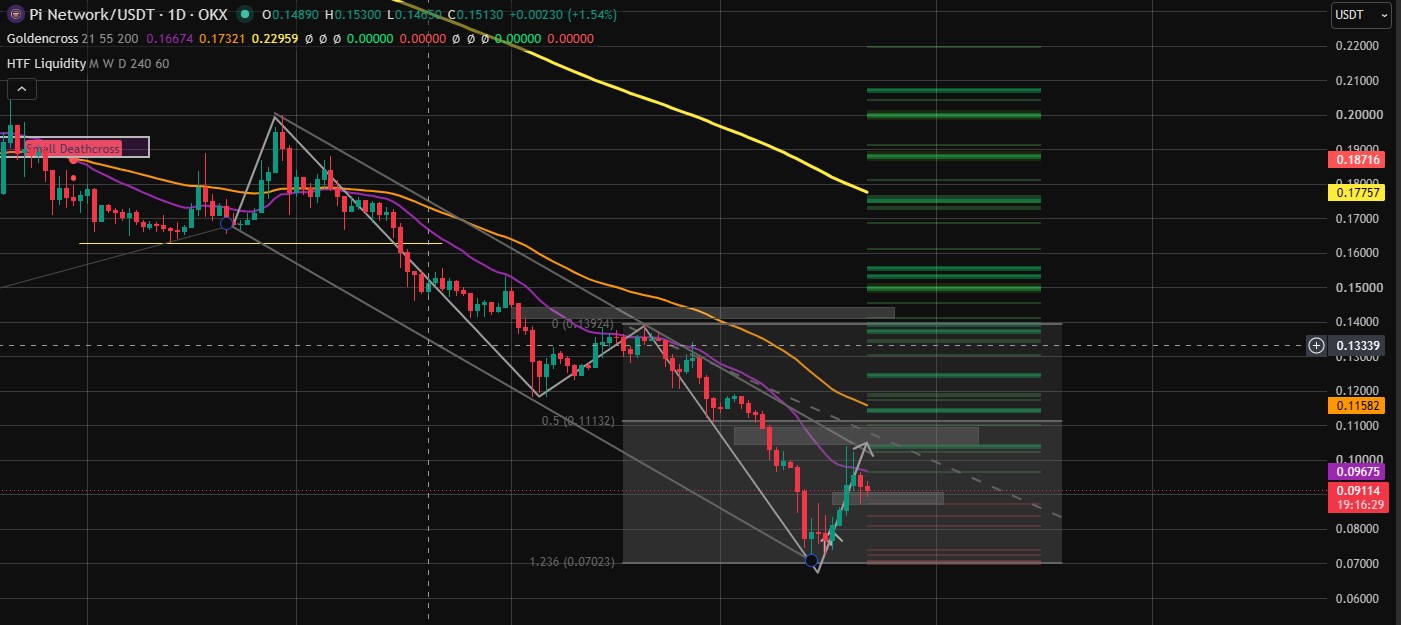
The 14-day Relative Strength Index has printed readings as low as 27 in recent sessions, the deepest oversold level since PI began public trading, which raises the odds of a short-term technical bounce without guaranteeing a trend reversal.
A weekly candle pattern described by some trackers as a bullish engulfing formation appeared around July 21, hinting at tentative buyer interest, but one candle on a weekly chart is not confirmation of a reversal against a multi-month downtrend.
Key resistance: $0.0974 (20-day EMA), then $0.115 (50-day EMA) and $0.135 (100-day EMA)
Key support: $0.090, then the July low near $0.0756
Momentum reading: RSI near 27–35, deeply oversold but not yet confirming reversal
Prediction Methodology
This prediction combines three inputs: technical structure (moving averages, RSI, and support/resistance levels observed across multiple trackers),
on-chain and tokenomic factors (the scale and timing of July's token unlocks relative to historical demand), and fundamental catalysts (adoption of the three Pi2Day products).
Ranges below are deliberately wide because Pi Network's price action depends heavily on non-market factors KYC migration pace, exchange access, and whether fee-based products generate real recurring demand that are difficult to model with technical data alone.
No forecast here should be read as a guaranteed outcome; all figures are scenario-based estimates, not price targets.
Short-Term / Weekly / Monthly / Yearly Forecast
Timeframe | Projected Range | Basis |
Short-term (24–48h) | $0.088 – $0.104 | Oversold RSI bounce potential vs. unlock supply overhang |
Weekly (July 25–31) | $0.085 – $0.11 | Test of $0.10 psychological level per current chart structure |
Monthly (August 2026) | $0.078 – $0.13 | Depends on whether new products offset ongoing unlock pressure |
Yearly (end of 2026) | $0.078 – $0.37 | Wide range reflecting unresolved adoption vs. supply dynamics |
Bull / Base / Bear Scenarios
Scenario | Price Range | Key Conditions |
Bear case | Below $0.075 | Unlock supply overwhelms demand; new products see weak adoption; deeper support near $0.05 tested |
Base case | $0.08 – $0.12 | Unlock-driven selling and early product interest roughly offset each other; range-bound trading |
Bull case | $0.12 – $0.14 | Verification/hosting products gain early traction; RSI-driven bounce reclaims 50-day EMA |
Extreme bull case | Above $0.18 | Utility demand scales faster than unlocks; broader altcoin rally lifts past its 200-day EMA |
Support & Resistance Levels
Level Type | Price | Significance |
Resistance 3 | $0.135 | 100-day EMA |
Resistance 2 | $0.115 | 50-day EMA |
Resistance 1 | $0.0974 | 20-day EMA |
Support 1 | $0.090 | Short-term psychological support |
Support 2 | $0.0756 | July 2026 swing low |
Support 3 | $0.05 | Deeper psychological floor if trend deteriorates |
Risks & Invalidation
The single largest risk to any bullish PI scenario is unresolved: whether the three Pi2Day products generate genuine, recurring fee-based demand fast enough to absorb monthly unlock supply.
If August and September unlocks continue at or above July's 103.7 million pace without a matching rise in transaction volume through the new verification and hosting services, further downside toward $0.05–$0.07 becomes the more likely path.
A bullish thesis would be invalidated by a confirmed close below the July swing low of $0.0756 on rising volume.
Conversely, a bearish thesis would face invalidation if it reclaims and holds its 50-day EMA (≈$0.115) for more than a week, since that would signal unlock supply is being absorbed rather than accumulating on order books.
Tokenomics & Unlocks
Pi Network's circulating supply continues to expand through scheduled unlocks tied to verified mining rewards on Mainnet, with allocations designed to grow in step with the pace of verified user migration rather than a fixed calendar.
July 2026 carries a notably heavier unlock than June: approximately 103.7 million PI, an increase of roughly 27 million tokens month-over-month which is the single most concrete near-term bearish factor identified in current data.
Because Pi's supply schedule is tied to KYC and migration completions rather than a purely fixed emission curve, unlock size can vary meaningfully month to month depending on how quickly the Pi Core Team processes verification backlogs.
Liquidity Analysis
PI's liquidity profile reflects a token still expanding its exchange footprint rather than one with deep, tier-1 order books.
The token is listed on several smaller and mid-tier exchanges, with Kraken confirmed as having integrated support, but a full-scale tier-1 listing remains the community's most-requested and still-unconfirmed milestone.
Thinner liquidity on the venues where PI does trade means both unlock-driven selling and any demand-side surprise from the new fee-based products can move price more sharply than would be the case for a token with deeper, more distributed order books.
Holder Distribution
Pi Network's user base is unusually large relative to its market capitalization, with more than 17.7 million KYC-verified Pioneers active on Mainnet and a broader ecosystem the project describes as exceeding 60 million engaged users across its mobile mining platform.
That scale is a double-edged fact for price: it represents a very large potential user and transaction base for the new fee-based products, but it also means a substantial pool of long-time holders many of whom mined tokens years
before any market price existed represent latent potential sell pressure whenever migration and liquidity conditions allow them to move tokens.
Developer Activity
Pi Network's development focus through mid-2026 has centered on App Studio, smart contract capability introduced on testnet under PiRC2, and infrastructure to let external, AI-assisted app creators connect to the Pi ecosystem's payment and identity rails.
The Pi Core Team has also floated merit-based rewards for developers who build applications generating real usage, signaling an attempt to shift incentives from passive holding toward active ecosystem building.
These are genuine, verifiable development efforts, though they remain early-stage relative to the scale of the user base, and their eventual effect on token demand is not yet visible in July's price data.
Genuine X (Twitter) Sentiment
Sentiment on X around Pi Network remains split, and the split has shifted since Pi2Day.
A segment of the long-standing Pi community continues to post enthusiastically about the new verification, hosting, and sign-in products, treating them as long-awaited proof of utility.
A separate and vocal segment often long-term holders frustrated by the token's multi-year decline from its $2.98 high is focused squarely on the unlock schedule and the fresh all-time low,
questioning whether new products can move the needle against ongoing sell pressure.
Crypto-market commentary accounts outside the Pi community tend to be more skeptical still, noting that Pi has repeatedly announced ecosystem milestones without those translating into sustained price recovery.
Read honestly, current sentiment is cautiously divided rather than uniformly bullish, and framing that describes an 'unstoppable rally' does not reflect the genuine tone of the conversation.
Source Links
CoinMarketCap: Pi Network Price Prediction 2026: Pi Coin Price in 2026, 2027–2030
minepi.com: Happy Pi Day 2026: Major Feature and Ecosystem Releases
Glossary
EMA (Exponential Moving Average): A moving average that weights recent prices more heavily, commonly used to gauge short- and long-term trend direction.
RSI (Relative Strength Index): A momentum oscillator (0–100) indicating overbought (above 70) or oversold (below 30) conditions.
Token unlock: The scheduled release of previously locked or unminted tokens into circulating supply, which can increase available sell pressure.
KYC (Know Your Customer): Identity verification required for users to migrate mined tokens to Pi's Mainnet and access full network features.
Mainnet: The live, fully operational blockchain network, as opposed to a test environment.
Final Verdict
Pi Network's July 2026 story is a genuine tension between a large, verified user base gaining early access to fee-based utility products and a heavier-than-usual monthly token unlock that is currently winning the battle for price direction.
The technical picture is bearish across every major timeframe, and describing the current price action as an unstoppable rally misrepresents both the chart and the underlying supply dynamics.
The more accurate framing is a token at a genuine inflection point: near all-time lows, testing whether its newest utility products
can convert a 17-million-plus verified user base into real recurring demand before further unlocks add more supply than the market can absorb.
Investors should watch unlock-adjusted volume on the new fee-based services, not headline rally claims, for the next real signal.
Disclaimer :
This article covers cryptocurrency, a Your Money or Your Life (YMYL) subject, and is for informational purposes only. It does not constitute financial, investment, tax, or legal advice, and nothing in it should be read as a recommendation to buy or sell any asset. Cryptocurrency markets, and presale or micro-cap tokens in particular, are highly volatile and carry a meaningful risk of total loss. Prices, on-chain figures, and project claims cited here reflect publicly available data as of the publish date and may change without notice. Readers should verify information independently and consult a licensed financial advisor before making investment decisions.
Also read: