Solstice Price Prediction: SLX Surges 50%. Is This Run Real?


Solstice price prediction is grabbing attention as SLX has done something the broader market hasn't managed in weeks; it moved. And it moved fast.
SLX is up over 50% in a single day, trading near $0.26, with volume exploding to $253 million. The big question right now isn't whether it pumped or not. It's whether it stays.
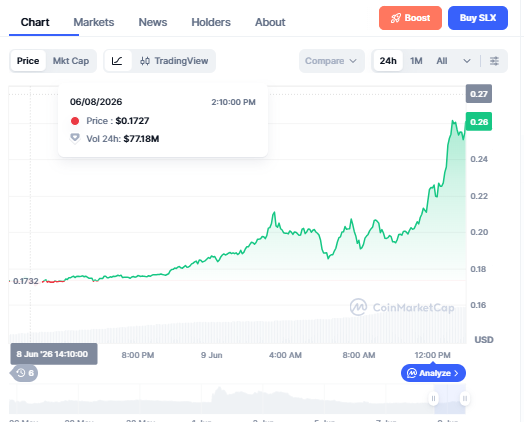
Source: Chart by CoinMarketCap
What Is Solstice and Why Is SLX Getting Attention
Solstice is a DeFi protocol built on the Solana blockchain, positioned as Solana's native stablecoin infrastructure. $SLX is the governance and utility token that powers this ecosystem.
The project launched in early 2026 and found its early audience among Solana-native DeFi users who were already comfortable with protocols like Exponent Finance, where stSLX, the staked version of $SLX, is now live on Version 2.
What separates Solstice from many other small-cap tokens is the actual product. There's a yield mechanism, a vesting structure with real lockup rules, and a community that pays close attention to on-chain activity.
It's not just a governance token floating in a vacuum. The stSLX integration with Exponent Finance V2 adds a real use case; you can set limit orders based on implied APY and earn rewards on YT trades.
That's not nothing for a token this young.
Why Solstice Has Real Ecosystem Weight Behind It
The listings tell part of the story. SLX went from a quiet launch on Binance Alpha and Bitget in late May 2026 to trading on over 20 exchanges within two weeks.
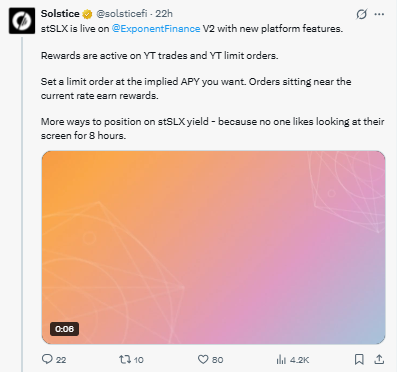
Source: Post on X by Solstice
Upbit added the SLX/KRW pair on June 1, and Korean retail demand has been one of the louder volume drivers since then. OKX, Bybit, Kraken, Gate.io, MEXC, BingX, XT.COM, and CoinEx all followed within days.
Futures markets opened on Binance, OKX, Bybit, Aster DEX, and Bitget shortly after. And the Solstice team hasn't been quiet.
But here's what most traders are missing: the vesting mechanics are creating real sell pressure.
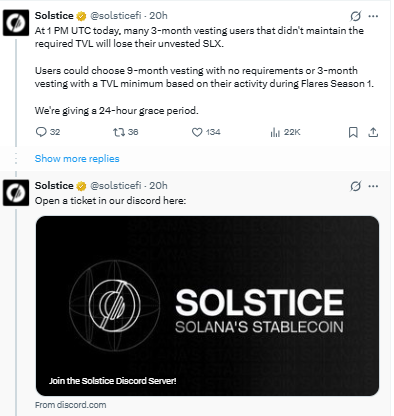
Users who chose the 3-month vesting option in Flares Season 1 are now at risk of losing unclaimed SLX if they don't maintain the required TVL.
The team announced a 24-hour grace period. But the urgency is real. That kind of forced decision-making doesn't just affect individual holders; it ripples through the market in short bursts.
Quick Numbers: Solstice SLX Token Snapshot
Field | Data |
Token Name | Solstice |
Ticker Symbol | SLX |
Blockchain | Solana |
Current Price | $0.2621 |
24h High | $0.2632 |
24h Low | $0.1692 |
Market Cap | $63.34M |
24h Trading Volume | $253.27M |
Vol/Mkt Cap Ratio | 412.22% |
Circulating Supply | 242.85M SLX |
Total Supply | 1B SLX |
Token Type | DeFi / Governance |
Source: Data by CoinMarketCap
SLX Just Moved 50% in One Day; Here Is What Triggered It
This is the part that matters right now. Solstice price prediction calls for 2026 have been all over the place, but what happened in the last 24 hours wasn't a slow grind; it was a spike.
The price moved from $0.1692 to as high as $0.2632, and volume hit $253 million, which is more than four times the market cap. That's not organic accumulation. That's a momentum event.
The Upbit Korean retail pair is likely doing heavy lifting here.
Korean traders have a documented history of sending small-cap altcoins vertical in short windows. The SLX/KRW pair launched June 1, and the volume hasn't slowed.
Add Bitget futures liquidity, and you've got a setup where speculators are piling in from multiple directions simultaneously.
Support at $0.20 is what traders are watching. Below that, the euphoria unwinds fast. The vesting pressure from 3-month holders adds another layer; any forced selling hits harder when the order book is thin and price discovery is still finding its floor.
Solstice Price Prediction: Three Scenarios for SLX Right Now
Worst Case: Volume dries up over the next 48 hours. The Korean retail wave fades, and vesting-related sell pressure from 3-month holders accelerates.
SLX loses the $0.20 support level and falls back toward the $0.15 zone, near where it traded in late May.
A broader altcoin risk-off move, especially around macro data like the US CPI, could accelerate this.
The all-time low of $0.1543 would become a real reference point again.
Base Case: Volume holds above $100M per day for the next few sessions. The $0.20 level acts as support.
SLX consolidates in the $0.22 to $0.26 range as profit-takers and new buyers find a balance.
This is the most realistic path given where the order book and exchange depth sit right now.
Best Case: A new CEX listing announcement, Binance main spot, or a Tier 1 with high spot volume triggers another leg up.
Korean demand stays elevated, RSI resets after a brief consolidation, and SLX pushes toward the $0.35 zone.
The all-time high of $0.468 becomes a realistic medium-term target if momentum sustains across multiple exchanges simultaneously.
Scenario Summary Table:
Scenario | Price Range | What Triggers It |
Worst Case | $0.15 to $0.18 | Volume collapse, vesting sell pressure, macro risk-off |
Base Case | $0.22 to $0.26 | Consolidation holds, stSLX TVL grows, current listings sustain |
Best Case | $0.30 to $0.46 | New Tier 1 listing, Korean demand sustains, RSI reset and rerun |
Three Price Levels Every SLX Trader Needs to Know
Resistance Zone: $0.30 to $0.35
This is the first real ceiling above the current price. SLX hasn't traded here yet, and thin order book depth means it could move through quickly or reject hard. If volume stays elevated, this zone gets tested within days.
Support Zone: $0.20
This is the line in the sand. The chart from June 8 shows the price was sitting at $0.17 for most of the session before the spike.
A pullback to $0.20 would still represent a major gain from recent lows. Losing this level flips the short-term structure bearish.
Invalidation Zone: Below $0.155
Below the May 26 all-time low of $0.1543, this move gets fully erased.
Any close below $0.155 on significant volume would signal the pump was a false breakout and the structural trend hasn't actually changed.
Final Thoughts: What the Chart Says and Where SLX Stands
When we pull up the full picture on SLX, the first thing that stands out isn't the price; it's the volume-to-market-cap ratio. A 412% ratio in 24 hours is extreme.
It means the entire float traded more than four times over in a single session. That doesn't happen on organic buying alone.
RSI is almost certainly overextended on shorter timeframes. A healthy reset toward the 50 to 60 zone wouldn't break the trend; it would actually strengthen it.
A weekly close above $0.22 is the signal worth watching. That would confirm this wasn't just intraday noise.
The Solstice price prediction story this week comes down to one question: does $0.20 hold? If it does, the base case plays out. If it doesn't, the bounce was just a bounce.
The external factor to track isn't on-chain. It's macro. US CPI data drops June 10.
A surprise to the upside narrows risk appetite fast, and small-cap tokens like SLX get hit first. The ecosystem is real. The listings are real. But risk is still very real too.
Watch the close. Watch the volume. The setup looks more bullish than most are giving it credit for, but don't ignore what could flip it.
Disclaimer: This article is for educational purposes only and does not constitute financial advice. Crypto markets are volatile. Consult your investment advisor before making any investment decisions.