SpaceX Stock Price Prediction SPCX Slides After Earnings, Unlock Looms

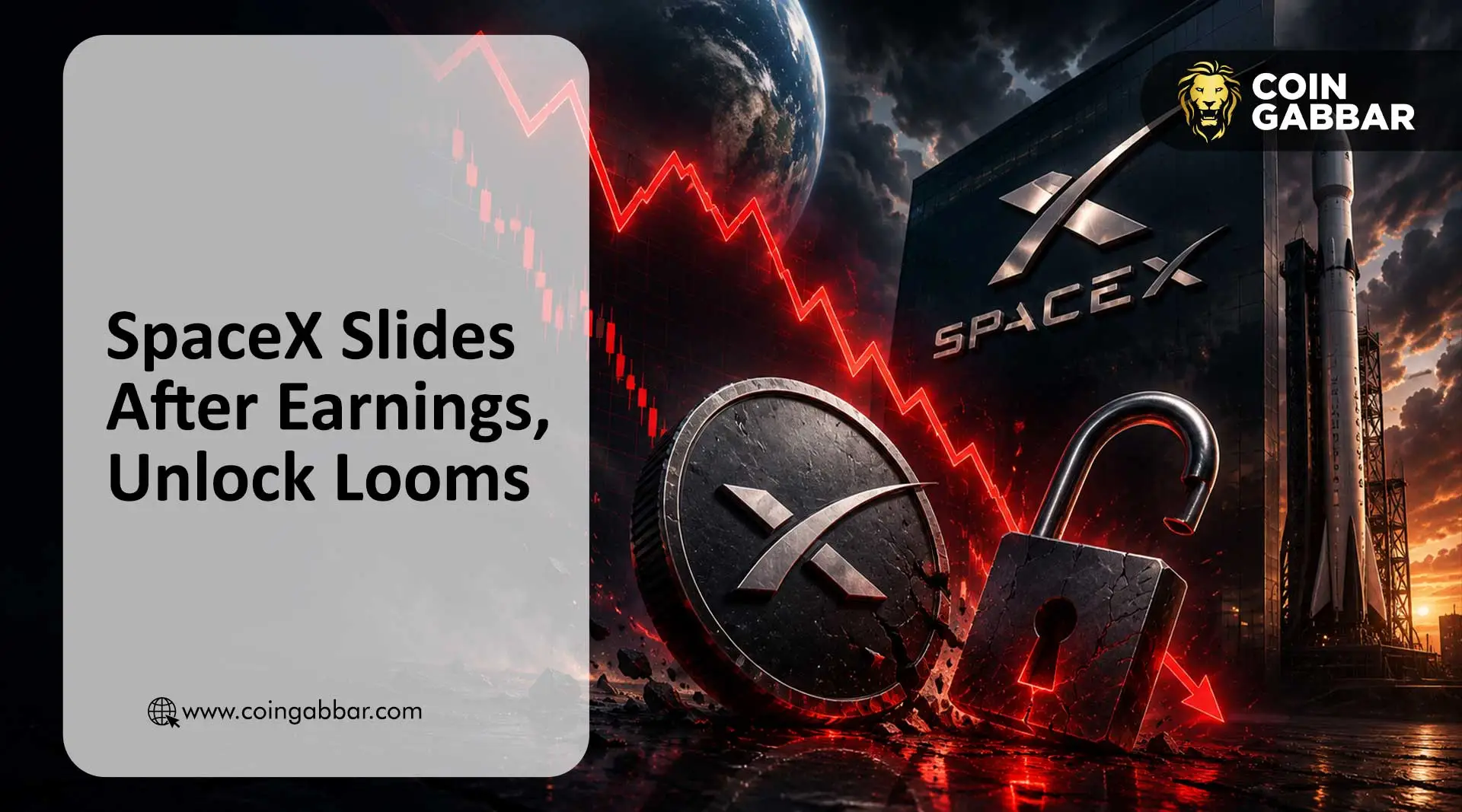
SpaceX stock swung wildly this week after the company posted its first earnings report since going public.
Shares of Space Exploration Technologies Corp. ($SPCX) jumped more than 9% in regular trading on August 4, then dropped over 7% in after-hours trading once the numbers came out.
The move has traders asking where SPCX stock goes next, especially with a large share unlock set for August 6.
Why did SpaceX stock fall after earnings?
SpaceX reported second-quarter 2026 revenue of $7.8B, up 92% from a year earlier and above the roughly $6.8 billion analysts had expected.
Net loss narrowed to $541 million from just over $1 billion in the same quarter last year. Adjusted EBITDA rose 191% to $3.5B.
The AI business stood out the most. Revenue there jumped 247% to $2.56B, though the segment still posted an operating loss of $1.26 billion.
Connectivity revenue reached $4.29B as Starlink subscribers doubled to 12 million, just short of the 12.19 million analysts had modeled.
What seemed to spook traders was spending. Capital expenditure hit $18.37 billion for the quarter, with $15.83B of that going toward AI infrastructure.
Management said capex would stay at similar levels for the rest of the year, and that weighed on sentiment even after a clear revenue beat.
SPCX also disclosed that its digital asset holdings, tied to the 18,712 BTC mentioned in its IPO filing, carried a value of $1.10 billion, down about 33% from the end of 2025.
Shares remain below the $135 IPO price even after the post-earnings bounce, a reminder that early investors are still sitting on paper losses at current levels.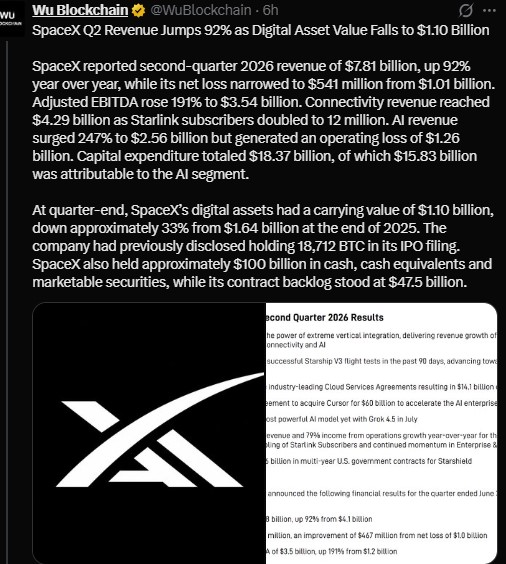
What else did SpaceX announce alongside earnings?
The quarter came with a string of headline-grabbing announcements beyond the numbers.
Nvidia satellite deal: SPCX is partnering with Nvidia to build the Starmind AI1 satellite compute payload. Each Starmind satellite will carry Nvidia Rubin GPUs and Vera CPUs, aimed at datacenter-class computing in orbit.
$60 billion Cursor acquisition: SPCX announced an agreement to acquire AI coding startup Cursor for $60 billion, a move it says will accelerate its AI enterprise push.
Grok 4.5: The company released its latest AI model, Grok 4.5, in July.
Starshield contracts: SpaceX was awarded more than $6 billion in multi-year U.S. government contracts for Starshield.
Cloud deals: SpaceX closed Cloud Services Agreements worth $14.1 billion in contracted sales during the quarter, including agreements with Alphabet and Anthropic to sell excess computing power.
Direct-to-mobile plans: COO Gwynne Shotwell said SpaceX intends to build terrestrial mobile infrastructure, pointing to broader plans to use Starlink for a direct-to-mobile service.
What is SpaceX's market valuation and derivatives activity?
At last check, SpaceX carried an intraday market capitalization of roughly $1.651 trillion.
The stock's 52-week range spans $104.83 to $225.64, and trailing twelve-month EPS sits at -$0.68, with no meaningful P/E ratio given the ongoing losses.
Derivatives markets have been active around the earnings event. SPCX derivatives volume jumped 202.65% to $5.85 billion, while open interest slipped 5.67% to $670.06 million.
The 24-hour long/short ratio sat close to even at 0.9889, and platforms tracking forced liquidations, or "rekt" data, showed roughly $21.38 million wiped out over 24 hours, split between long and short positions.
What is the SpaceX share unlock on August 6?
Only a small slice of $SPCX shares can trade right now. Roughly 638 million shares sit in the public float, while the unlock scheduled for August 6 could release around 900 million more shares held by early investors and employees.
That detail matters because roughly 34% of the tradable float is currently sold short. Some traders think the recent squeeze higher happened partly because shorts struggled to find shares to borrow and cover.
A large new batch of shares could change that setup fast, though it could just as easily get absorbed over time as new holders settle in.
What do the $SPCX stock charts show?
On the hourly chart, SPCX broke out of a multi-week descending channel and reclaimed its 20, 50, and 100-hour EMAs before the earnings-driven pullback. That breakout stays technically valid as long as price holds above key support.
Level Type | Price Zone | Notes |
Support | $115 - $117 | Cluster of moving averages |
Support | $110 - $107 | Next demand zone if support fails |
Resistance | $122 - $125 | First hurdle above support |
Resistance | $132 | 38.2% Fibonacci retracement |
Resistance | $140 | 50% Fibonacci retracement |
The stock closed regular trading at $125.33 on August 4, then slipped to $116.23 after hours, landing right inside that critical support band.
Is Cathie Wood's Ark Invest still holding SpaceX stock?
Yes. Across ARKK, ARKQ, ARKX, and ARKW, Ark Invest holds about 4.54 million $SPCX shares, worth roughly $521 million at recent prices. ARKK carries the largest position with more than 2.5 million shares, followed by ARKQ, ARKX, and ARKW.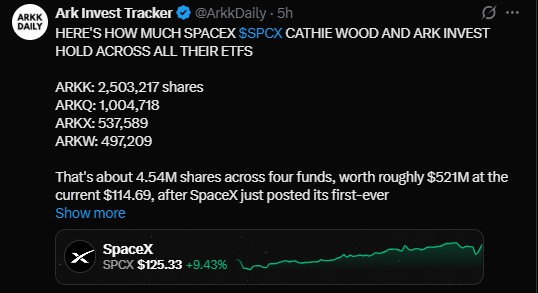
SpaceX stock price prediction: what's next for SPCX?
SpaceX stock sits at a crossroads. The revenue beat and narrowing losses give bulls a reason to stay interested, especially with a $47.5 billion contract backlog and close to $100 billion in cash and marketable securities on hand.
But heavy AI spending, a small Starlink subscriber miss, and a huge unlock arriving within days add real uncertainty.
If the $115 to $117 support zone holds, chart watchers see room for a move back toward $132 and $140. A break below $110 could open the door toward $107 or lower.
Given the size of the incoming unlock, volatility around SpaceX stock is likely to stay elevated in the days ahead. No one can say for sure which way it breaks, and traders will probably watch trading volume closely once the new shares hit the market.
Disclaimer
This article is for informational purposes only and does not constitute financial, investment, or trading advice. Past performance and technical chart patterns do not guarantee future results. Always do your own research and consult a licensed financial advisor before making investment decisions.