Stellar Price Prediction: A Galactic Adventure Could Lift XLM


Stellar Price XLM three-indexed Data APIs
Stellar (XLM) is strengthening its blockchain infrastructure with three advanced indexed data APIs, giving developers faster and more efficient access to on-chain information.
The 'galactic adventure' in Stellar's name has always been more branding than substance; the network has nothing to do with actual space travel.
But the metaphor fits this week's real news better than usual: Stellar activated its Protocol 27 upgrade, nicknamed 'Zipper,' on mainnet on July 10, and the market's reaction, a 6% price jump and trading volume that tripled overnight, was the kind of liftoff moment XLM hasn't had in weeks.
This piece explains what Zipper actually does, why institutions in particular should care, and what the token's chart says now that the initial reaction has settled.
XLM trades in the $0.178–$0.19 range as of the most recent readings, having jumped roughly 6% on July 10 when Protocol 27 'Zipper' activated on Stellar's mainnet, with trading volume tripling on the news.
The upgrade introduces delegated authentication (CAP-0071-01) for smart contract accounts and developer identity verification, aimed squarely at making Stellar more usable for institutional and enterprise payment rails.
XLM also rejoined Bitwise's Top 10 crypto ETF index on July 10, a second institutional signal landing the same week.
The honest caveat: protocol upgrades are historically prone to becoming 'sell the news' events if they don't translate into visible user growth quickly.
The initial pop has already partially faded in subsequent sessions, and the real test is whether developer and institutional activity actually picks up in the weeks following Zipper's activation.
The Insider Data: What Protocol 27 'Zipper' Actually Does
Detail | Explanation |
Activation date | July 10, 2026, following a mainnet vote scheduled for July 8 |
Core feature: CAP-0071-01 | Delegated authentication for smart contract accounts, letting accounts verify actions through delegated signers rather than a single private key |
Developer identity verification | New tooling to verify developer identity for smart contract deployment, aimed at institutional-grade trust and compliance |
Market reaction | XLM rose roughly 6% on activation day; 24-hour trading volume tripled versus the prior session, per CoinMarketCap |
Strategic context | Part of Stellar's broader 'Quantum Preparedness Plan,' aiming to future-proof enterprise wallets with quantum-safe cryptography within 2026 |
Bitwise Top 10 ETF re-entry | XLM rejoined Bitwise's Top 10 crypto index on July 10, the same week as the Zipper activation, a second, separate institutional signal |
The reason this matters more than a typical protocol upgrade is the audience it's built for.
Delegated authentication and developer identity verification aren't retail-facing features; they're institutional plumbing,
the kind of infrastructure banks and payment processors specifically ask for before committing real transaction volume to a network.
Stellar's core pitch has always been cross-border payments and tokenized real-world assets; Zipper is a direct, technical answer to what institutional partners have reportedly been asking for.
Why 'Sell the News' Risk Is Real Here
Historical patterns across Stellar's own upgrade cycles and across the broader market, shows that protocol activations often produce an immediate price pop that fades within days if the upgrade doesn't quickly translate into measurable user or transaction growth.
That's not a criticism specific to Stellar; it's a general pattern for infrastructure-focused tokens where the payoff (developer adoption, institutional integration) takes months to show up in on-chain metrics, while the price reaction happens in hours.
The 6% pop and tripled volume on July 10 already shows signs of partial fade in the days since, which fits this pattern rather than breaking it.
The disciplined way to read Zipper, then, is as a genuine technical positive whose real payoff arrives on a longer timeline than the initial price spike suggests.
Watching for concrete signs, new institutional partnerships citing the delegated authentication feature specifically; growth in Soroban smart contract deployments; or expanded real-world asset tokenization volume will tell you more about whether this upgrade matters than the next few days of price action will.
Facts: XLM 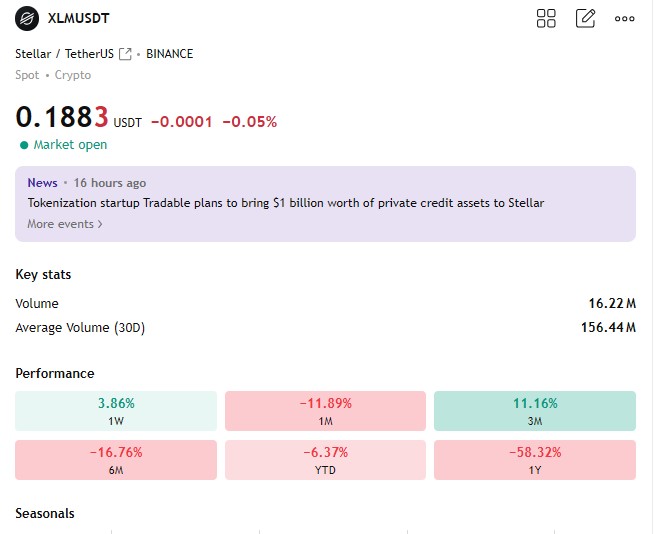
Metric | Current Reading |
Current Price (approx.) | $0.178–$0.19 |
Protocol 27 'Zipper' Activation | July 10, 2026 |
Price Reaction on Activation | +6%, with trading volume tripling |
Bitwise Top 10 ETF Re-Entry | July 10, 2026 |
200-Day Moving Average | $0.2043–$0.2127, depending on source |
50-Day Moving Average | $0.2078–$0.2151 |
RSI (14-day, recent readings) | Roughly neutral, low-to-mid 40s to mid-50s depending on source and date |
Key Resistance | $0.185 (7-day SMA), then $0.25–$0.27 zone |
Key Support | $0.17, then $0.15–$0.16 |
SEC/CFTC Digital Commodity Designation | March 17, 2026 — clarified regulatory status for institutional custody |
X (Twitter) Sentiment 
The community reaction has been notably more technical than celebratory; more accounts are discussing what the upgrade actually enables than simply reacting to the price move, which suggests a maturing, more institution-aware corner of the market.
Technical Analysis 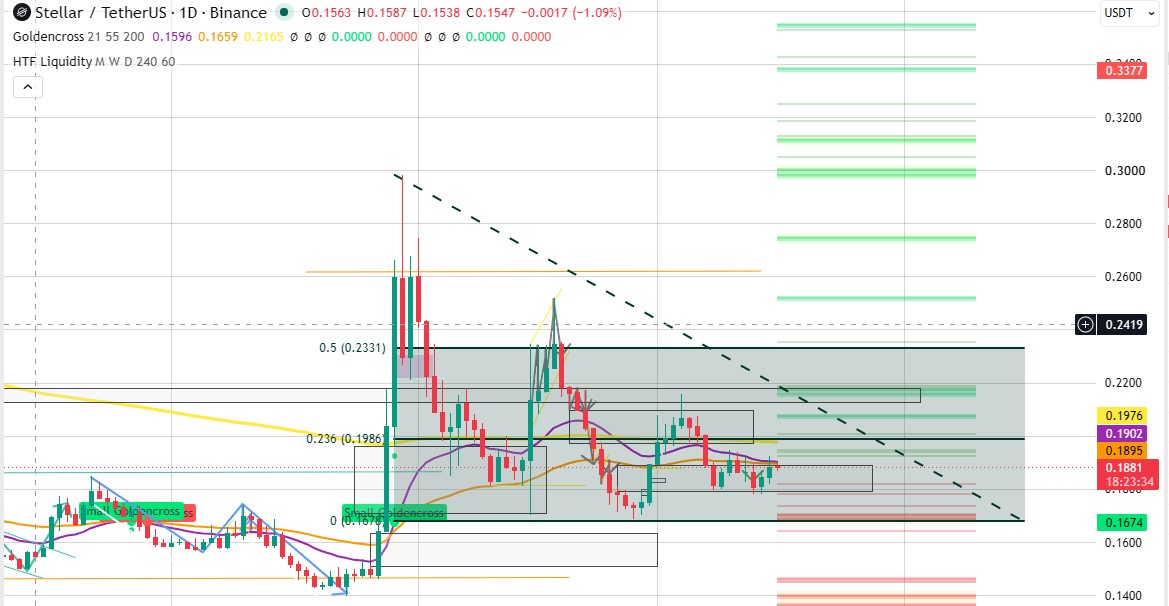
Indicator | Current Reading | Signal |
Price vs. 200-day MA | Below to near the ≈$0.204–$0.213 zone depending on source | Mixed signal; some sources show XLM below this key long-term line |
RSI (14-day) | Roughly neutral across recent readings | No strong overbought or oversold bias currently |
Key resistance | $0.185, then $0.25–$0.27 | Multiple layers to clear before a sustained breakout is confirmed |
Key support | $0.17, then $0.15–$0.16 | Zone that has held during prior 2026 pullbacks |
Volume post-Zipper | Elevated versus pre-activation levels, though moderating | Initial surge partially fading, consistent with typical post-upgrade patterns |
Stellar Price Prediction: Bear, Base, Bull, and Extreme Bull Scenarios
Scenario | Next 30 Days | End of 2026 | Key Condition |
Bear Case | $0.15–$0.17 | $0.17–$0.22 | Zipper's price pop fully fades; no visible institutional adoption follows; broader market weakness persists |
Base Case | $0.17–$0.21 | $0.20–$0.30 | Gradual, steady institutional integration continues without a dramatic breakout |
Bull Case | $0.21–$0.27 | $0.30–$0.50 | Concrete institutional partnerships cite the delegated authentication feature; Soroban and RWA volume grow visibly |
Extreme Bull | $0.28+ | $0.60–$1.00 | Major bank or payment processor announces large-scale Stellar integration tied directly to Zipper's capabilities |
Risk & Opportunity
Risks | Opportunities |
Protocol upgrades historically risk becoming 'sell the news' events if adoption doesn't follow quickly | Zipper's delegated authentication is a genuine, institution-facing technical upgrade, not just marketing |
The initial 6% pop has already shown signs of partial fade in subsequent sessions | The same-week Bitwise Top 10 ETF re-entry is a separate, concrete institutional signal beyond the upgrade itself |
XLM remains below several key moving averages depending on the data source used | March 2026's SEC/CFTC digital commodity designation continues easing institutional custody concerns |
Broader crypto market sentiment (Fear-leaning per recent Fear & Greed readings) can suppress even fundamentally positive news | Stellar's established payment-rail and tokenization use case gives Zipper a clear, specific audience to serve |
YMYL Disclaimer: This article covers cryptocurrency, a Your Money or Your Life (YMYL) subject. It is for informational purposes only and does not constitute financial, investment, or legal advice. Cryptocurrency markets are highly volatile, and protocol-upgrade-driven price moves can reverse quickly. Prices, technical levels, and upgrade details referenced here reflect publicly available information as of July 16, 2026, and may change without notice. Always conduct independent research and consult a licensed financial advisor before making investment decisions.
Also read: